Industry Insights •
14 min read •December 13, 2025•270 views
Advanced AI Voice Generator Platform Development
Table of Contents
The world is moving toward voice-first experiences faster than we ever imagined. Whether it’s those smart assistants we talk to every morning, the automated customer support we rely on, or the AI-powered stories we enjoy on YouTube, the demand for AI voice generator technology that sounds real, emotional, and human-like has exploded.
The global AI voice generator market is growing much faster than anyone expected. It was worth approximately USD 2.9 billion in 2024, and experts predict it may reach nearly USD 10.8 billion by 2034, with a projected annual growth rate of 14.2%. When a technology grows this quickly in just a few years, it’s clear that it’s reshaping industries everywhere.
The reality is, if you look around your daily life, you’ll notice the shift too. I recently spoke to a creator who joked that she no longer records her own narrations because her AI voice generator does it better, faster, and even in multiple accents. That’s the kind of personal impact people are experiencing today.
Behind this huge change is a powerful idea called advanced AI voice generator platform development, a technology that is reshaping how we create content, communicate with others, and connect emotionally through voice.
What Is Advanced AI Voice Generator Platform Development?
Advanced AI voice generator platform development focuses on building intelligent tools that turn written text into natural, human-like speech. These platforms can clone real voices, change someone’s voice in real time, and even add emotions, tones, and accents, all powered by AI. They bring together technologies like neural text-to-speech, AI voice cloning, voice changers, and speech-to-speech systems to create clear, expressive audio that sounds genuinely human.
To explain simply, advanced AI voice generator platform development makes it easy for anyone to create high-quality voice content without a studio or professional equipment. Whether you’re a business owner, content creator, teacher, gamer, or part of a customer support team, these tools help you generate clear, natural, human-like audio in just a few seconds.
Moreover, you can build your own cloned voice, create realistic AI narrators, offer multilingual support, or generate voiceovers instantly. Modern solutions such as AI voice creators, free AI voice generators, AI voice changers, and AI voice text-to-speech tools are all part of this fast-growing ecosystem, making professional-grade audio simple, affordable, and accessible for everyone.
If you look around, you’ll probably notice how AI voices are everywhere, in YouTube videos, Instagram reels, ads, podcasts, training modules, and even customer support systems. This rise isn’t just a trend. It’s a clear sign of how AI voice generator tools are transforming the way we create and consume content.
Nowadays, in businesses, we can see many teams creating ads, explainer videos, and training material in hours instead of weeks. With AI voice generators, they don’t worry about schedules or expensive voice-over fees. A single script can be transformed into multiple languages, keeping the same warm, consistent brand voice. Some companies even build a custom AI voice clone that becomes the official “brand narrator.”
Even creators are embracing AI voice generators, as they have changed their daily workflow completely. They can produce dozens of videos without ever recording a single line. Some use their own AI-cloned voice, while others play with accents, emotions, or character voices to make stories more fun. Free AI voice generators and AI voice changers help them experiment without spending anything.
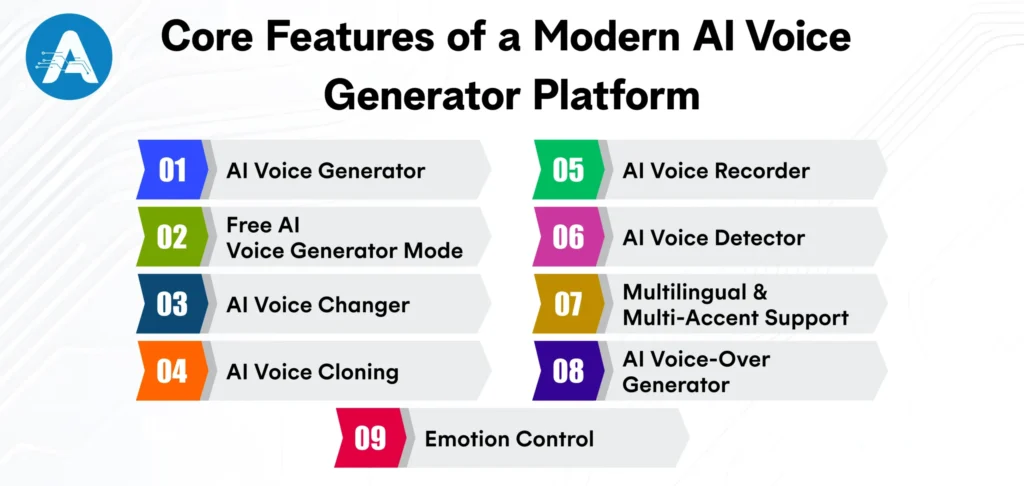
Core Features of a Modern AI Voice Generator Platform
Let users turn text into natural, human-like speech and clone voices easily. With tools like AI voice changers and AI voice text-to-speech, creators and businesses can quickly produce high-quality audio content. Here are the following key features of the AI voice changer:
AI Voice Generator- Converts any text into lifelike, expressive speech that feels natural and human.
Free AI Voice Generator Mode- Beginners and creators can experiment with AI voices at no cost.
AI Voice Changer- Instantly modify voice pitch, tone, age, gender, or accent for flexibility.
AI Voice Cloning- Generate a digital version of any voice using just a few seconds of audio.
AI Voice Recorder-Record, edit, and polish audio directly within the platform.
AI Voice Detector- Quickly verify if a voice is real or AI-generated for responsible use.
Multilingual & Multi-Accent Support- Create authentic voices in 30–120 languages and accents.
AI Voice-Over Generator – Perfect for creators, educators, marketers, and e-commerce projects.
Emotion Control- Add emotions like happy, sad, calm, dramatic, storytelling, or professional tones.
API Integration- Seamlessly integrate AI voice features into apps, websites, or games.
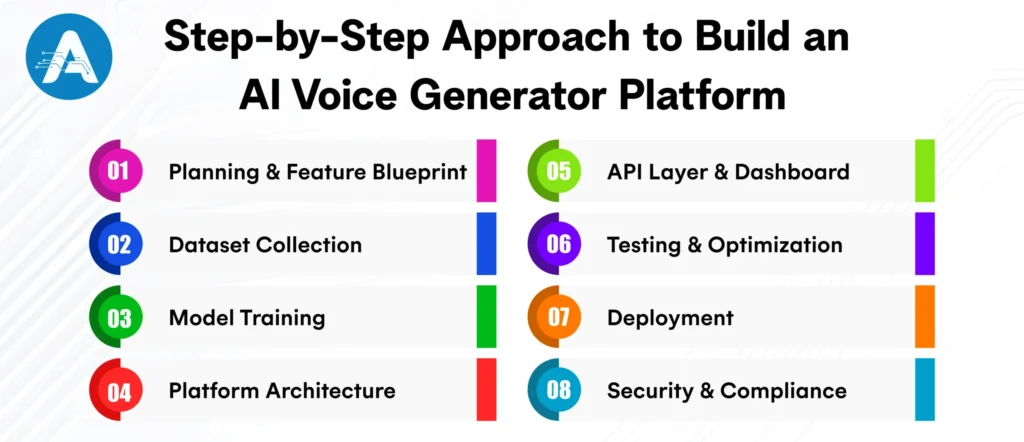
Step-by-Step Approach to Build an AI Voice Generator Platform
Building a modern AI voice generator platform happens in a series of clear steps, starting from planning and design all the way to deployment. Here’s a simple, step-by-step breakdown of the entire process.
Step 1: Planning & Feature Blueprint
Before development starts, it’s important to clearly outline the platform’s goals:
Understand the needs of your users and the problems you want to solve.
Identify the industriesyou want to target, such as e-learning, marketing, gaming, or healthcare.
Plan the voice library, including different genders, accents, and emotional tones.
Decide on multilingual supportfor a global audience.
Choose a pricing model, whether freemium, credit-based, or API subscription.
Step 2: Dataset Collection
Collecting high-quality voice data is essential for creating realistic and natural-sounding AI voices:
Gather 5,000+ hours of diverse speech recordings
Include multiple genders and age groups to cover a wide range of voices
Incorporate varied accents and languages for global reach
Use emotion-rich recordings to make AI voice text-to-speech sound expressive and human-like
Step 3: Model Training
This is the most resource-intensive stage of building an AI voice generator.
Train models for text-to-speech,AI voice cloning, and AI voice changers using advanced neural networks.
Leverage GPUs and cloud infrastructure to speed up training and handle large datasets efficiently.
Fine-tune the models to ensure natural emotion, accurate tone, and proper accent for realistic, human-like voices.
Step 4: Platform Architecture
A strong and well-planned architecture is key to a smooth and reliable AI voice generator platform:
The backend is developed using Python or Node.js, using frameworks like TensorFlow or PyTorch for AI processing.
The frontend is built with React or Next.js to deliver a smooth and responsive user experience.
Databases such as MongoDB or PostgreSQL are used to efficiently store and manage large volumes of voice data.
Step 5: API Layer & Dashboard
Provide easy access to users:
A web interface allows content creators to generate and manage AI voices easily.
A mobile app provides on-the-go access for creating voice content anytime, anywhere.
REST APIs enable seamless integration of AI voice features into other apps and platforms.
Step 6: Testing & Optimisation
Ensure high-quality output:
Check for accuracy and correct pronunciation in generated voices.
Measure latency to ensure real-time speech generation works smoothly.
Ensure emotional consistency so voices sound natural and expressive.
Monitor for voice drift or any unnatural variations over time.
Confirm multilingual consistency across different languages and accents.
Step 7: Deployment
Deploy the platform with scalable infrastructure:
Use Docker to package the platform efficiently.
Deploy with Kubernetes for scalable and reliable operations.
Utilise GPU cloud services to handle heavy AI processing.
Set up CI/CD pipelines for continuous updates and improvements.
Step 8: Security & Compliance
Protect users and maintain ethical use:
Apply voice watermarking to protect generated content.
Incorporate AI voice detection tools to prevent misuse.
Verify user consent before using AI voice cloning or generating voices.
To build an advanced AI voice generator, it’s important to understand the technologies behind it. Modern platforms combine several key components to produce natural, human-like speech and support features like AI voice cloning, AI voice text-to-speech, andAI voice changers.
Deep Learning Models: Most modern AI voice generators use models like Tacotron 2, FastSpeech 2, VITS, diffusion-based engines, and transformer architectures. These models help produce expressive, lifelike speech that feels natural to listeners.
Voice Cloning Algorithms: Using speaker encoders and autoencoders, these platforms can accurately replicate voices, capturing tone, emotion, style, and pronunciation patterns. This is the core technology behind AI voice cloning for personal or brand-specific voices.
Natural Language Processing (NLP): NLP ensures the speech sounds context-aware by handling pauses, emphasis, sentence emotion, and punctuation. This makes AI voice text-to-speech sound human and engaging.
Speech Enhancement & Audio Processing: To deliver high-quality audio, platforms apply background noise removal, pitch correction, loudness normalisation, and studio-quality rendering. These features ensure professional-ready output from AI voice generators.
Cloud & GPU Infrastructure: Training and running these models require powerful computing resources. Most platforms use AWS, Google Cloud, Azure, or NVIDIA DGX machines. This infrastructure enables real-time processing, handles large datasets, and supports advanced voice features efficiently.
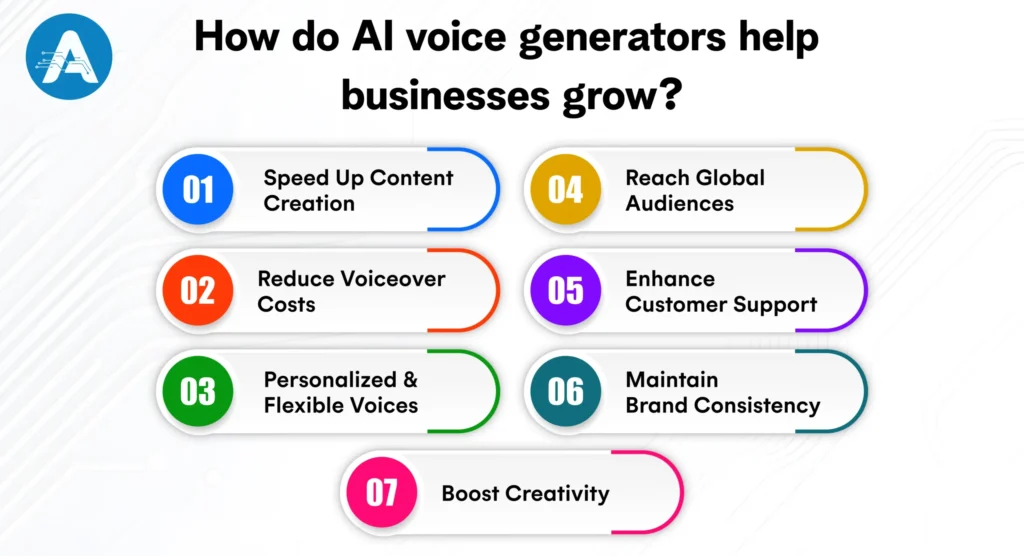
How do AI voice generators help businesses grow?
Modern AI voice generators are transforming the way businesses create audio content, helping save time, cut costs, and maintain high quality. Here’s how they make an impact:
Speed Up Content Creation- E-learning platforms use AI voice generators to narrate lessons in multiple languages within minutes, reaching students worldwide faster.
Reduce Voiceover Costs- Brands can leverage AI voice cloning instead of hiring voice actors for every ad or video, saving money while maintaining professional audio quality.
Personalised and Flexible Voices- With AI voice changers, businesses can adjust tone, pitch, or style. Game developers, for instance, create unique character voices without recording each line manually.
Reach Global Audiences- AI voice text-to-speech enables companies to generate audio in multiple languages and accents, ideal for e-commerce product descriptions and international campaigns.
Enhance Customer Support- AI-powered voice bots provide 24/7 assistance in natural, human-like voices, improving user experience and reducing support costs.
Maintain Brand Consistency- Using AI voice cloning, businesses can keep a consistent voice across ads, videos, and tutorials, making their brand instantly recognisable.
Boost Creativity- Media and entertainment creators use AI voice generators for podcasts, dubbing, and storytelling, allowing them to experiment and innovate quickly.
Apart from the numerous benefits of AI voice generators, there are some challenges that businesses and creators may face while using these platforms. Let’s take a closer look at the common challenges of AI voice generator platforms and explore practical solutions using keywords like AI voice cloningAI voice text-to-speech, and AI voice detectors.
Common Problems and Solutions for AI Voice Generator Platforms
Robotic or Unnatural Voices
Challenge: AI voice text-to-speech may sound mechanical at times. Solution: Apply diffusion models and prosody adjustments for natural, human-like speech.
Misuse of AI Voices
Challenge: AI voice cloningcould be used unethically. Solution: Use AI voice detectors and watermarking to prevent unauthorised use.
High Computing Costs
Challenge: Training AI voice models consumes significant GPU resources. Solution: Optimise models and use compression techniques to lower costs.
Accent and Pronunciation Issues
Challenge: AI voices may mispronounce words or struggle with regional accents. Solution: Develop language-specific models for accurate pronunciation and natural-sounding voices.
Scaling for Multiple Projects
Challenge: Managing high-volume audio production can be challenging. Solution: Utilise cloud infrastructure and API integration to scale AI voice generator platforms efficiently.
How are AI voice generator platforms used in real life?
Businesses and creators rely on AI voice generators for e-learning, marketing, customer support, gaming, healthcare, and dubbing. Tools like AI voice cloning, AI voice changers, and AI voice text-to-speech help produce natural, human-like audio quickly, supporting multiple languages and diverse applications.
AI application developers are now integrating these advanced voice technologies into custom solutions, enabling brands and platforms to deliver more personalised and immersive audio experiences.
E-Learning: Educators and course creators use AI voice generators to narrate lessons in multiple languages, making learning engaging and accessible worldwide.
Digital Marketing: Companies create consistent voiceovers for ads, promotional videos, and social media content using AI voice cloning.
Customer Support: AI voice bots handle calls and queries around the clock, providing natural, human-like responses that enhance customer satisfaction.
Gaming & Entertainment: Game developers and animators generate character voices instantly, bringing stories to life with AI voice changers.
Healthcare: AI voice assistants support patient communication by sending reminders, guiding users, and assisting healthcare professionals.
Film & Dubbing: Studios streamline dubbing with AI voice generators, producing multi-voice content faster and more efficiently.
How will AI voice generator technology shape the future?
The future of AI voice generator development promises exciting improvements. We can expect innovations like zero-latency real-time speech generation, fully emotion-driven AI voice generators, and multimodal audio combined with lifelike video avatars. Advanced platforms will allow the creation of hyper-personalised “digital twin” voices, enabling individuals and brands to have their own unique voice identity.
Furthermore, AI-powered podcast engines that require little to no human input will further simplify content production, making audio creation faster, easier, and more scalable. As these technologies evolve, an AI development company will play a pivotal role in driving this transformation, leveraging AI voice cloning, AI voice changers, and advanced text-to-speech tools to revolutionise digital marketing, e-learning, entertainment, customer support, and personal communication.
The possibilities for creating engaging, human-like, and personalised voice experiences are virtually limitless, opening new avenues for innovation across industries.
Wrapping Up
Advanced AI voice generator platforms are rapidly becoming a cornerstone of modern content creation, marketing, automation, and digital communication. Leveraging AI voice generators, AI voice creators, AI voice cloning, and AI voice text-to-speech tools allows businesses and creators to produce professional, human-like audio faster and at scale, giving them a clear competitive edge.
For anyone planning to build an AI voice generator platform, the timing couldn’t be better. With features like real-time speech generation, emotion-driven voices, and multilingual capabilities, this industry is poised for massive growth over the next decade, offering endless opportunities for innovation and impact.
Furthermore, AI application development services are now enabling companies to turn these advanced voice technologies into powerful, user-friendly products tailored to specific industry needs. By integrating custom workflows, automation, and scalable architectures, these services help businesses launch AI voice solutions faster and more efficiently.
Planning for AI Project
Get clarity on use cases, architecture, costs, and timelines with insights from 50+ real-world AI implementations.
An AI voice generator is a platform that converts text into natural, human-like speech using advanced machine learning and deep learning models.
2. How long does it take to generate AI voice content?
Most AI voice generators can produce text-to-speech in seconds, depending on the length of the text and the complexity of the voice model.
3. Is AI voice generation legal and ethical?
Yes, as long as platforms use AI voice detectors, watermarking, and consent from voice owners, the technology can be used ethically and legally.
4. How can AI voice changers be used in content creation?
AI voice changers allow users to modify pitch, tone, gender, or style, making it easy to create unique voices for gaming, storytelling, or videos.
5. Is it safe to use AI-generated voices for commercial purposes?
Yes, but using AI voice detectors and watermarking helps prevent misuse and ensures ethical, legal use of generated voices.
6. Can AI voices be used for podcasts and audiobooks?
Yes, AI voice generators and AI voice-over generators are widely used to produce podcasts, audiobooks, and other audio content without manual recording.
7. Can AI voice generators mimic celebrity or famous voices?
Yes, advanced AI voice cloning technology can replicate voices with proper consent, creating realistic celebrity-style speech for entertainment or marketing.
With tech titans like Jack Dorsey, Elon Musk, and Richard Branson using pivotal moments to spark conversations about new inventions, Deepinder Goyal’s recent appearance…