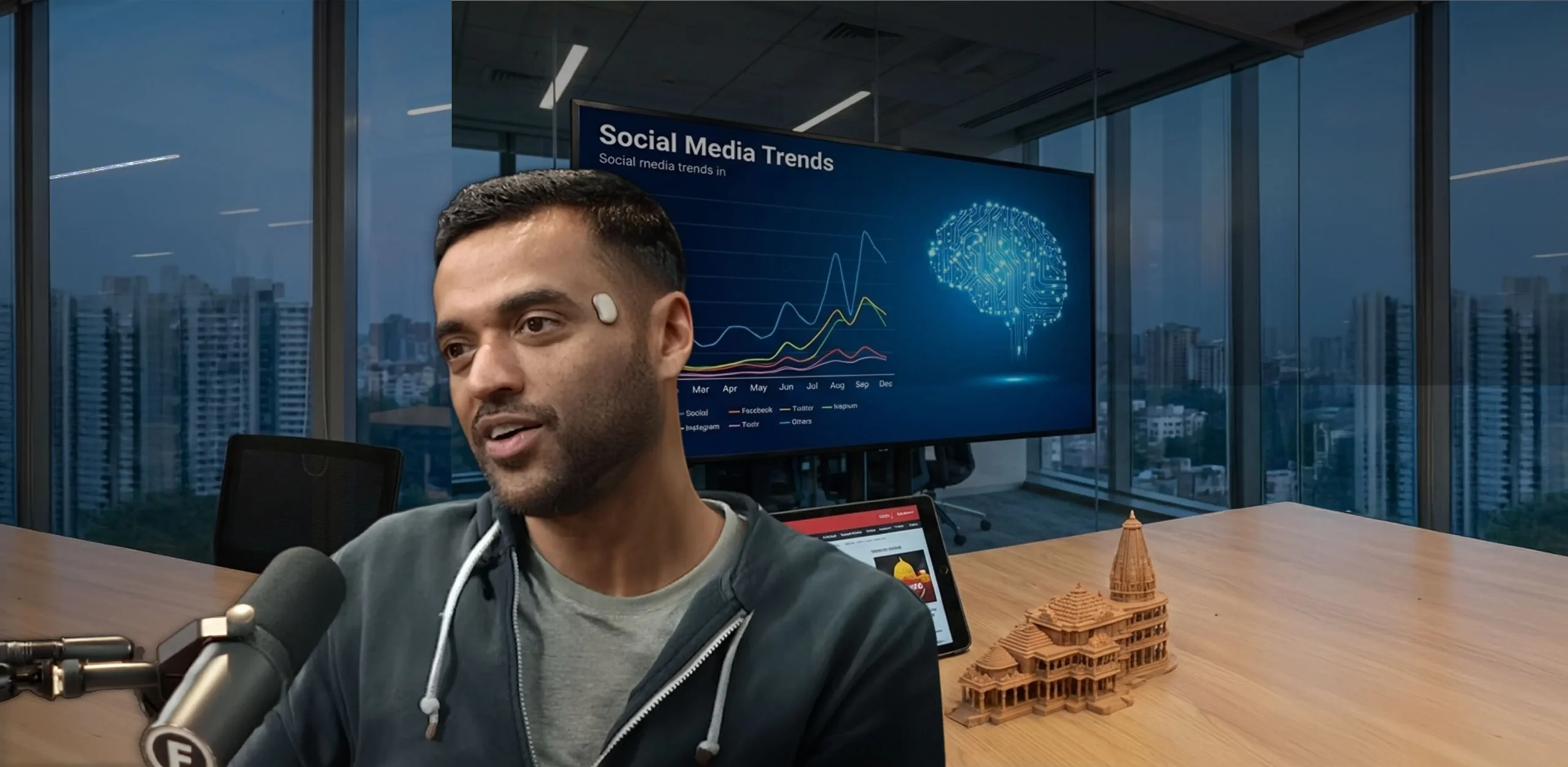
With tech titans like Jack Dorsey, Elon Musk, and Richard Branson using pivotal moments to spark conversations about new inventions, Deepinder Goyal’s recent appearance on a popular podcast, where he was seen wearing a peculiar gadget on his temple, has emerged as a fascinating case study. What could have otherwise been a routine discussion has escalated into a full-blown phenomenon, not based on what was said but based on what was worn: a fancy gadget made of metal, which has since gone public with a name, Temple, launched by Deepinder Goyal himself. Its impact was immediate. Viral memes, widespread discussions, skepticism among medical professionals, and growing curiosity across the global community created an organic wave of attention that no traditional marketing campaign could have achieved.
However, beneath all the social commotion, one question arises: Can such viral occurrences serve as an effective platform for marketing innovative designs offered by AI technology, even those still at the experimental level? This blog will unpack the ways through which viral marketing can be an influential platform for influencing the discussion surrounding AI-enhanced technology.
Everyone Had the Same Question: How Temple Took Over the Internet
During an episode of a podcast hosted by Raj Shamani, Zomato CEO Deepinder Goyal was noticed not for making a corporate announcement, but for an unusual device clipped to the back of his ear. The audience automatically began to focus on it as the video began to roll.
Social media was flooded with guesses:
- Was it a next-generation health sensor?
- A neural interface?
- A miniaturized medical device?
With the curiosity building, the media has helped shed light on the confusion: “The device, called Temple, is an experimental wearable that tracks changes in blood flow to the brain in real time. This data correlates to the health and function of the brain and the effects of aging.”
This piques curiosity because the wearable that tracks health indicators is already among the leading technologies in the personal technology front, but brain-related wearables have not seen significant advancements.
It is this organic act of discovery, before a formal product launch, launch event, or advertising campaign, that exemplifies what marketers refer to as “earned media,” that is, publicity that is created, rather than purchased, through consumer-generated buzz.
Temple: Hype or Innovation? A Closer Look at the Device
Before we can fully grasp the implications of this in terms of marketing, there is a need to highlight what Temple is in a very brief manner:
- It’s a wearables experiment designed for the continuous measurement of blood flow to the brain, a function found in very few wearables currently on the market.
- Goyal’s work revolves around the technology that is substantiated through the “Gravity Ageing Hypothesis,” which suggests that the force of gravity could have an impact on the circulation of blood in the body, ultimately contributing to the
- The initial response has been skeptical by some doctors, being termed unproven scientifically, and with calls not to get too carried away, while an ex-AIIMS doctor has termed it as having no scientific standing.
Worth noting is the fact that Temple is not yet a commercial product. In fact, Temple is still in the testing phase. However, it managed to draw the attention of the world prior to the official marketing and release.
This one-of-a-kind circumstance, in which a prototype takes center stage, proves to be both an opportunity and a challenge for AI developers.
Why Going Viral Works So Well for Tech Brands
1. They Turn Curiosity into Awareness
A defining trait of the viral moment is how it converts unintended details into headlines.
Goyal didn’t appear on the podcast to hawk Temple. He didn’t declare a launch date. And the device on his wrist wasn’t the topic at hand, but that didn’t stop anyone from noticing it. The result? Conversation across social media, blogs, forums, and news outlets-all free of paid advertising.
Conventional marketing would spend thousands on:
- TV spots
- Advertisements on the internet
- PR campaigns
- Influencer tie-ins
Yet Temple managed to pull off organic reach simply by being on someone’s head during a video that went viral. Viral attention is essentially user-generated marketing run on curiosity.
This is a clever tactic because people are fundamentally curious about what they don’t know, particularly when the things they don’t know revolve around technology and the human body.
2. They Encourage Community Involvement and Discussion
Viral moments spark discussion, both positive and negative. “The Temple tool had exactly that kind of effect,” Ray Kelly, the NYPD’s police commissioner, explained: “It helped
- It was described as “fascinating” and “wild” by tech cognoscenti and startup entrepreneurs, which can only be described as laudatory talk that further adds to its innovative quality in the device.
- But there was a valid concern raised by medical professionals about a lack of proof and scientific validation.
This two-sided conversation keeps the topic in the news longer than a formal ad campaign would. Both critics and supporters of the topic are participating in the long-tail conversations.
3. They Position Leaders as Forward-Thinkers
By donning Temple, Goyal made, or made himself to appear, as:
- A visionary with experience in innovative wearable technology projects
- A leader who is not afraid to speak out about radical thoughts
- The founder is willing to be open about his own use of the experimental technology
“Being tied to the story of AI is an amazing branding experience, especially if you are involved in AI innovation. Your personal brand gets linked to the story of the innovation that is AI.”
This stylistic choice has a connection with tech giants who display their technological prowess at conferences by showing how they use gadgets in their personal lives, but in this situation, a wearable experience had a similar impact without purpose, ironically making it rather interesting.
What Temple Teaches Us About AI Marketing
Therefore, what kind of lessons can AI innovators draw from this viral moment? Here are the actionable marketing pointers:
1. Let Authentic Context Drive Exposure
Visibility at Temple was part of a natural event rather than a planned advertisement. Being genuine is more effective than a staged demo. Viewers tend to believe naturally occurring content more readily than advertisements. This is simply because it is less planned.
How to Put This into Practice:
- It is good to encourage thought leaders in your company to use your technology in public situations.
- Share authentic, unscripted stories because they have more impact than a commercial.
- “Create stories out of user stories instead of specs.”
Authenticity breeds shareable moments.
2. Engage in a Conversation Even When it is Critical
Not all attention is necessarily good attention. In fact, the Temple device was greeted with scepticism by doctors and vigorous debate over its validity.
However, the negative or critical reporting is also a conversation, and conversation drives attention.
How to Put This into Practice:
- Ready your brand to respond to critics in a respectful manner
- As a response to skepticism, it should be seen as an avenue to clarify and educate.
- Use debates to create thought leadership content or Q&A articles
Criticism is not a setback. When handled openly, it builds credibility.
3. Blending Storytelling with Technology
The tale of Temple is more than a gadget because the story revolves around a theory, curiosity, and a vision for human health. The tale added meaning to the technology.
How to Put This into Practice:
- To make your innovation more meaningful and memorable, frame it in the context of an interesting story that includes the problem, vision, and
- Don’t use technical talk in a vacuum. Connect the tech to a human experience.
- Use storytelling to convert features to impact.
It’s the Stories That Make Technology Memorable.
4. Create Buzz Across Multiple Channels
The Temple viral video was shared across:
- Podcasts
- Social Media Reactions
- Social
- Tech news and blog sites
- Meme subculture and conversation speak
Each of the channels added to it their own element. Also importantly, a viral event is not spread through an advertising campaign but is itself shared through multiple channels.
How to Put This into Practice
- Your tech should be represented in public forums, talk show programs, forums, and communities.
- User-generated content related to your innovation should be encouraged.
- Monitor organic mentions and engage if necessary.
Different channels will give you an even bigger audience.
Possible Risks and Ethical Concerns
Viral marketing, although highly effective, also has its dangers:
1. When Hype Outruns Evidence
There have even been questions raised over Temple’s scientific basis, with medical professionals advising people not to regard it as proven technology.
It is important for firms in AI and health technology to avoid making promises about their products. Viral media attention without any tangible results can lead to negative effects in the future.
What Works Best: The best balance to strike: Curiosity must be tempered by caveats.
2. Misinterpretation by the Public
Memes and jokes are entertaining, but they may misrepresent the true intention of the technology. This is crucial in ensuring the right perception of the technology among the general public.
What Works Best: Take advantage of “viral” events to communicate and educate, not just entertain.
3. Privacy and Ethics in AI Wearables
Brands have the responsibility of being open regarding privacy and the use of health-related data when they market their offerings involving AI and wearable technology.
What Works Best: Keep commitments to uphold privacy at the forefront and make them readily understandable, especially during times of heightened public interest.
What This Means for the Future of AI
What the Temple phenomenon underlines is that viral moments will lift AI innovations into mainstream discussion, even if the complete product is still an idea. It contravenes traditional marketing wisdom and opens up organic doors to brand shaping.
The lesson for AI innovators is a simple one:
Visibility doesn’t require perfection; it requires presence.
By being part of the conversation, even incidentally, your technology can reach further than it can through contrived marketing.
Conclusion
Though Deepinder Goyal’s Temple gadget might still be in its experimental stages, with its scientific claims open to interpretation, its journey into the limelight proves an important fact: curiosity-driven humans remain the best marketing tools.
Whether it’s a revolutionary AI algorithm, a wearable tech product, or a health tech device, never forget the power of actual moments, and moments that intrigue, surprise, and propel conversations can mean more than advertising budgets totaling billions of dollars.
In the social media era and the hyper-connected audience, the most successful campaigns begin with a question, and not a pitch.
Planning for AI Project
Get clarity on use cases, architecture, costs, and timelines with insights from 50+ real-world AI implementations.