AI Platform •
12 min read •January 16, 2026•340 views
How AI Chatbot is Transforming the Future of Supply Chain and Logistics Industry
Table of Contents
Right now, small supply chain issues like delays or higher fuel costs may be impacting your profits, and without an AI Chatbot, you may not even see them happening.
Global trade is accelerating, but supply chains are falling behind because they don’t have clear, real-time visibility into their operations. Despite the hype, McKinsey reports that only 33% of businesses have successfully scaled an AI Chatbot or agentic system across their enterprise. For the other 67%, the lag between a disruption and an operational response is costing the automotive sector alone an estimated $13 billion annually.
The era of passive “Where is my package?” bots is over. We are now in the age of agentic AI chatbots. These modern artificial intelligence chatbots have evolved into 24/7 digital orchestrators that not only identify problems but also proactively resolve them before they can impact your bottom line.
What is an AI Chatbot?
In simple terms, an Artificial intelligence chatbot is a program capable of conversing with people, just like humans, via text & voice. It learns through interactions, understands what users request, and provides useful responses by applying technologies such as machine learning and natural language processing.
In the early 2020s, a free chatbot was essentially a digital filing cabinet. You asked a question, and it fetched a static link. In 2026, the best AI chatbot for supply chain is a Reasoning Engine.
An AI Chatbot today connects your ERP, your fleet’s IoT sensors, and your global carriers into one conversational hub. Whether built by an AI development company or deployed through a hyperscaler platform, these tools now possess “Agentic Logic”, which is the ability to perform multi-step tasks without human hand-holding.
Why the Supply Chain Industry Needs AI Chatbots Now
The logistics business is put under constant pressure: changing demand, global inconvenience, labor deficit, and growing customer demands for transparency. The traditional systems tend to be in silos and cause delays and communication gaps.
AI chatbots overcome these obstacles by:
Giving real-time access to information.
Reducing dependency on manual support teams
Enhancing collaboration in the supply chain touchpoints.
Enabling more data-driven decisions.
Due to this, several organizations are no longer content with basic chat support and are instead investing in the best Artificial intelligence chatbot solutions built by experienced AI application developers that will be integrated well into their logistics background.
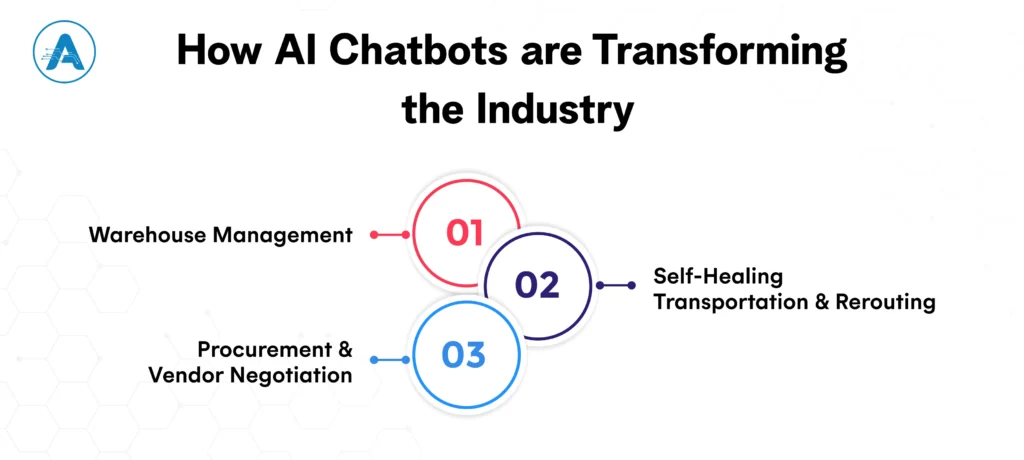
How AI Chatbots are Transforming the Industry
AI chatbots are reshaping supply chain and logistics by turning complex, manual operations into real-time, intelligent workflows. Instead of reacting to issues, logistics teams now use Artificial intelligence chatbots to monitor, decide, and act across warehouses, transportation, and procurement.
1. Warehouse Management
Warehouse managers are moving away from clipboards and towards artificial intelligence chatbots that act as floor supervisors.
Inventory on Demand: Instead of running reports, staff ask, “What is our stock-out risk for SKU-502?” and the bot analyzes live inventory levels vs. predicted demand.
Automated Slotting: The best Artificial intelligence chatbot can suggest warehouse layout changes based on high-frequency picking patterns, reducing travel time for workers.
2. Self-Healing Transportation & Rerouting
This is where Artificial intelligence chatbots become truly transformative.
Proactive Rerouting: When a Google AI chatbot notices there is something wrong with a large port, it does not simply send out an alert. It studies other carriers, evaluates the effects of tariffs, and poses to the logistics manager, “Should I reroute the 40 cargo units of secondary port at an extra $1,200?”
Fleet Communication: The drivers communicate with an Artificial intelligence chatbot through free online applications to report mechanical problems or successes of delivery, which automatically updates the central ledger automatically updated.
3. Procurement and Vendor Negotiation
The top AI chatbots are now capable of handling the boring parts of procurement.
Autonomous RFQs: When stock hits a threshold, the bot automatically sends Requests for Quotations to vetted suppliers.
Negotiation Logic: Advanced artificial intelligence chatbots can compare quotes, check historical performance data (FACTS scores), and finalize purchase orders within pre-set budget limits.
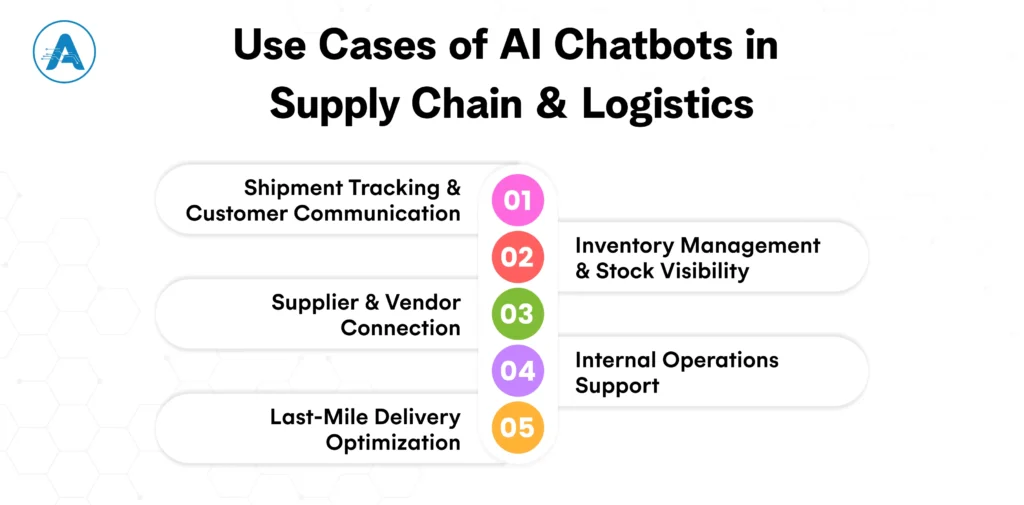
Use Cases of AI Chatbots in Supply Chain and Logistics
The best AI chatbot is defined by its ability to integrate with the entire logistics ecosystem. Here is how an Artificial Intelligence Chatbot moves the needle across the supply chain:
1. Shipment Tracking and Customer Communication
One of the most common applications of an AI Chatbot in logistics is real-time shipment tracking.
Customers contacting support teams for updates, Artificial intelligence chatbots can instantly provide shipment status, ETAs, and delivery confirmations.
Overall improvement in customer experience while drastically reducing inbound support requests.
Free AI chatbots can handle basic tracking queries, while advanced AI chatbots offer proactive notifications and predictive alerts before a delay occurs.
2. Inventory Management and Stock Visibility
Inventory-related queries are frequent across logistics operations.
An artificial intelligence chatbot can fetch live inventory data from warehouse systems and answer questions such as stock availability, reorder levels, and specific warehouse location details.
Operations teams reduce dependency on manual reports and static dashboards, while for partners and distributors, it improves coordination and planning accuracy.
3. Supplier and Vendor Connection
Supply chains rely heavily on timely communication with suppliers.
AI Chatbot streamlines interactions related to purchase orders, shipment confirmations, delivery schedules, and documentation.
By acting as a centralized communication interface, the best AI chatbots minimize fragmented email chains and time-zone delays, ensuring smoother collaboration across global geographies.
4. Internal Operations Support
Internal logistics teams need fast, on-demand access to operational data.
Common queries include order status, route details, warehouse performance, and exception handling.
An artificial intelligence chatbot provides instant answers to these operational questions.
Reduces dependency on IT and operations support teams.
Particularly valuable in large enterprises.
Helps unify access to data scattered across multiple legacy systems.
5. Last-Mile Delivery Optimization
Real-time communication is critical in last-mile delivery.
An AI chatbot assists drivers with route updates and delivery-specific instructions.
Enables instant issue reporting from the field.
Provides customers with real-time delivery updates via an Artificial intelligence chatbot online.
Allows customers to reschedule or modify delivery preferences without human intervention.
Reduces operational costs.
Increases first-time delivery success rates.
Benefits of AI Chatbot in Logistics Businesses
Implementing an AI Chatbot isn’t just about modernizing your interface; it’s about building a resilient, self-healing network. Companies integrating an artificial intelligence chatbot are seeing a fundamental shift in their performance.
Lower Operational Expenses: By automating nearly 35% of individual manual tasks, an AI chatbot allows logistics firms to handle higher volumes without increasing headcount.
Round-the-Clock Agility: Logistics never sleeps. A top Artificial Intelligence chatbot provides instant support across all time zones and in 100+ languages, ensuring that a customs delay in Europe is addressed while your home office is asleep.
Reduction in Decision Latency: The best AI chatbot of 2026 is proactive. It identifies a “Decision Gap,” the time between an event and a response, and closes it in seconds by suggesting rerouting plans.
Frictionless Customer Experience: Speed is the new currency. Using an AI chatbot online brings average response times down from hours to seconds, which is critical since 87% of shoppers say shipping directly affects their repurchase decisions.
Workforce Force Multiplier: Far from replacing humans, AI chatbots act as co-pilots. They handle the “boring” tracking data, allowing your team to focus on complex, high-value strategy and relationship management.
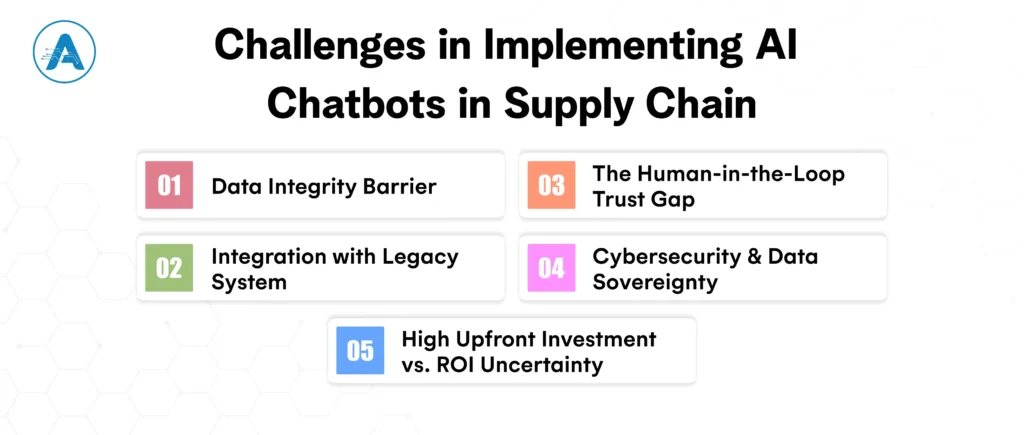
Challenges in Implementing AI Chatbots in Supply Chain
While the transformation and benefits are impressive, there are also some obstacles to deploying a 2026-grade AI chatbot. To build a truly resilient system, one must navigate these critical roadblocks:
1. Data Integrity Barrier
An Artificial intelligence Chatbot is only as smart as the data it consumes. Many logistics firms struggle with “Data Silos” where warehouse information, carrier updates, and customer data live in separate, incompatible systems.
Feeding fragmented or old data into an artificial intelligence chatbot leads to “hallucinations,” such as promising a delivery date based on an outdated port schedule.
2. Integration with Legacy System
The majority of the supply chains used worldwide are still based on the decades-old ERP and TMS software. Those systems were not modeled after the plug-and-play of the contemporary AI chatbots.
To fill the gap between a mainframe logic in the 1990s and a chatbot in the year 2026 that uses AI, many API development and custom middleware are frequently needed.
3. The Human-in-the-Loop Trust Gap
The best AI chatbots are developing to no longer respond to questions, but make independent choices, such as rerouting a fleet. There is a significant issue of trust. Frontline employees might not want to follow the recommendation of a bot when they are not aware of the logic behind it.
4. Cybersecurity and Data Sovereignty
By 2026, data will be more valuable than oil. Customer addresses, supplier contracts, and proprietary route logic are sensitive information accessed by an Artificial intelligence chatbot. There is a rise in cyber attacks orchestrated by artificial intelligence chatbots to steal shipment details or tamper with the procurement bid.
5. High Upfront Investment vs. ROI Uncertainty
While an AI chatbot free pilot is easy to start, a full-scale artificial intelligence chatbot deployment involves significant costs for specialized talent and cloud infrastructure.
Many firms hesitate to commit because, despite the long-term savings, the initial “buy-in” for enterprise Artificial Intelligence chatbots can be intimidating for small to medium-sized companies.
Finding the Right AI Chatbot
The market is flooded with AI chatbot options. However, for a logistics business, one size never fits all. Choosing the wrong tool can lead to the very “Visibility void” you are trying to escape.
To find the best Artificial intelligence chatbot for your operation, evaluate your options against these four specific pillars of 2026 logistics tech:
I. Integration Depth
A top AI chatbot is useless if it can’t “talk” to your existing stack. Look for platforms that offer pre-built connectors for:
ERPs: SAP, Oracle, and Microsoft Dynamics.
TMS/WMS: Manhattan Associates, Blue Yonder, or Körber.
Carrier APIs: Direct links to FedEx, DHL, and ocean carrier portals.
You do not need an AI chatbot that will have to upload CSVs manually; you want the one that will fetch the live data directly from the source.
II. Conversational Intelligence vs. Scripted Logic
Avoid basic, menu-based bots that feel like a phone tree. The best AI chatbots use Agentic NLP.
Standard Bot: Recognizes keywords like “Tracking” and asks for a number.
Agentic AI Chatbot: Understands intent like, “My shipment at Rotterdam is tardy; shall we hurry the next one?” It then examines your stock, surveys other lanes, and presents an answer all in one conversation.
III. Multichannel and Multilingual Support
Logistics is global. Your artificial intelligence chatbot must be where your drivers and customers are.
Channels: Make sure that it is connected to WhatsApp Business, Microsoft Teams, and SMS.
Languages: A Google AI chatbot framework often provides the best real-time translation, allowing a warehouse manager in Poland to communicate seamlessly with a carrier in Brazil.
IV. Scalability and Edge Readiness
During peak seasons, your query volume can spike by 300%. Many enterprises partner with providers offering full AI application development services to ensure scalability, security, and long-term ROI.
Scalability: Ensure the platform can handle thousands of simultaneous chats without latency.
Edge Capability: The most advanced Artificial intelligence chatbots now offer voice-to-text features, allowing warehouse pickers or drivers to use the tool “hands-free” via headsets while on the move.
Wrap Up
AI chatbots have not only graduated to the level of a mere digital assistant, but also become the Operational Brain of the global supply chain. The reactive tracking to agentic Artificial Intelligence orchestration is a business necessity.
These smart systems eliminate the visibility gap, allowing logistics executives to recapture lost billions of productivity, reduce operational expenses by up to 15%, and transform last-mile operations into a seamless customer experience.
However, the path to maturity requires more than just installing a Google AI chatbot. It needs clean data, safe integration, and a transparent human-AI partnership.
The wait-and-see window has been shut. Regardless of whether you are rolling out a pilot program for free or you are ramping up a custom-built enterprise agent, the goal is simple: to establish a supply chain that does not just respond to the world, but anticipates it.
Planning for AI Project
Get clarity on use cases, architecture, costs, and timelines with insights from 50+ real-world AI implementations.
1. Can an AI Chatbot handle complex shipping documents like Bills of Lading?
Yes. The best AI chatbots use Document Intelligence to read, verify, and summarize complex logistics paperwork. They can instantly flag inconsistencies in HS codes or commercial invoices, reducing customs delays.
2. How does an AI Chatbot reduce WISMO calls?
By providing an AI chatbot online interface available 24/7, customers can get live ETAs pulled directly from your TMS. This typically automates up to 80% of routine tracking inquiries, freeing your staff for higher-value tasks.
3. Can I start with a Free AI chatbot?
You can use a free AI chatbot for basic website FAQs. However, to see real ROI, like autonomous rerouting or inventory updates, you will need a custom-integrated AI Chatbot that connects to your ERP via APIs.
4. Does an AI Chatbot replace human logistics planners?
No. The AI chatbots act as Co-pilots. They handle the high-volume noise and data crunching, while human planners step in to manage high-level strategy and complex vendor relationships.
5. Can the chatbot communicate in multiple languages?
Yes. Top AI chatbots utilize real-time translation layers. This allows a dispatcher in Germany to communicate perfectly with a driver in Brazil, translating text and even voice on the fly.
6. How do I measure the ROI of my AI Chatbot?
Success is measured by Cost Per Interaction, First Contact Resolution (FCR), and Decision Latency. Most firms using a top AI chatbot report a 15% reduction in overall logistics costs within the first year.
7. What if the AI Chatbot makes a mistake or hallucinates?
To prevent this, we use Grounding. This ensures the artificial intelligence chatbot only pulls answers from your specific, verified data rather than guessing from the general internet.
NLP in Healthcare is rapidly transforming how medical data is processed, analyzed, and utilized. With nearly 80% of healthcare data unstructured, ranging from clinical…
Hiring has always been one of the most critical and challenging functions for any organization. Yet, traditional recruitment processes often rely on manual screening,…