AI Platform •
10 min read •February 10, 2026•290 views
Best AI Image Generator Tools for Modern Designers
Table of Contents
Design workflows are evolving at breakneck speed. AI Image Generators have officially transitioned from experimental “toys” to essential everyday assets for modern creatives. The data is clear: over 65% of designers now integrate AI into their ideation phase, with teams reporting up to 4× faster visual creation compared to traditional stock photography or manual drafting.
However, the AI gold rush has shifted. The value isn’t just in making any image; it’s about precision, brand consistency, and legal safety. Businesses using a modern image generator AI reduce creative costs by 30–50%, but the real winners are those moving beyond generic prompts toward specialized, architecturally aware models.
This is also where organizations increasingly partner with an AI development company to move from tool usage to long-term visual infrastructure.
Whether you are testing an AI image generator free online for a rapid mock-up or scouting the best AI image generator for professional production, this guide highlights the tools that bridge the gap between creative spark and production-ready output.
We’ll also examine why elite teams are now seeking AI application developers for hire to build proprietary models that protect their unique visual identity.
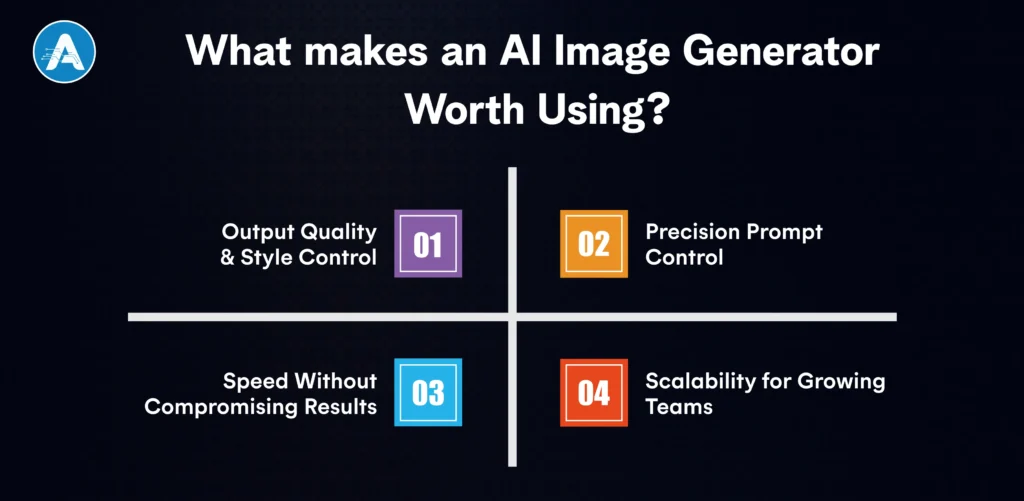
What makes an AI Image Generator Worth Using?
A good AI Image Generator should feel like a natural extension of a designer’s workflow, not a gimmick. While many tools can produce visually appealing outputs, only a few consistently deliver usable, repeatable, and real-world-aligned results.
Understanding why certain features matter helps designers choose the right image generator AI for both creative exploration and production work.
1. Output Quality & Style Control
The foundation of any best-in-class AI image generators is its ability to accurately understand and execute prompts. Designers often need precise control over style, composition, lighting, and mood.
For example, when generating hero visuals for a website, multiple AI generated image may be required that look cohesive across different sections.
Tools that allow prompt refinement, style locking, and iterative adjustments make it easier to generate AI images that meet professional standards.
Many free AI image generator tools are excellent for quick ideas, but struggle with consistency when used repeatedly.
2. Precision Prompt Control
Designers design in various formats such as ads, app screens, social media posts, and presentations.
The realistic image AI generator allows custom aspect ratios, high-resolution exports, and little in the way of post-editing.
This is more so necessary when applying an AI image generator on a free online platform, where factors such as poor resolution or constraints may slow down the delivery.
Tools that can fit into the current workflow assist designers in making the transition to the final output quicker.
3. Speed Without Compromising Results
Rapidity is important, however, not at the expense of quality. The most useful tools are the ones that balance to create images fast, but at the same time, observe detailed hints.
The tools of an ai images generator help designers discover several visual directions within minutes, when it would take hours otherwise.
It is this fast iteration, where AI image generators can actually generate value over the conventional design processes, which can provide valuable benefits.
4. Scalability for Growing Teams
The bigger the projects, the higher the expectations. Grouping styles or data sets, or even bespoke pipelines that are unavailable in general tools, can be required by teams.
At this point, companies tend to go beyond the shelf solutions and seek the services of AI developers and invest in AI application development services to build systems.
This would guarantee continuity anda greater level of control over the alignment of AI generator image outputs to brand identity.
Best 8 Image Generator Tools
A designer-oriented and practical list of the best AI Image Generators, including the reasons why one tool is important to the workflow, how it is applied in practice, and when it is reasonable to use this or that tool, appears below. This list is a balance between the premium tools and the best free AI image generator sources that are employed by contemporary design teams.
1. Midjourney
Midjourney is arguably the top AI image generator when it comes to designers who place a premium on design and artistic quality. Its products are cinematic, expressive, and purposefully designed, so it is popular in brand storytelling and luxury creative work.
Why designers rely on it: Midjourney is very good at deciphering mood, light, texture, and abstract concepts. In creating AI generated image in campaigns or hero sections, the designers receive results that are less artificial and more crafted.
How it’s used in real workflows: Designers often use Midjourney during early ideation, exploring multiple art directions before committing to one. It’s especially effective when you need inspiration quickly without opening complex design tools.
Limitations to know: Prompt structure matters a lot. Without refinement, outputs can vary, which makes it better for exploration than strict brand-controlled production.
2. DALL•E
DALL·E focuses on clarity and precision, making it one of the most practical image generator AI tools for designers working on business-focused visuals.
Why designers choose it: It follows prompts more literally than most tools. This helps when designers need specific objects, layouts, or explanatory visuals rather than abstract art.
How it fits design use cases: Designers commonly generate AI images for blog illustrations, onboarding screens, UI visuals, and marketing banners where structure matters more than artistic flair.
Free vs paid value: Limited credits make it a usable AI image generator free online option for testing and small projects, with paid plans offering consistency at scale.
3. Adobe Firefly
Adobe Firefly will target users who are already integrated into the Adobe ecosystem.
Why it stands out: The greatest strength that it possesses is trust. Firefly learns using licensed data, and the output of visuals is less risky in commercial and client-facing applications.
How designers use it: The designers create AI images in Photoshop or Illustrator, which eliminates context switching and accelerates production actions.
Best suited for: The teams of enterprises, agencies, and designers who care about legal safety and working process coherence more than experimentation.
4. Stable Diffusion
The image AI generator that is the most flexible and is used today is Stable Diffusion.
Why it’s powerful: It also gives complete control, including custom models, datasets, and fine-tuning, which none of the hosted systems can complete.
How it’s used: Stable Diffusion is frequently used with internal tools or contracted to AI developers to create brand-specific generators by design teams.
Who should use it: High-end users and organizations that require long-term scalability and customization.
5. Leonardo AI
Leonardo AI is constructed with the asset consistency consideration.
Why designers prefer it: It is also good at creating repeatable styles – essential to games, UI kits, and icon systems.
How it’s used: Designers create AI images such as characters, UI, and environment elements, yet retain visual consistency.
Free value: It is one of the most powerful AI image generators available as a free version, which can be used in serious experiments.
6. Canva
The image generator feature of Canva is focused on speed and simplicity through AI generators.
Why it works: It eliminates the complexity in designing among marketers and founders who require visuals in real time.
How it’s used: Designers and non-designers use it to create AI images to present, post, or advertise via social media.
Trade-off: Less creative control compared to high-tech.
7. Bing Image Creator
Bing Image Creator provides rapid access to DALL*E-generated image.
Why it’s popular: It is a free choice of an AI image generator, thanks to its zero-configuration setup.
How designers use it: Primarily references, mockups, and inspiration- not finished production.
Edge over rivals: Cost-free rapid ideation vs paid barriers.
8. NightCafe
NightCafe is open-minded and participatory-based.
Why it’s useful: Several models are housed together in a single place, enabling designers to compare outputs quickly.
Best for: Fashion experimentation and artistic experimentation.
Edge advantage: Model variety speeds creative exploration.
AI Image Generators are no longer a curiosity or optional experiment; they are now a foundational layer in modern creative workflows. Throughout this guide, we’ve shown how AI Image Generators are used not only for speed, but for smarter decision-making across branding, UI, marketing, and product design. The real strength of AI Image Generators lies in their ability to reduce production time, expand creative exploration, and maintain visual quality while supporting real business outcomes.
For individual designers and small teams, AI Image Generators available as free online tools are often enough to create mockups, references, and early-stage concepts. As project complexity grows, professionals naturally shift toward advanced AI Image Generators that offer higher consistency, better resolution, and stronger prompt control.
Scaling organizations move beyond generic AI Image Generators entirely, working with AI developers for hire to build custom AI Image Generators that protect brand identity, enforce design systems, and align with long-term product vision.
Ultimately, choosing the right AI Image Generators comes down to intent. Whether you need fast inspiration, production-ready assets, or a fully customized AI Image Generators pipeline.
In this blog demonstrate how AI Image Generators empower designers to work faster, think broader, and deliver better outcomes. The future of design isn’t about replacing designers; it’s about AI Image Generators evolving alongside them, adapting to how modern creatives think, design, and ship results.
Planning for AI Project
Get clarity on use cases, architecture, costs, and timelines with insights from 50+ real-world AI implementations.
1. What are AI Image Generators and their application by designers?
Image generators are machine learning applications that generate images based on textual or visual inputs. The applications of AI Image Generators in the work of designers concern quick ideation, concept exploration, UI mockups, marketing creatives, and visual references, which saves a lot of time on manual drafting or searching for stock images.
2. Are there AI Image Generators that are appropriate in professional design?
Indeed, most of the AI Image Generators are currently designed to be used professionally. Midjourney, Adobe Firefly, and Stable Diffusion are the tools that present a high-quality output, which can be applied to branding, product design, and marketing. The trick here is to select AI Image Generators providing consistency, resolution control, and commercial rights of use.
3. Does it have a trustworthy free online AI image generator for designers?
The number of AI Image Generators that provide a free online version with restricted credits or options is significant. These are the best options that can be used when testing out ideas or in early-concept or mockups. Nevertheless, to make their results repeatable and ready for production, designers frequently purchase paid AI Image Generators.
4. What are the benefits of AI Image Generators to design processes?
AI Image Generators reduce time in the process since they allow designers to create numerous visual directions within minutes. It enables shorter feedback loops, expanded creative research, and less reliance on a library of stock, thus AI Image Generators can be an important addition to contemporary design pipelines.
5. How is it that free and paid AI Image Generators are different?
Free AI Image Generators are the most suitable ones when it comes to testing ideas and learning how prompt-based design works. The quality of paid AI Image Generators is higher, with higher resolution, controls immediate, consistency, and are commercially licensed- this is why they are client and enterprise-friendly.
6. Will AI Image Generators be able to preserve brand strength?
Other advanced AI Image Generators include style locking, model tuning, and dataset control, which are useful in keeping the brand consistent. In organizations where strict brand rules are observed, AI Image Generators are often used with a custom workflow or target models.
NLP in Healthcare is rapidly transforming how medical data is processed, analyzed, and utilized. With nearly 80% of healthcare data unstructured, ranging from clinical…
Hiring has always been one of the most critical and challenging functions for any organization. Yet, traditional recruitment processes often rely on manual screening,…