AI Platform •
9 min read •February 13, 2026•417 views
How to Build Your Own Custom AI Solution
Table of Contents
As businesses grow, operations become more complex, and customer expectations rise. A custom AI solution helps automate processes, improve decision-making, and deliver personalized experiences built around your unique workflows. Instead of relying on generic tools, you create intelligence tailored specifically to your data and goals.
From smarter support systems to predictive insights across departments, customized AI solutions can drive efficiency and long-term scalability. If you’re considering AI for customer service or broader automation, the key is building it with the right strategy from the start.
In this guide, you’ll learn the practical steps, cost considerations, and hiring insights needed to turn AI into a real competitive advantage.
What does Custom AI Solution Mean?
A custom AI solution is an artificial intelligence system designed specifically for your business needs, rather than a one-size-fits-all product. It is built using your data, integrated into your existing systems, and aligned with your workflows. This makes it far more accurate and practical than generic AI tools.
Unlike prebuilt tools, customized AI solutions offer:
Deeper integration with your CRM, ERP, or internal platforms
Higher accuracy because models are trained on your business data
Greater flexibility to scale as your company grows
Stronger data control and security
For example, an AI customer service solution trained on your historical support data can provide faster, more relevant responses compared to a generic chatbot. That’s the real difference: precision, control, and long-term scalability.
Why Businesses Are Investing in Custom AI Solutions
Generic AI tools can automate basic tasks, but they often fail when business needs become complex. That’s why many companies are moving toward a custom AI solution that aligns with their exact requirements instead of adapting their workflows to fit a tool.
In AI solutions in customer service, tailored systems outperform generic bots because they understand company rules, brand tone, and escalation logic. Over time, customer service AI solutions become strategic assets rather than support tools.
Many organizations partner with an AI development company to ensure proper architecture, scalability, and long-term performance from day one.
Best Use Cases for a Custom AI Solution
Not every business needs the same type of AI. The real value of a custom AI solution comes from applying it where it creates a measurable impact.
1. Customer Service & Support
Many companies start with AI customer service solutions because support teams handle repetitive queries daily. A tailored system can automate responses, classify tickets, analyze sentiment, and assist agents in real time. Well-designed customer service AI solutions reduce response time while preserving brand consistency.
2. Predictive Intelligence
Organizations use custom AI ML solutions to forecast sales, predict churn, detect fraud, and optimize inventory. These systems help leaders make faster, data-driven decisions.
3. Operational Automation
From HR screening to financial reporting, customized AI solutions streamline internal workflows and minimize manual intervention. Businesses often rely on AI application development services to build these tailored systems efficiently.
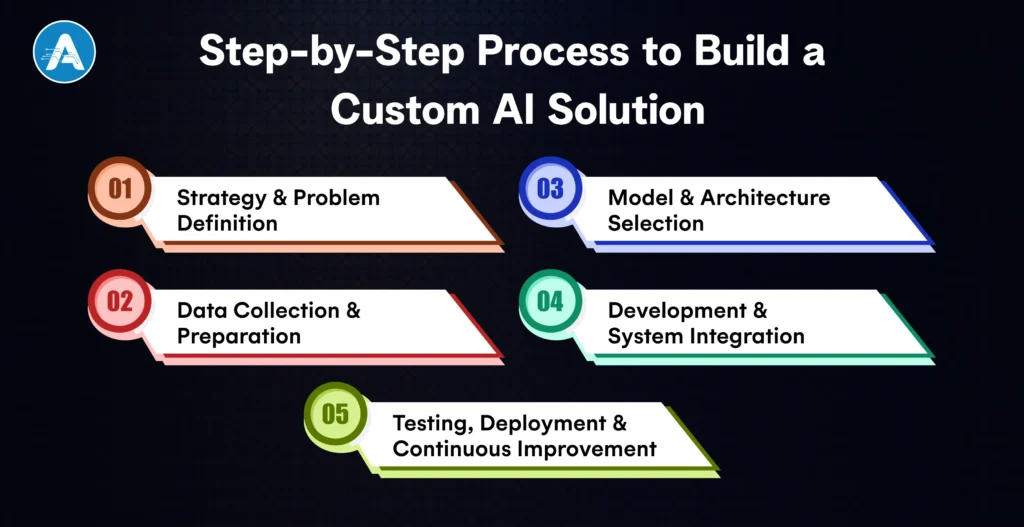
Step-by-Step Process to Build a Custom AI Solution
Creating a custom AI solution is a phased process that moves from strategy to execution. Each stage ensures the system is practical, scalable, and aligned with business impact.
Step 1: Strategy & Problem Definition
Everything begins with clarity. Define the exact business challenge and the outcome you expect. Are you aiming to reduce manual workload, improve customer response time, or enhance decision-making accuracy? Set measurable KPIs from the start. A focused objective ensures your custom AI solution delivers real ROI instead of becoming an experimental project.
Step 2: Data Collection & Preparation
AI performance depends on data quality. Gather relevant internal data such as transaction records, support conversations, operational logs, or CRM history. Clean the data, remove inconsistencies, and structure it properly for training. In AI customer service solutions, well-prepared historical conversations significantly improve response accuracy.
Step 3: Model & Architecture Selection
Choose the right technical approach based on your goal. Some use cases require predictive machine learning, while others benefit from NLP or an AI platform for custom LLM solutions. For complex automation, combining language models with retrieval systems enhances contextual understanding and reliability.
Step 4: Development & System Integration
This is where the system is built and connected to your existing infrastructure. It includes model training, backend APIs, cloud deployment, and integration with CRM, ERP, or helpdesk tools. A production-ready custom AI solution must prioritize scalability, monitoring, and security from the beginning.
Test thoroughly before rollout. Monitor accuracy, performance, and user feedback. Continuous refinement ensures long-term reliability, especially for AI for customer service solution implementations.
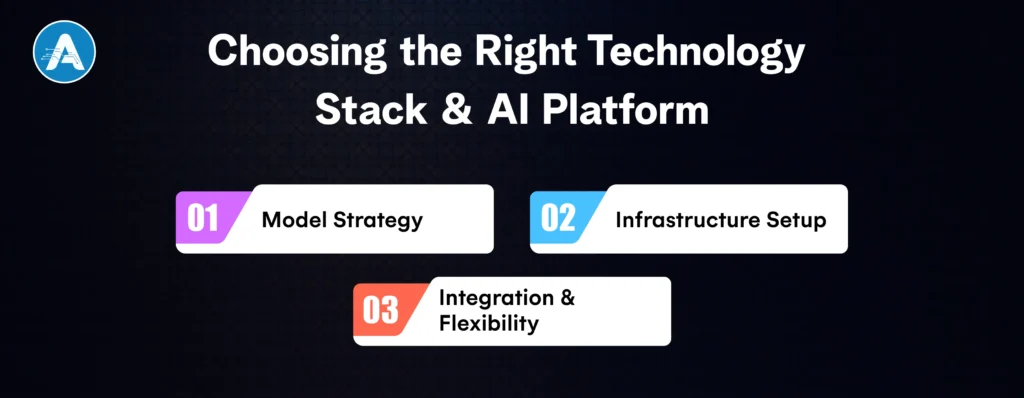
Choosing the Right Technology Stack and AI Platform
The technology behind your custom AI solution determines how well it performs today and how easily it scales tomorrow. Your use case, data maturity, and growth plans should drive this decision.
1. Model Strategy
Start by deciding the type of intelligence you need. Predictive tasks may require traditional machine learning models, while conversational systems often rely on advanced language models. For businesses building AI customer service solutions, combining large language models with retrieval mechanisms improves contextual accuracy and reduces hallucinations.
2. Infrastructure Setup
Next, choose where your system will run. Cloud environments offer flexibility and faster deployment, while on-premise infrastructure provides tighter control for sensitive data. The right setup depends on compliance requirements and scalability goals.
3. Integration & Flexibility
Your custom AI solution should connect smoothly with CRM systems, helpdesk tools, ERP platforms, or mobile applications. It must also allow ongoing updates, retraining, and performance monitoring without major redevelopment.
How Much Does a Custom AI Solution Cost?
Once you understand the development process and technology choices, the next practical question is investment. Planning the budget early helps avoid surprises and ensures your custom AI solution is built with long-term sustainability in mind.
The scope of the project plays the biggest role. A focused AI customer service solution that automates chat or ticket handling requires a smaller budget than a multi-department enterprise automation system.
Data condition also impacts pricing. If your historical data is clean and structured, development moves faster. If data needs cleaning, labeling, and restructuring, both time and cost increase.
Technology and infrastructure decisions such as cloud hosting, integrations, security layers, and monitoring systems further shape the final estimate.
A realistic custom AI solution estimate should focus not just on upfront cost, but on long-term ROI, efficiency gains, and operational savings
Should You Hire AI Developers or Build In-House?
The selection of an appropriate execution strategy is of paramount importance in the development of a custom AI solution. The following is a comparison of the good and the bad:
Build In-House
Applicable in case you already have experienced ML engineers and data scientists
Makes architecture and long-term evolution entirely controllable
Good where there are ongoing AI programs in companies
Best suited when your core product is based on a custom AI solution
Hire AI Developers
More expedited deployment through expert power
Less technical risk in the architecture and integration
More advanced implementation of sophisticated custom AI ML solutions
Better execution of AI customer service solutions at the level of production quality
Availability of specialists in terms of an AI platform to custom LLM solutions
Hybrid Approach
The first custom AI solution is developed and implemented by external experts
Internal team handles monitoring, optimization, and scaling
Moderate price, speed, and flexibility over the long term
Future of Custom AI Solutions in Business
As AI technology evolves, the role of a custom AI solution is shifting from simple automation to intelligent decision support and autonomous execution.
1. Hyper-personalized customer interactions
Advanced AI customer service solutions will adapt responses based on behavior, purchase history, and sentiment in real time.
2. AI copilots for employees
Customized AI solutions will assist teams in drafting emails, analyzing reports, generating insights, and accelerating workflows.
3. Autonomous AI agents
Future systems will handle multi-step tasks independently, especially in AI for customer support solutions and operational automation.
4. Industry-specific AI platforms
Businesses will increasingly adopt an AI platform for custom LLM solutions tailored to healthcare, finance, retail, and logistics.
Businesses investing early in custom-made AI solutions position themselves ahead of competitors in adaptability and innovation.
Final Thought
A custom AI solution is not just about adopting new technology; it’s about building intelligence tailored to your business model. When designed strategically, it improves efficiency, strengthens decision-making, and enhances customer experience in ways generic tools cannot match.
Whether you’re implementing AI customer service solutions, exploring custom AI ML solutions, or working with an AI application developer, success depends on clarity, data quality, and the right execution roadmap. Start focused, measure impact, and scale gradually.
In the long run, businesses that invest in customized AI solutions don’t just automate processes; they build a sustainable competitive advantage powered by their own data and innovation.
Planning for AI Project
Get clarity on use cases, architecture, costs, and timelines with insights from 50+ real-world AI implementations.
1. How long does it take to build a custom AI solution?
Most projects take between 2 and 6 months, depending on complexity, data readiness, and integration requirements.
2. What is a realistic custom AI solution estimate?
Costs vary based on scope and infrastructure. A focused AI customer service solution is more affordable than enterprise-wide custom AI ML solutions with multiple integrations.
3. Are AI customer service solutions suitable for small businesses?
Yes. Even small companies can benefit from AI for customer support solutions to reduce response time and improve customer satisfaction.
4. Do I need to hire AI developers?
If you lack in-house AI expertise, it’s often safer and faster to hire AI developers who understand architecture, deployment, and scalability.
5. How do customized AI solutions differ from ready-made AI tools?
Customized AI solutions are built around your specific data, workflows, and business goals, offering better accuracy and long-term control.
NLP in Healthcare is rapidly transforming how medical data is processed, analyzed, and utilized. With nearly 80% of healthcare data unstructured, ranging from clinical…
Hiring has always been one of the most critical and challenging functions for any organization. Yet, traditional recruitment processes often rely on manual screening,…