Picture this: you ask your phone to set a reminder, and it understands you perfectly. You open Netflix, and it already knows you’re in the mood for a thriller. Your email filters out spam before you ever see it. Behind all of this sits the same quiet force, artificial intelligence.
But what is AI, exactly? At its simplest, artificial intelligence is the ability of a computer system to perform tasks that would normally require human thinking. Things like recognising speech, making decisions, understanding language, or spotting patterns in mountains of data.
The term “artificial intelligence” was coined back in 1956 by computer scientist John McCarthy, who defined it as the science of making machines that can do things that would require intelligence if done by humans. Decades later, that definition still holds, but the technology has grown in ways McCarthy could barely have imagined.
Today, what is AI is one of the most-searched questions on the internet, and for good reason. AI is no longer a lab experiment or a sci-fi concept. It’s embedded in your smartphone, your bank’s fraud detection, your doctor’s diagnostic tools, and even the ads you see while scrolling. Understanding it isn’t just for engineers, it’s for everyone.
How Does AI Work? The Engine Under the Hood
Think about how you learned to recognise a dog as a child. Nobody handed you a rulebook. You saw dozens of dogs, big ones, fluffy ones, tiny ones, and your brain gradually built a mental model of “dog-ness.” That’s almost exactly how AI works. Through systems designed by an AI application developer using real-world data.
Instead of explicit instructions, most modern AI learns from examples. Feed it thousands of photos labelled “cat” and “not cat,” and over time, it builds its own internal set of rules for telling the difference. This process is called machine learning, and it’s the engine behind most AI today.
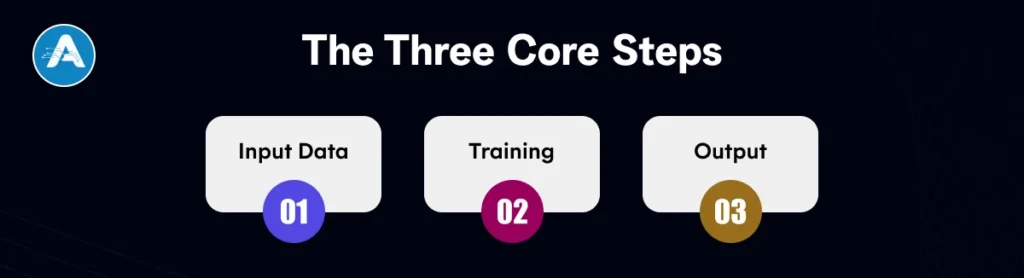
The Three Core Steps
Every AI system, no matter how complex, follows three fundamental steps to learn and make decisions.
1. Input Data
AI systems are fed huge amounts of data, text, images, numbers, and audio to learn from. Quality data is everything.
2. Training
The system processes data, adjusts its internal parameters, and gradually gets better at identifying patterns.
3. Output
Once trained, the AI makes predictions or decisions on new data it has never seen before.
A key concept here is feedback. When an AI gets an answer wrong, the system is corrected and adjusts itself. Repeat this millions of times, and the AI becomes remarkably accurate, not because someone programmed the right answer, but because it discovered the patterns on its own.
This is why AI artificial intelligence can feel almost magical. The system isn’t following a fixed script. It’s reasoning from experience, just like you would.
Types of AI: Not All AI is Created Equal
Here’s something that surprises most people: the AI that beats world champions at chess cannot drive a car. The AI that writes your emails cannot diagnose a medical scan. That’s because different types of AI are built for different jobs, and most are extremely narrow in scope.
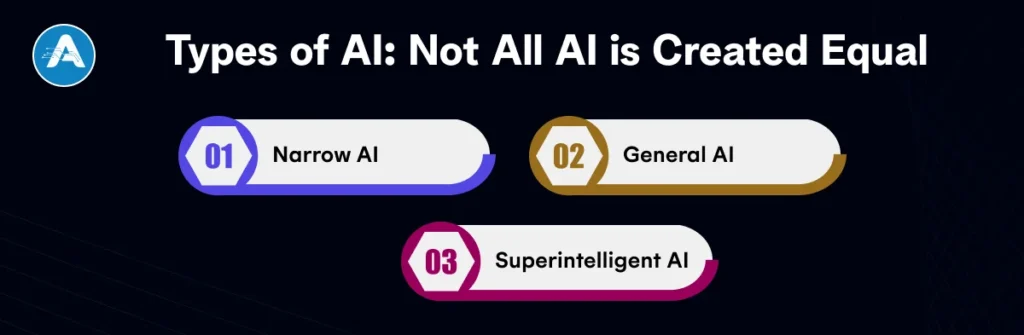
Broadly, researchers classify AI into three categories. Understanding these will completely change how you think about every AI program you encounter.
1. Narrow AI
Designed for one specific task. Think Siri, spam filters, recommendation engines, or image recognition tools. This is the only type of AI that actually exists today.
2. General AI
A hypothetical AI that can perform any intellectual task a human can, reasoning flexibly across completely different domains. Still in research territory.
3. Superintelligent AI
An AI that surpasses all human intelligence in every field, creativity, science, and social skills. Pure theory for now, and the subject of much philosophical debate.
Within Narrow AI, there are also useful subtypes worth knowing about. Reactive machines (like chess engines) respond to the present moment but have no memory. Limited memory AI uses short-term data to make decisions. Both are widely used AI programs that power billions of daily interactions.
AI Algorithms: The Brain Behind Artificial Intelligence
When people ask what is AI, they’re really asking how machines make decisions. The answer lies in AI algorithms, the core instructions that power every artificial intelligence system.
An artificial intelligence algorithm is simply a structured set of steps designed to solve problems using data. Think of it like a recipe: instead of ingredients, it uses data inputs; instead of cooking, it processes and learns patterns.
But unlike traditional programs, AI artificial intelligence systems improve over time by learning from experience. This is exactly how AI works: it adapts, refines, and becomes more accurate with more data.
1. Decision Trees
Decision trees work like a flowchart of yes/no questions. They break down decisions step by step, making them easy to understand and interpret. These AI programs are widely used in loan approvals, medical diagnosis, and customer service automation.
2. Neural Networks
Inspired by the human brain, neural networks consist of interconnected layers that process data. They are essential in modern artificial intelligence applications, such as image recognition, speech processing, and language understanding.
3. Reinforcement Learning
This approach teaches machines through trial and error. The system gets rewards for correct actions and penalties for mistakes, gradually improving its performance. It’s commonly used in robotics, gaming AI, and advanced automation systems.
4. Natural Language Processing (NLP)
NLP enables machines to understand and generate human language. It powers chatbots, translation tools, and virtual assistants. This is a key application of artificial intelligence in everyday digital experiences.
5. Deep Learning
Deep learning is a specialised branch of artificial intelligence algorithms that uses multi-layered neural networks. It handles complex tasks like facial recognition, medical image analysis, and large language models. This represents one of the most advanced levels of artificial intelligence in use today.
Applications of AI: Where It’s Already Changing Your Life
The clearest way to understand what is AI is to see where it shows up in your everyday routine. The application of artificial intelligence is no longer futuristic; it’s already embedded in the tools, platforms, and services you use daily.
At its core, AI artificial intelligence systems analyse data, recognise patterns, and make decisions. This is exactly how AI works across industries: the same underlying AI algorithms power completely different real-world use cases.
Industry
How AI Is Used
Real Example
Healthcare
Disease detection, drug discovery, patient risk scoring
AI detects breast cancer in mammograms with accuracy matching senior radiologists
Finance
Fraud detection, algorithmic trading, and credit scoring
Your bank flags unusual transactions before you even notice them
Google Maps uses AI to predict traffic and suggest faster routes in real time
Agriculture
Crop monitoring, pest detection, yield prediction
Drone-based AI systems scan fields and detect disease before it spreads
Final Thought
Let’s take a moment to appreciate how far we’ve come in just a few scrolls. You now understand what is AI, not the sci-fi caricature, but the real technology reshaping industries. You know the difference between types of AI, how AI algorithms learn from data, and the wide gap between the AI of today and the superintelligent AI of science fiction.
Most importantly, you understand that AI is not magic, and it’s not a threat from another world. It is a tool. And like any powerful tool, its true impact depends on how it’s built and used. Whether through a skilled AI development company, a dedicated AI application developer, or advanced AI application development services, the future of AI will be shaped by those who understand it and apply it wisely.
Planning for AI Project
Get clarity on use cases, architecture, costs, and timelines with insights from 50+ real-world AI implementations.
AI systems are developed by experts, such as an AI application developer or an AI development company. They design and implement solutions using modern AI application development services for businesses across industries.
2. Is AI replacing humans?
No. While AI automates tasks, it is designed to assist, not replace, humans. It enhances productivity and helps people make better decisions rather than eliminating human involvement.
3. What are AI algorithms?
AI algorithms are the step-by-step instructions that allow machines to process data and make decisions. An artificial intelligence algorithm can learn from data and improve its performance over time, unlike traditional fixed programs.
4. What is the difference between AI and machine learning?
Artificial intelligence is the broader concept of machines performing intelligent tasks. Machine learning is a subset of AI that allows systems to learn from data using AI algorithms without being explicitly programmed for every scenario.
5. What is deep learning in AI?
Deep learning is an advanced area of AI artificial intelligence that uses multi-layered neural networks. It enables systems to handle complex tasks like image recognition, speech processing, and natural language understanding.
NLP in Healthcare is rapidly transforming how medical data is processed, analyzed, and utilized. With nearly 80% of healthcare data unstructured, ranging from clinical…
Hiring has always been one of the most critical and challenging functions for any organization. Yet, traditional recruitment processes often rely on manual screening,…
Artificial intelligence has evolved rapidly over the past decade, especially with the rise of large language models (LLMs) and generative AI systems. However, one…