
We’ve all witnessed how artificial intelligence has grown from an emerging concept into a business-critical advantage. In real projects we’ve worked on, Artificial Intelligence Development Companies have helped teams make faster decisions, automate repetitive tasks, and improve performance in ways you can actually measure.
Industry studies indicate that the global AI market is expected to reach $360 to $540 billion by 2026, with the U.S. market alone projected to exceed $300 billion, underscoring the rapid adoption of AI by businesses. Companies using AI report 25 to 55% productivity improvements, which explains why AI is delivering real business value today, from automating customer support and understanding customer behavior to accurately predicting market demand and helping businesses operate smarter and faster.
In this blog, we’ll explore the top AI companies along with global leaders that reshape the market much faster than most people expect. Together, we’ll look at how these companies are turning AI into practical, results-driven solutions that businesses can actually rely on.
You may also want to know the AI Development Agency
Choosing the Right Artificial Intelligence Development Companies
Artificial intelligence development companies bring a wide range of expertise to the table. Some focus on advanced research, others specialize in enterprise-scale deployments, while many emerging AI firms excel at solving specific business challenges with precision.
When evaluating artificial intelligence development companies, the key question is not who is using AI but who is delivering measurable business results with AI.
Successful AI adoption depends on a few basic factors:
- Well-prepared data that AI can use properly
- Clearly defined goals for what the business wants to achieve
- AI solutions that can expand as the business grows
- Continuous support to keep AI systems accurate and effective
The best AI development companies do more than build AI models. They help you use AI in daily business processes to improve customer experience, reduce costs, and create new revenue opportunities.
How to Choose the Best AI Development Companies?
Choosing the best AI development companies means focusing on factors that matter most for real business success. Our evaluation covered a wide range of artificial intelligence development companies, including top AI companies, best AI companies, and up-and-coming artificial intelligence development companies, to provide a balanced and practical perspective.
We analyzed how artificial intelligence development companies and AI development companies build, deploy, and scale AI solutions across real-world use cases. The evaluation focused on successful real-world AI deployments, strong expertise in AI engineering and research, and the ability to scale AI solutions across different industries. We also assessed ongoing innovation in generative AI, machine learning, and automation.
In addition, we reviewed the commitment of AI solutions companies and artificial intelligence solution companies to trust, ethical AI practices, and responsible data governance. This structured approach ensures the artificial intelligence development companies featured here deliver meaningful and measurable business impact, not just popularity.
Top AI Development Companies
Artificial Intelligence solution companies drive innovation by helping businesses adopt intelligent technologies that improve efficiency and decision-making. The best AI companies stand out for their ability to build scalable AI solutions that deliver real business value. These companies are shaping how organizations across various industries utilize AI to drive growth and remain competitive.
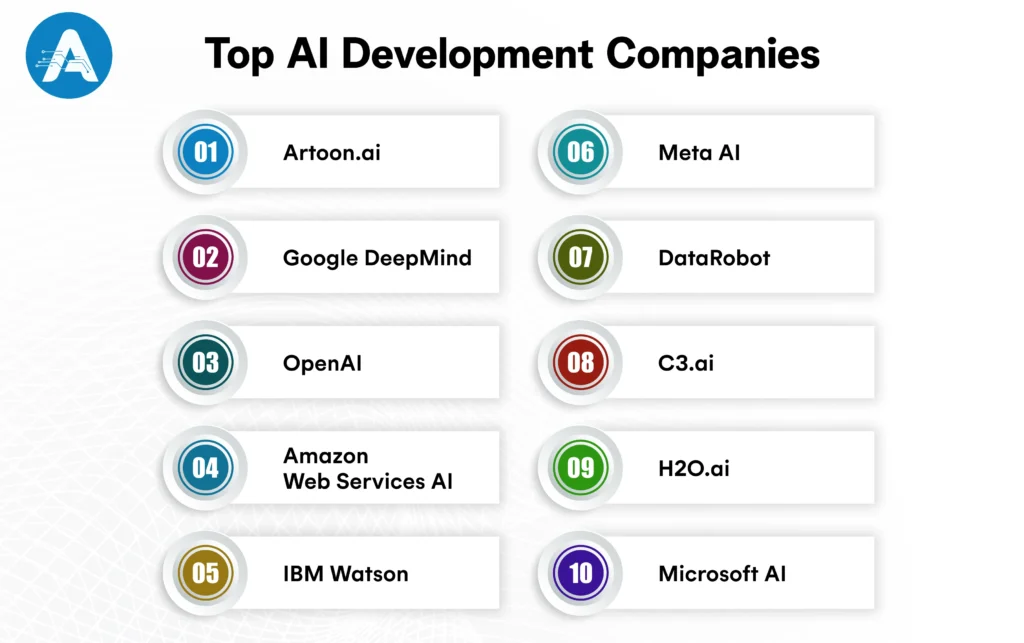
1. Artoon.ai
When businesses search for reliable artificial intelligence development companies that deliver real business impact, Artoon.ai stands out for its practical and scalable AI capabilities.
Artoon.ai is a leading AI development company specializing in intelligent solutions that help organizations automate operations, improve decision-making, and enhance user experiences. The company brings strong expertise in artificial intelligence, machine learning, data-driven applications, and intelligent automation, all tailored to meet specific business requirements. From predictive analytics and AI-powered applications to smart recommendation engines and workflow automation, Artoon.ai enables businesses to adopt AI with clarity and confidence.
This artificial intelligence development company is an ideal choice for organizations seeking dependable AI services aligned with operational efficiency and long-term business growth.
Key Highlights:
- Advanced AI and machine learning capabilities
- Real-world AI applications across business and industry use cases
- Scalable, enterprise-ready AI solutions built for long-term growth
2. Google DeepMind
When people talk about artificial general intelligence companies, Google DeepMind is often the first name that comes up.
DeepMind is one of the most advanced artificial intelligence development companies in the world. It has made strong progress in machine learning, healthcare AI, and scientific research. A well-known example is AlphaFold, an AI system that helps scientists understand protein structures much faster. This was a problem that earlier took many years to solve manually. Today, this technology is helping researchers speed up medical discoveries and improve healthcare outcomes.
This AI development company is ideal for enterprises and institutions seeking cutting-edge AI research translated into practical solutions.
Key Highlights:
- Industry-leading research
- Real-world applications in healthcare and science
- Backed by Google’s infrastructure
3. OpenAI
When people discuss innovative AI development companies, OpenAI is one of the most talked-about names worldwide.
OpenAI is recognized for developing advanced AI models that enable businesses to automate tasks, enhance customer communication, and generate content at scale. Many companies use OpenAI tools for chatbots, customer support automation, and data analysis. These solutions enable teams to work faster and make more informed decisions using AI.
Among global AI investment companies, OpenAI is ideal for businesses seeking to quickly adopt practical AI solutions with minimal infrastructure requirements.
Key Highlights:
- Strong expertise in generative AI
- Widely used AI models across industries
- Easy integration for business applications
4. Amazon Web Services AI
Amazon Web Services is one of the most widely used artificial intelligence solution companies in the world.
AWS AI helps businesses build, train, and deploy machine learning models using cloud services. Companies use AWS AI for demand forecasting, recommendation systems, and operational automation. It supports both small AI companies and large enterprises.
As one of the reliable AI solutions companies, it is a strong choice for businesses seeking flexible and cost-effective AI solutions.
Key Highlights:
- Highly scalable AI services
- Wide range of machine learning tools
- Used by startups and enterprises alike
5. IBM Watson
IBM Watson is one of the most trusted artificial intelligence development companies, especially for large enterprises and regulated industries.
IBM Watson focuses on using AI to support healthcare, finance, and government organizations. Through its AI application development services, it helps analyze large volumes of data, improve decision-making, and maintain transparency in AI-driven processes. Many enterprises rely on IBM Watson for secure and reliable AI adoption.
This artificial intelligence development company is well-suited for organizations that need responsible and explainable AI solutions.
Key Highlights:
- Strong focus on enterprise AI and AI application development services
- Trusted by global organizations
- Emphasis on data security and governance
6. Meta AI
Meta AI is recognized as one of the top AI companies applying artificial intelligence at a massive global scale.
Meta uses AI to improve content recommendations, image recognition, and language understanding across its platforms. It also supports open research initiatives that help advance AI development worldwide and benefit the broader technology community.
It is one of the well-known artificial intelligence solution companies that helps businesses with social, visual, and language-based AI solutions.
Key Highlights:
- Strong AI research initiatives
- Large-scale real-world AI applications
- Focus on language and computer vision
7. DataRobot
DataRobot is one of the fastest-growing small AI companies focused on business users.
It helps companies use AI without needing deep technical expertise. Its platforms allow teams to build and deploy AI models quickly for forecasting, risk analysis, and process optimization. By simplifying complex AI processes, DataRobot enables businesses of all sizes to gain actionable insights faster.
Many organizations choose DataRobot because it combines ease of use with powerful AI capabilities, making it one of the most reliable options among small AI companies. This approach helps businesses improve efficiency, reduce costs, and make smarter data-driven decisions.
Key Highlights:
- User-friendly AI platforms
- Faster time to business value
- Strong focus on automated machine learning
8. C3.ai
C3.ai delivers AI applications designed for large-scale business operations.
The company serves industries such as manufacturing, energy, and logistics, providing AI solutions that help organizations improve efficiency, reduce costs, and streamline complex processes. By offering practical and scalable AI tools, C3.ai supports businesses in making smarter, data-driven decisions.
As one of the reliable artificial intelligence development companies, it provides enterprises with trusted AI solutions for large operational datasets.
Key Highlights:
- Industry-focused AI solutions
- Strong enterprise adoption
- Practical AI for improving operational efficiency
9. H2O.ai
H2O.ai is a well-known name among up-and-coming artificial intelligence development companies.
It provides open source and enterprise AI tools that help businesses build transparent and reliable AI models. Many financial and healthcare organizations use H2O.ai for predictive analytics, risk management, and operational decision-making. By simplifying complex AI processes, H2O.ai enables businesses to adopt AI faster and more effectively.
This artificial intelligence development company is suitable for businesses that value flexibility, explainable AI, and scalable solutions. Its platforms are designed to support both small AI teams and large enterprises, making it a practical choice for organizations at any stage of AI adoption.
Key Highlights:
- Strong open-source AI community
- Focus on transparent and explainable AI
- Used across regulated industries
10. Microsoft AI
Microsoft AI is among the top AI companies helping businesses adopt artificial intelligence at scale.
Microsoft integrates AI into everyday business tools, including cloud platforms, productivity software, and enterprise systems. This makes it easier for companies to utilize AI for automation, forecasting, and customer insights without having to rebuild their existing systems. By combining powerful AI capabilities with familiar tools, Microsoft helps teams work smarter, faster, and more efficiently.
This artificial intelligence development company is ideal for businesses that want smooth, scalable, and reliable AI implementation. Its solutions support both small businesses and large enterprises, making AI adoption simpler and more effective across industries.
Key Highlights:
- Deep integration with business software
- Scalable cloud-based AI solutions
- Strong global enterprise adoption
Small AI Companies Creating an Impact
If we focus on small AI companies, then we can analyze that some of the most exciting AI ideas are coming from small, focused companies, where we can clearly see AI creating real value.
Startups are creating AI tools that tackle real-world challenges, from catching fraud before it happens to helping doctors make faster and more accurate diagnoses to streamlining complex supply chains. These are exactly the kinds of projects where an AI application developer can step in and build solutions that truly solve problems, making technology work in ways that feel practical and meaningful in everyday life.
These small AI companies are gaining attention for their innovative ideas, strong growth prospects, and the ways they are transforming how we live and work.
AI Funding Is Driving Startup Growth
The recent boom in AI investments is sparking exciting innovation across the AI world. Venture capitalists and corporate investors are backing artificial intelligence solution companies that are creating real impact worldwide.
Moreover, funding is increasing for areas such as generative AI platforms, AI tools created for specific industries, and ethical and explainable AI. For you as a business leader, this means more opportunities and more choices when it comes to working with the right AI partner to achieve your goals.
You may also want to know AI Website Builder
How to Choose the Best AI Companies for Your Business?
Choosing the right partner from top artificial intelligence development companies means finding one that understands your business, can make sense of your data, and builds solutions that grow with you. The following points enable you to find the best artificial intelligence development companies that fit your business requirements:
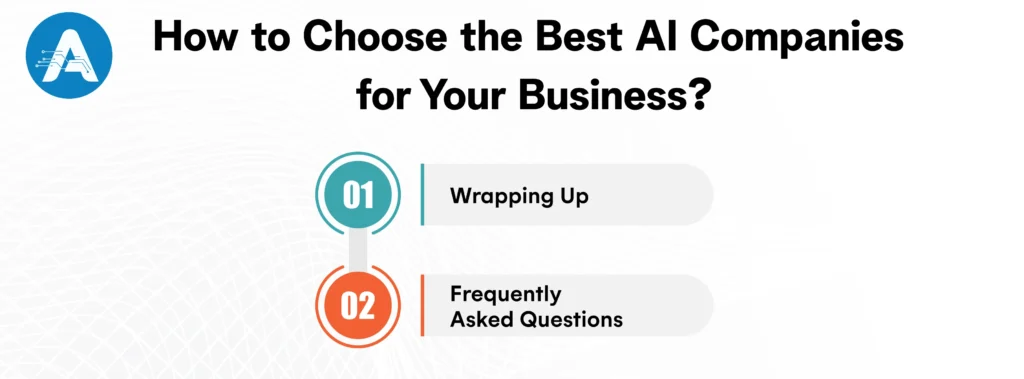
- Focus on AI solutions companies that understand your business goals and help solve real problems, not just showcase the latest technology.
- Ensure that artificial intelligence development companies possess strong data expertise to help you clean, organize, and enable you to get the most out of your data so you can make smarter decisions.
- The reliable, up-and-coming artificial intelligence development companies create AI systems that grow with your business, ensuring your solutions remain effective as your needs expand.
- Leading artificial general intelligence companies should follow transparency and ethical practices to build long-lasting relationships with valuable clients.
- Ensure that the top AI companies stay with you after launch, helping you continuously refine and improve your solutions as your business evolves.
Wrapping Up
Artificial intelligence is not just a trend for the future. It is something you need today to help your business work smarter, make better decisions, and grow stronger. The artificial intelligence development companies are helping businesses of all sizes to operate more efficiently, compete more effectively, and deliver real results globally.
Whether you are working with global leaders or exploring up-and-coming artificial intelligence companies, the important thing is to work with partners who understand your goals and can deliver real results.”
Indeed, AI works best when it is practical, purposeful, and directly aligned with business needs. When you choose the right AI development company, you are not just adopting technology; you are creating a smarter and more resilient future for your business.
Artificial intelligence has transitioned from boardroom discussions to everyday business applications. What once felt experimental has now become essential. According to Stanford University’s 2025 report, 78% of organisations are using an AI development agency in at least one core business function, up from 55% in 2023, indicating how quickly adoption is accelerating. This rapid shift makes one thing clear: AI is no longer optional; it’s a must for businesses that want to stay competitive.
However, I’ve seen firsthand while working with both startups and established companies that bringing AI into a business is easy, but deriving real value from it is not. Many organisations partner with AI vendors, expecting quick transformation, only to encounter delayed timelines, rising costs, and solutions that appear impressive in demos but fail to deliver real results. The outcome is often frustration, wasted investment, and leadership left wondering whether AI was worth the effort at all.
That’s why choosing the right AI development company matters more than ever. In this blog, I’ll share a practical, experience-based approach to finding an AI partner who truly understands your business goals. Supported by real statistics, proven frameworks, and insights from actual projects, this guide will help you avoid costly missteps and utilize AI to genuinely grow your business, rather than treating it as just another tech experiment that fades away.
Why Is It Important to Choose The Right AI Development Partner?
When AI is implemented correctly, it can become a strong driver of business growth. It helps automate everyday tasks, turns data into meaningful insights, and creates new opportunities for innovative business models.
However, choosing the wrong partner can quickly reverse these benefits. Many businesses face projects that take far longer than expected, systems that are difficult to maintain or scale, and AI solutions that fail to align with real business goals. In the end, this often leads to wasted investment and little to no meaningful return, leaving teams frustrated and leadership disappointed with the results.
Studies indicate that the global AI market is growing rapidly and is expected to more than double in value over the next few years. This surge has created massive demand for AI expertise, and as a result, many companies now claim to be AI specialists.
The fact is, while many companies talk confidently about AI, only a few actually know how to turn it into real business results. That’s why choosing the right generative AI agency isn’t just a good decision; it plays a critical role in how successful your AI journey will be.
How to Choose A Reliable AI Development Agency?
Choosing the right AI partner doesn’t have to be complicated. The following step-by-step process helps you identify an AI development agency that truly understands your business needs. It ensures you invest in solutions that create long-term value, not just short-term wins.
Let’s move ahead to explore the process that helps you in finding an AI partner that truly understands your business and delivers results.
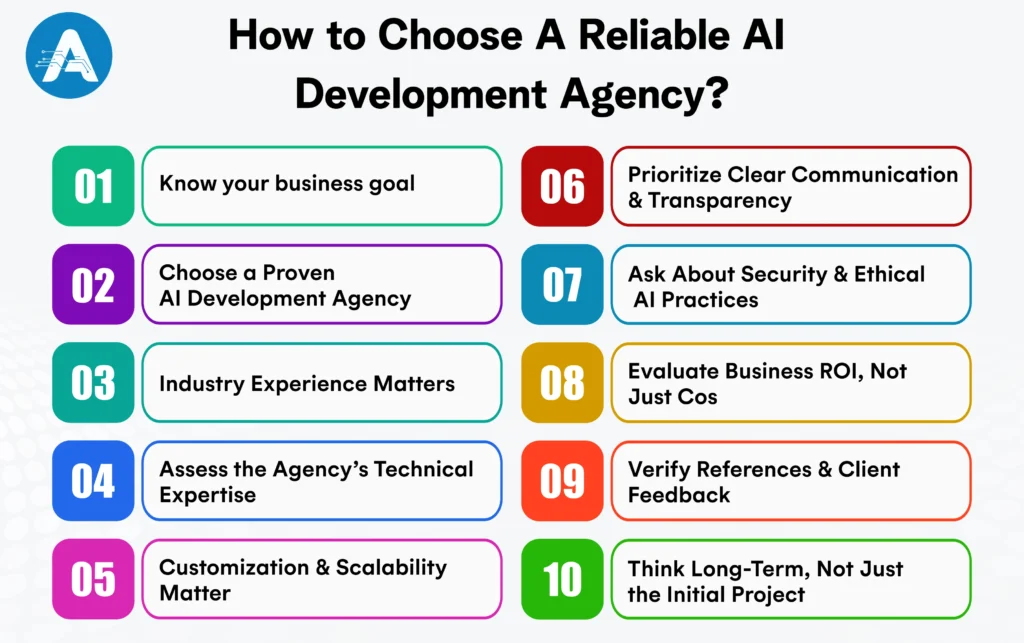
1. Know your business goal
Before searching for an AI partner, take time to clearly understand what you want your AI initiative to achieve. A well-defined goal sets the foundation for a successful project.
Consider these points:
- What specific business challenge do we want AI to solve?
- Will this solution interact directly with customers, such as a chatbot or mobile app?
- Or is it meant to improve internal operations through automation or data-driven insights?
- How will we measure success higher revenue, reduced costs, improved efficiency, or stronger customer retention?
When your goals are clear, it becomes easier to avoid generic proposals and select an AI development partner that truly understands your vision and can deliver meaningful results.
2. Choose a Proven AI Development Agency
Not every AI Development agency that talks about AI actually builds intelligent systems. You need a partner with hands-on experience, one that delivers real, working AI solutions rather than just industry buzzwords.
When evaluating an AI development agency, look for:
- Documented case studies that demonstrate measurable business results
- Experience working within your specific industry
- Strong technical expertise in leading AI frameworks such as TensorFlow, PyTorch, and cloud-based AI platforms
- Proof of successful AI deployments, not just experimental prototypes
- A strong portfolio reflects real-world AI impact and shows the agency’s ability to turn ideas into scalable, business-ready solutions.
3. Industry Experience Matters
Different industries have unique requirements. An AI solution for healthcare must comply with HIPAA and protect sensitive patient data, while AI projects in finance require strong risk management and regulatory compliance. An AI development agency without relevant industry experience may deliver a solution that looks impressive on paper but fails in real-world use.
Before signing a contract, ensure that:
- They understand your industry’s workflows and processes
- They have successfully delivered similar solutions for clients in your sector
- They are familiar with industry regulations and practical business constraints
- This helps ensure the AI solution is effective, compliant, and built for long-term success.
4. Assess the Agency’s Technical Expertise
AI isn’t a single tool, but a combination of advanced technologies working together, such as machine learning, neural networks, natural language processing, generative AI models, strong data pipelines, and reliable deployment practices.
A trustworthy AI development agency should clearly explain not only what they will build, but also how the solution will be designed, trained, and maintained. Working with an experienced AI application developer ensures that your AI solution is built efficiently, is scalable, and delivers real business value.
Before partnering, ask questions like:
- Do they create custom models or adapt existing ones?
- Which programming languages, platforms, and frameworks do they use?
- How do they manage data quality, updates, and ongoing model improvements?
5. Customization and Scalability Matter
AI solutions don’t follow a one-size-fits-all approach. Your business goals, data, and challenges are unique, and your AI solution should be customized accordingly.
Before choosing an AI partner, make sure to check:
- Do they provide custom AI development services tailored to your needs?
- Can the solution scale smoothly as your business and data grow?
- Do they offer ongoing support, monitoring, and regular model updates?
The best AI agencies don’t deliver static tools, but they build flexible, future-ready systems that grow and adapt alongside your business.
6. Prioritize Clear Communication and Transparency
Many AI projects fail not because of technology, but due to poor communication.
A reliable AI development agency should:
- Break down complex AI concepts into simple, business-friendly language
- Clearly define project scope, timelines, and deliverables from the start
- Share regular progress updates using tools like Jira, Slack, or Trello
- Provide a clear roadmap with milestones, so you always know what comes next
If you walk away from early discussions feeling unclear or overwhelmed, it’s a strong warning sign.
7. Ask About Security and Ethical AI Practices
AI solutions often handle sensitive business and customer data, making security and ethics critical.
Ensure your AI partner follows best practices such as:
- Strong data privacy and protection policies
- Secure data encryption and access controls
- Compliance with regulations like GDPR, HIPAA, and industry standards
- Ethical AI practices that reduce bias and ensure fair, responsible outcomes
Security and ethics aren’t optional; they safeguard both your data and your brand reputation.
8. Evaluate Business ROI, Not Just Cost
While budget is important, choosing the lowest-priced option can be costly in the long run.
Instead, ask:
- What measurable ROI can this AI solution deliver?
- How will it reduce costs, improve efficiency, or generate revenue?
- What are the long-term expenses for maintenance, scaling, and upgrades?
A credible AI services agency will help you estimate business impact, not just quote a project fee.
9. Verify References and Client Feedback
Always ask for client references and take the time to speak with them directly.
Key questions to ask past clients include:
- Was the project delivered on time and within budget?
- Did the AI solution produce real, measurable business results?
- How responsive and transparent was the agency throughout the project?
Honest client feedback reveals far more than sales presentations ever will.
10. Think Long-Term, Not Just the Initial Project
AI isn’t a one-time implementation as it grows and evolves with your business.
Before committing, clarify:
- Who will maintain and monitor the AI models?
- How often will models be retrained as data changes?
- Will the agency support future upgrades, features, and scaling needs?
Choose an AI development agency that views your business as a long-term partner, not a short-term contract.
You may also want to know AI App Development Services
Key Questions to Ask Before Choosing an AI Partner
Before choosing an AI partner, it’s important to ask the right questions. These conversations can quickly show whether an AI software development agency is focused on delivering real results or just selling a service.
How do you measure the success of an AI project?
A good partner will talk about success in terms of your business goals, such as improving customer retention, increasing revenue, or saving time through automation.
How is your AI approach different from others in the market?
Strong agencies explain their process clearly and focus on step-by-step development instead of using one-size-fits-all solutions.
How do you ensure data privacy and security?
Your AI partner should follow strict data protection practices and be transparent about how your data is stored, used, and secured.
What kind of support do you offer after the AI solution is launched?
The best agencies don’t disappear after launch. They offer ongoing monitoring, improvements, and support to make sure the AI continues to perform well.
By asking these questions, you can know the difference between agencies that only build a solution and those that support your growth over time.
Avoid Common AI Project Mistakes
Even experienced business leaders often face challenges when implementing AI. Here are some of the most common mistakes that businesses make and practical tips on how to avoid them.
- Always define what you want to achieve from the start, as if you don’t clearly set your goals, you won’t be able to tell if the project worked or not.
- Many agencies claim to be AI experts, but not all deliver results. Focus on partners with real experience, case studies, and proven outcomes.
- AI affects not just systems, but people, too. Plan for training, adoption, and support to make sure everyone can work effectively with the new tools.
- AI only works well if the data is good. Messy or poor-quality data can lead to wrong results, so make sure your agency cleans and organizes its data properly.
- Technology alone isn’t enough. AI should directly help your business goals, so ask how each feature will create real value.
- AI needs ongoing care. Without monitoring and updates, performance can drop over time. Make sure your partner provides long-term support and maintenance.
You may also want to know Artificial Intelligence Development Companies
Estimating the Budget For Your AI Project
AI project costs can differ greatly depending on complexity and scope. Simple AI integrations are usually lower in cost and quicker to implement. Custom AI solutions require a moderate investment, while enterprise-level projects often need a larger budget and phased delivery. The key is to focus on the value AI brings, not just the price.
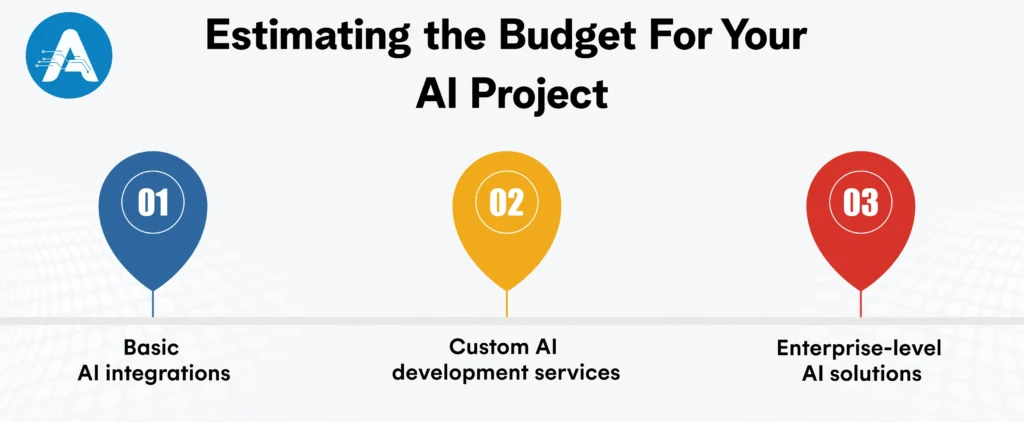
Based on the points mentioned below, the cost of AI projects can vary:
- Basic AI integrations- Affordable and fast to implement
- Custom AI development services- Medium investment for solutions built to fit your needs
- Enterprise-level AI solutions- Larger budget, delivered in stages for complex projects
Focus on value, not just cost. An AI solution from a trusted AI development agency that improves revenue, customer experience, or efficiency often pays for itself quickly.
Conclusive Statement
Choosing the right AI development agency for artificial intelligence development services can do more than just automate tasks. It can help your business grow, innovate, and stay competitive. Success begins with defining clear business goals and understanding what AI can realistically achieve. It is essential to carefully evaluate potential partners, considering their experience, past results, and communication skills. Take the time to ask the right questions and learn from real success stories to guide your decisions. By following this approach, your AI project will not be just another technology initiative; it can become a true strategic advantage that delivers meaningful results for your business.
Artificial intelligence has moved beyond future predictions and is now driving real-world innovation across modern digital businesses. From AI chatbots that handle customer support in seconds to predictive systems that reduce operational costs, AI development services are transforming how organisations operate. Studies show that over 70% of enterprises have adopted AI in at least one business function, with many reporting significant improvements in productivity and decision-making.
For example, a global e-commerce company implemented AI-driven recommendation engines and customer support automation, resulting in higher conversion rates and faster issue resolution. This growing impact has pushed businesses to invest in AI app development services and partner with experienced AI development agencies to build intelligent, scalable applications that deliver long-term value.
How AI Development Services Are Shaping the Future of Digital Business?
The digital age is defined by speed, scale, and data. Every click, transaction, and interaction generates information that can be transformed into intelligence with the right tools. Artificial intelligence development services enable businesses to convert raw data into predictive insights, automated workflows, and intelligent applications that drive efficiency and growth.
AI development services are shaping the future of digital business by enabling automation at scale, personalized customer experiences, and data-driven decision-making. Companies using AI report higher productivity, faster decisions, and improved customer engagement, which explains the rising demand for AI development services in USA and worldwide.
Moreover, organisations now view AI not as a cost, but as a strategic investment. Unlike traditional software, AI systems continuously learn and improve. This ability to adapt to changing data and customer behavior allows businesses to respond quickly to market shifts and stay competitive in an increasingly dynamic digital environment.
What Are AI App Development Services?
AI app development services involve creating intelligent applications powered by machine learning, natural language processing, computer vision, and predictive analytics. An experienced AI development company designs these applications to learn from data, adapt to user behavior, and continuously improve over time, unlike traditional software.
These services typically include:
- Data collection, preparation, and preprocessing
- Model selection, training, and validation
- Intelligent application design and system integration
- Deployment, performance monitoring, and ongoing optimization
A skilled AI software development agency ensures that AI-powered applications are not only technically robust but also aligned with business goals, scalable for future growth, and compliant with security and regulatory standards.
What Are the Main Types of AI App Development Services
AI app development services cover a wide range of solutions designed to help businesses and developers integrate artificial intelligence into their applications. The main types of AI app development services typically include:
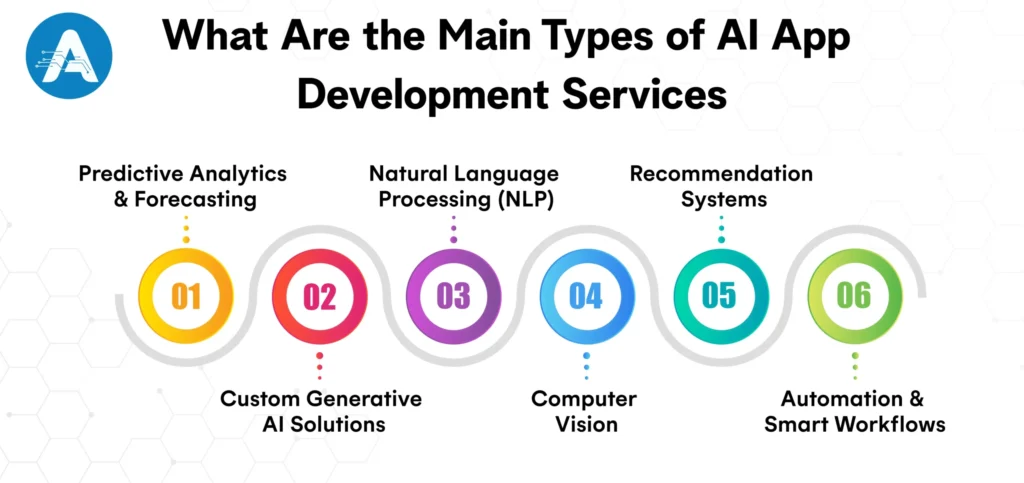
Predictive Analytics and Forecasting:
Predictive analytics uses historical and real-time data to forecast future outcomes such as demand, sales trends, or financial risk.
For example, manufacturers use AI to analyze sensor data and predict equipment failures early, reducing downtime and extending machine life.
Custom Generative AI Solutions:
Custom generative AI development services enable applications to generate text, images, code, and creative assets tailored to business needs.
For example, marketing teams use custom generative AI to quickly create ad copy and visuals, helping them launch campaigns faster, test ideas easily, and maintain a consistent brand voice.
Natural Language Processing (NLP):
NLP allows applications to understand, analyze, and generate human language. Common use cases include chatbots, document analysis, sentiment analysis, and summarization.
For example, financial institutions use NLP-powered AI to understand customer queries, automate support, and quickly review documents for compliance, saving time and reducing manual work.
Computer Vision:
Computer vision enables applications to interpret images and videos for inspection, detection, and analysis.
For example, hospitals use AI to analyze medical images, helping doctors detect conditions earlier, prioritize urgent cases, and speed up diagnoses without compromising accuracy or compliance.
Recommendation Systems:
Recommendation engines personalize product, content, or service suggestions using user behavior and contextual data.
For example, a mid-sized e-commerce brand used AI-powered recommendations to suggest relevant products based on customer behavior, leading to higher order values and more repeat purchases.
Automation and Smart Workflows:
AI-driven automation enhances traditional workflows through intelligent routing, decision-making, and document processing.
For example, fintech companies use AI to monitor transactions in real time, catching fraud more accurately while reducing false alerts and operational costs.
You may also want to know Hiring AI Developers
Why Businesses Choose Custom AI Development Services
Pre-built AI tools may enable faster deployment, but they often lack the flexibility required for complex and evolving business environments. This is why many organizations opt for custom AI development services tailored to their unique data, workflows, and long-term objectives.
Key Benefits of Custom AI Solutions
- AI models trained on your own data deliver more accurate, relevant insights tailored to your specific business needs.
- Custom AI solutions seamlessly integrate with existing tools, platforms, and workflows, minimizing disruptions to operations.
- Unique, business-specific AI capabilities help you stand out in the market and are difficult for competitors to replicate.
- Scalable AI architectures ensure your solutions grow and adapt as your business requirements change over time.
The Role of a Custom AI Development Partner
When businesses choose custom AI development services, they go beyond adopting technology and build long-term partnerships with experts who design AI solutions for real business needs. While pre-built AI tools offer quick results, customization becomes essential when the data is unique, the requirements are complex, or scalability is a concern.
Custom AI solutions are especially valuable for organizations that handle proprietary data, have strict privacy or compliance requirements, or need to integrate legacy systems. A trusted AI development agency follows a collaborative approach that includes clear goal setting, model development, secure deployment, and ongoing optimization using MLOps (Machine Learning Operations) best practices.
By partnering with an AI provider focused on long-term collaboration, organizations achieve stronger returns on investment and sustained innovation.
AI App Development Services for Smarter Applications
Building an AI-powered app is easier with the right guidance. AI app development services work closely with your team to create intelligent, scalable applications that utilize machine learning, natural language processing, and predictive analytics, ensuring your solution delivers real value while maintaining safety and responsibility.
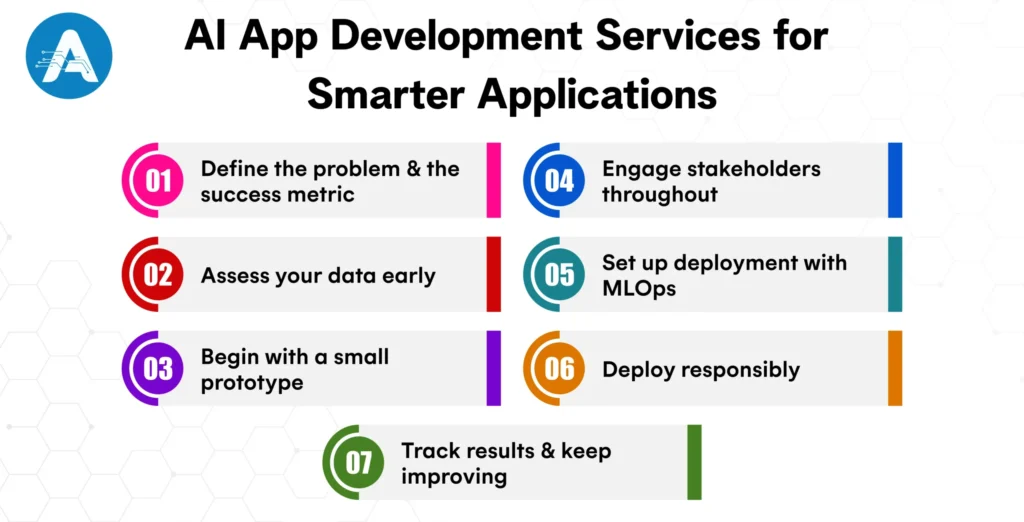
Define the problem and the success metric:
Start by clearly identifying the business challenge you want AI to solve and deciding how you will measure success. This could mean reducing customer churn, improving prediction accuracy, or speeding up key decisions.
Assess your data early:
Take a close look at the data you already have. Good AI development services start by checking data quality, volume, labeling accuracy, potential biases, and any regulatory or privacy constraints.
Begin with a small prototype:
Create a lightweight proof of concept to test whether your idea works before committing to full development. Many artificial intelligence development services teams use this approach to save time and cost while validating feasibility.
Engage stakeholders throughout:
Keep business users and domain experts involved from the start. Their feedback helps refine the model, ensures accuracy, and builds confidence in the AI system.
Set up deployment with MLOps:
Prepare your model for real-world use by establishing monitoring, performance tracking, retraining triggers, and rollback plans. This keeps your AI running smoothly and reliably.
Deploy responsibly:
Think about privacy, fairness, and transparency from the beginning. For regulated industries, include governance, documentation, and audit trails to stay compliant.
Track results and keep improving:
AI is not something you set up once and forget. Keep an eye on your results, update your models as new data comes in, and adjust for changing user behavior. Regularly refining your AI ensures it continues to deliver meaningful results for your business.
How to Choose the Right AI Development Agency
Picking the right partner for your AI journey is crucial. Whether you are looking for artificial intelligence development services in USA, the right agency can make all the difference. Here’s what to look for:
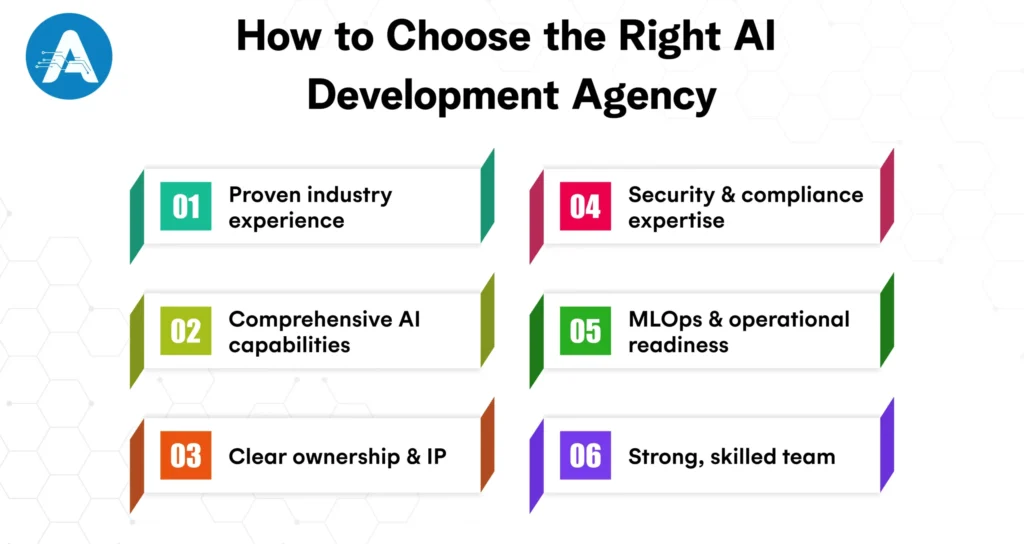
- Proven industry experience: Check for real case studies that demonstrate measurable results and tangible business impact.
- Comprehensive AI capabilities: Ensure the agency can handle everything from data engineering and model development to user experience design and deployment.
- Clear ownership and IP: Confirm who owns the models, code, and any data transformations.
- Security and compliance expertise: Look for experience with regulated data and adherence to privacy and governance standards.
- MLOps and operational readiness: Make sure the agency can deliver production-ready monitoring, orchestration, and model maintenance.
- Strong, skilled team: A mix of data scientists, machine learning engineers, DevOps experts, and product designers is essential for project success.
Working with a local AI development agency in the USA that combines domestic presence with global talent can simplify legal, compliance, and procurement processes while giving you access to top-notch expertise. Choosing a partner who understands your business goals and works closely with your team ensures your AI initiatives deliver real value.
You may also want to know the AI Development Agency
The Power of Generative AI for Smarter Solutions
Generative AI is one of the most powerful innovations today. With custom generative AI development services, your business can build AI systems that produce text, images, videos, and even software code, helping your team work faster, smarter, and more creatively.
Practical Applications of Generative AI
- Automated content creation: Effortlessly generate blogs, emails, and ad copy while keeping your brand voice consistent.
- AI-powered chatbots: Build chatbots that interact naturally with customers, providing human-like conversations.
- Product design and prototyping: Quickly visualize new ideas and accelerate design workflows.
- Code generation and testing: Save time by automating repetitive coding tasks and simplifying testing processes.
Organizations using generative AI experience faster content creation and improved productivity across their teams. Partnering with a custom generative AI development services provider ensures your AI solutions are safe, match your brand’s voice, and consistently deliver high-quality results.
Common Hurdles in AI App Development
While AI offers significant advantages, developing AI applications comes with challenges:
- Data quality: Inaccurate or incomplete data can lead to unreliable results.
- Integration hurdles: Legacy systems may need updates to work seamlessly with AI.
- Ethical considerations: Bias, fairness, and transparency must be actively addressed.
- Talent gap: Skilled AI professionals are in high demand and can be hard to find.
Partnering with a trusted AI development agency helps you tackle common AI challenges with confidence. They bring proven processes, strong governance, and industry best practices to deliver AI solutions that are reliable, ethical, and aligned with your business goals. With the right partner, your AI projects move smoothly from concept to deployment, creating real value for your team and customers.
How to Implement AI Successfully?
Successfully implementing AI begins with defining clear objectives and understanding your data. Collaborating with a skilled AI application developer or a trusted artificial intelligence app development services provider helps create solutions that are reliable, scalable, and optimized for ongoing performance. Following these steps ensures your AI initiatives deliver real business value and sustainable ROI (Return On Investment) over time.
- Define clear business goals: Start by identifying the problem you want AI to solve and how success will be measured.
- Focus on high-quality data: Use accurate, relevant, and well-labeled data to build reliable AI models.
- Choose scalable and secure architecture: Ensure your AI system can grow with your business while keeping data safe.
- Implement continuous monitoring and updates: Regularly track performance, retrain models, and adapt to changing data or user behavior.
- Work with experienced AI partners: Collaborate with trusted artificial intelligence app development services providers to leverage expertise and best practices.
How AI Development Services Are Transforming Businesses
The future of AI is focused on smarter, ethical, and industry-specific solutions. AI development services are evolving to prioritize explainable AI, autonomous systems, and smooth collaboration between humans and machines.
By adopting AI strategically today, your business can gain a strong competitive edge. Partnering with a reliable AI development agency helps you transform complex digital challenges into opportunities for innovation, growth, and lasting business value.
Wrapping Up
AI is no longer just a trend. It is transforming the way businesses create products, interact with customers, and make smarter and more informed decisions. AI app development services enable smarter automation, personalized experiences, predictive insights, and even generative content creation.
By choosing the right custom AI development services, working with a reliable AI development agency, or exploring custom generative AI development services, your business can unlock innovation, efficiency, and a lasting competitive edge.
Investing in AI today means positioning your organization to lead the digital economy of tomorrow, turning complex challenges into opportunities for growth and success.
Hiring AI developers is one of the most important decisions a business can make today. Artificial Intelligence (AI) isn’t just a trend; it’s a game-changer, revolutionising sectors ranging from healthcare and finance to retail and supply chain management. AI powers smarter decisions, automates complex processes, and creates intelligent products that can redefine customer experiences and business growth.
Most organizations face the challenge that without the right individual, even the best AI plans won’t work. Skilled developers are essential in the organisation to transform ideas into effective, functioning AI solutions. Learning how to hire AI developers is not only important but essential for any business aiming to stay ahead.
Whether you’re a startup building your first AI product, a large company scaling AI projects, or a manager in charge of hiring, knowing how to hire AI developers is essential. In this guide, you will learn everything you need to know, from understanding AI developer roles and the talent market to finding the right candidates, evaluating their skills, setting budgets, and keeping your top AI talent.
The Rising Demand for AI Developers Across Industries
Every day, we make use of apps like predictive typing, personalized recommendations, or voice assistants. All of these work because of skilled AI developers. Today, AI isn’t just an added feature; it has become a must-have for businesses that want to grow, compete, and stay relevant.
Study indicates that AI job postings have grown by 119% globally in just the last two years, showing how quickly demand for skilled AI developers is rising. At the same time, millions of AI roles remain unfilled due to a shortage of qualified talent, making it harder for businesses to hire AI developers who can drive innovation and growth.
From startups building generative AI products to large enterprises driving digital transformation, hiring AI developers has become a top strategic priority. Today, AI developers are among the most valuable and in-demand tech professionals, helping businesses turn ideas into practical, competitive solutions.
Different Types of AI Developers and Their Roles
Before you hire AI developers, it’s essential to understand the different roles within the AI ecosystem, especially the role of an AI application developer. Partnering with experts or an AI application development services provider can help address business needs such as rapid deployment, cost efficiency, and long-term scalability. Choosing the right AI role ensures your project aligns with your goals, budget, and timeline from the very start.
AI Developer
An AI developer is a multi-skilled professional who works across various areas of artificial intelligence. They create algorithms, train machine learning models, and integrate AI capabilities into software systems to solve real business problems and make them ideal for organizations building complete, end-to-end AI solutions.
AI App Developers
AI application developers specialize in building AI-powered web and mobile applications. They combine AI models with frontend and backend development, APIs, and user experience, making them a strong choice for creating chatbots, recommendation engines, AI-driven applications, and workflow automation tools.
Artificial Intelligence Developer
An artificial intelligence developer specializes in advanced AI technologies, including deep learning, neural networks, natural language processing (NLP), and computer vision. Their work involves designing, fine-tuning, and optimizing complex models, which makes them essential for high-complexity AI systems and data-intensive applications.
Freelance AI Developer
A freelance AI developer works on a contract or project basis, offering flexibility along with specialized AI expertise. This role is well-suited for short-term requirements, Proofs-of-Concept (PoCs), or testing AI ideas before investing in a full-time AI team.
AI Developers for Hire
AI developers for hire are pre-screened professionals sourced through agencies, talent platforms, or AI consulting firms. This option helps businesses quickly access experienced AI talent, particularly when rapid scaling, tight deadlines, and reliable technical expertise are critical.
You may also want to know the best AI for Writing Code
Must-Have Skills to Look for in AI Developers
When you plan to hire AI developers, keep this in mind: it’s not only about technical skills. The best AI developers understand your business goals and can turn ideas into practical, real-world solutions that deliver results.
Key Technical Skills:
A skilled AI developer should be comfortable working with common programming languages like Python and Java, and using popular AI and machine learning tools such as TensorFlow or PyTorch. They should know how to handle data using SQL (Structured Query Language) and analytics tools, build AI models for prediction and automation, and deploy AI solutions on cloud platforms so they can scale as your business grows.
You don’t need to know all the technical details because what truly matters when you hire AI developers is their ability to build reliable and scalable AI solutions that work smoothly in real business environments.
Essential Soft Skills:
AI developers don’t just rely on technical expertise; they also bring important people skills. They are strong problem-solvers who can break down complex challenges and find practical solutions. They communicate clearly, making it easy for non-technical teams to understand how AI works and why it matters. They collaborate closely with product, business, and marketing teams and stay focused on results, using AI to deliver real business value rather than just advanced technology.
Additional Skills:
Along with core skills, some AI developers bring added expertise that can make a big difference. This includes experience with MLOps (Machine Learning Operations) to deploy and manage AI models in real products, hands-on work with Large Language Models (LLMs), and a strong understanding of AI ethics and compliance to ensure solutions are responsible, secure, and trustworthy.
Which Hiring Model Is Right for AI Developers?
When you plan to hire AI developers, choosing the right hiring model is just as important as choosing the right talent. Each option has its own benefits and challenges, depending on your goals, budget, and timeline.
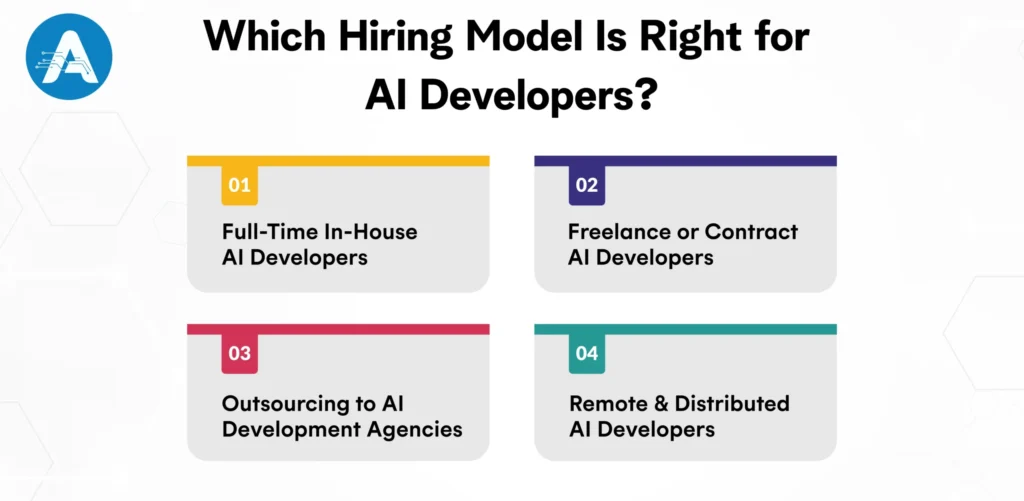
Full-Time In-House AI Developers:
Hiring full-time in-house AI developers gives you a team that deeply understands your product, users, and long-term business goals. These AI developers become part of your company culture and stay aligned with your vision over time. You also have better control over data security, workflows, and intellectual property.
However, this model comes with higher costs, including recruitment, salaries, benefits, and tools, and the hiring process can take several months. This approach works best when AI is a core part of your business strategy, and you are ready to invest for the long term.
Freelance or Contract AI Developers:
Working with a freelance AI developer is a flexible and faster way to get AI work done, especially for short-term or clearly defined projects. Many businesses hire AI developers on a contract basis for proof-of-concept development, data analysis, or specific AI integrations.
While this option is more cost-effective upfront, it can be harder to maintain consistency and fully integrate freelancers into your internal team. Freelance AI developers may also need closer management to ensure timelines and quality stay on track.
Outsourcing to AI Development Agencies:
Outsourcing to an AI development agency allows you to hire AI developers who can handle the entire project from planning to delivery. Agencies provide access to experienced, pre-vetted AI developers and usually follow structured processes, making timelines more predictable.
The downside is higher costs compared to freelancers and less direct control over day-to-day development decisions. This model suits companies that want quick results without building an in-house AI team.
Remote and Distributed AI Developers:
Hiring remote AI developers opens access to a global talent pool and helps manage costs more efficiently. Many businesses now hire AI application developers from regions such as Eastern Europe, Latin America, and India to find the right balance of skills, affordability, and time zone compatibility.
This approach works well for companies that want to scale quickly while maintaining flexibility and access to top AI talent worldwide.
How to Choose the Right AI Developer
When you plan to hire AI developers, using a clear evaluation process helps you avoid costly mistakes and find the right talent faster. Below is an easy, practical way to assess AI developers at every stage.
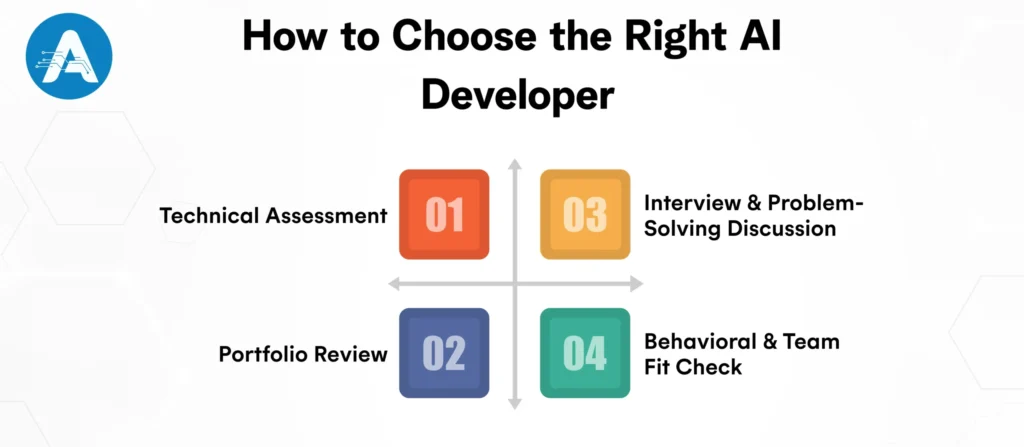
Technical Assessment
Start by testing practical skills. Ask candidates to complete a small coding task, build a basic machine learning model, or work with a sample dataset. This helps you understand how the AI developer applies knowledge, not just theory.
Portfolio Review
Review past work carefully. Look at GitHub repositories, Kaggle profiles, research demos, or previous AI applications. Strong AI app developers usually have hands-on projects that show real problem-solving ability.
Interview and Problem-Solving Discussion
Use simple, practical questions to see how the candidate thinks. Ask how they chose a model for a past project, how they improved performance, or how they handled missing or messy data. Good AI developers can explain complex decisions clearly.
Behavioral and Team Fit Check
AI developers often work with product, business, and marketing teams. Assess communication skills, collaboration style, and alignment with your company values. Team fit is just as important as technical expertise.
For example, a SaaS company interviewed AI developers for a customer support automation project. One candidate clearly explained how the AI solution would improve response times and user satisfaction. That AI developer later became the technical owner of the AI product.
You may also want to know AI App Development Services
How Much Does It Cost to Hire AI Developers?
When you hire AI developers, it’s important to remember that AI talent is highly sought after, and salaries reflect this demand. Experienced AI developers typically earn more than traditional software engineers due to their specialized skills and the business impact they deliver.
Average Salaries for AI Developers
In the United States and Western Europe, an AI developer can expect to earn between $120,000 and $180,000 per year, with highly specialized roles earning even more. In India, AI app developers usually earn between ₹12 to ₹24 lakh per year, depending on experience and expertise. For flexible arrangements, a freelance AI developer may charge anywhere from $40 to $160 per hour globally, depending on their skill level and the complexity of the project.
Plan Your AI Developer Budget
Many startups and growing companies opt to hire AI developers remotely or bring on freelance AI developers to balance costs while accessing top talent. This approach can help reduce expenses, but highly skilled developers with expertise in machine learning or generative AI often still command premium rates. Planning for these costs ensures you attract the right talent without compromising on quality.
Most importantly, salary is only one part of the picture when you hire AI developers. To attract the best talent, offer perks like flexible work arrangements, training and professional development budgets, equity options, and challenging projects that let them make an impact. Many AI developers care about growth and meaningful work as much as pay.
By planning your budget with these factors in mind, you can hire AI developers for your business effectively while keeping them motivated, productive, and committed for the long term.
Common Challenges When Hiring AI Developers
Hiring AI developers comes with its own set of challenges.
- Talent Shortage: Skilled AI professionals are in high demand, making recruitment competitive and sometimes difficult.
- Long Hiring Cycles: Screening, vetting, and onboarding can take several weeks or even months.
- Integration Issues: AI developers need to collaborate closely with product, business, and marketing teams, which can be challenging if processes aren’t well-defined.
- Expectation Misalignment: Business leaders may overestimate what AI can achieve, so it’s important to set realistic goals.
How to Overcome These Challenges:
To overcome these challenges, focus on clear communication, structured hiring processes, and realistic expectations. This helps you hire AI developers effectively and ensures they integrate smoothly into your team.
- Write clear and detailed job descriptions.
- Use structured evaluation tests to assess technical and soft skills.
- Align AI projects with your overall business objectives.
- Plan realistic timelines for hiring, onboarding, and project delivery.
Emerging AI Hiring Practices
As AI changes the way businesses operate, companies are changing how they hire. They now focus more on practical skills than degrees and are creating new roles like prompt engineers. Using AI-powered hiring tools and offering internal training programs are becoming key ways to attract and retain top AI talent.
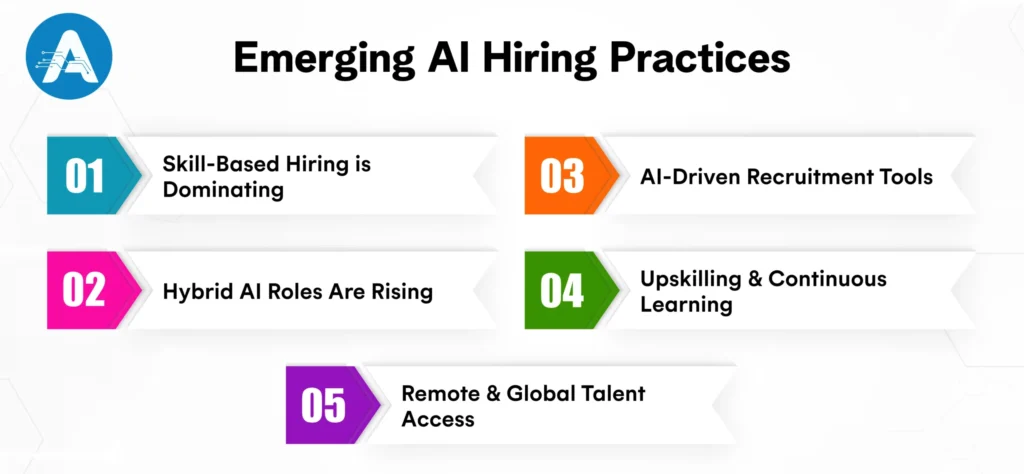
- Skill-Based Hiring is Dominating: Companies are shifting focus from degrees to practical AI skills. Portfolios, real projects, and hands-on experience now carry more weight than formal credentials.
- Hybrid AI Roles Are Rising: New positions like AI product managers, MLOps(Machine Learning Operations) specialists, and prompt engineers are in high demand, reflecting the growing complexity of AI applications.
- AI-Driven Recruitment Tools: Organizations are using AI-powered hiring platforms for resume screening, skill assessment, and candidate matching, making recruitment faster and more accurate.
- Upskilling and Continuous Learning: Through 2027, Gartner predicts that 80% of the engineering workforce will need to upskill in generative AI (GenAI) to stay relevant, prompting companies to invest in internal AI training programs to retain talent and remain competitive.
- Remote and Global Talent Access: Businesses are increasingly tapping into global AI talent pools, hiring remote developers to accelerate project delivery and leverage diverse expertise.
Steps to Hire AI Developers
Follow these clear steps to hire AI developers effectively. This guide will help you find, evaluate, and onboard the right AI developers for your business.
- Write clear and detailed job descriptions to attract the right AI developers and set expectations from the start.
- Use structured evaluation tests to assess both technical skills and soft skills of AI developers for better hiring decisions.
- Align AI projects with your business objectives so that the AI developers you hire deliver real value to your company.
- Plan realistic timelines for hiring, onboarding, and project delivery to ensure your AI developers integrate smoothly.
- This approach enables you to hire AI developers effectively and create a skilled, collaborative, and high-performing AI team
Conclusive Statement
Hiring AI developers is more than just filling technical roles. It is a strategic move that can shape the future of your business. Building the right team can accelerate innovation, improve efficiency, and keep your company competitive in an AI-driven world.
Whether you’re looking for an AI app developer, a freelance AI developer, or a full in-house team, careful planning, clear strategies, and smart hiring practices are essential. Partnering with a trusted AI development company or hiring the right talent ensures your business can lead the AI revolution instead of playing catch-up.
In the recent past, AI in software development was treated as an experiment, something developers tried on side projects or discussed with curiosity. Today, it has become a daily companion in real production environments. From auto-completing functions to generating tests and fixing bugs, AI code assistants are now deeply ingrained in modern development workflows.
By 2024–2025, this transformation was impossible to ignore. AI coding tools moved firmly into the mainstream, supported by clear adoption data. Their use is no longer limited to early adopters or innovation teams; developers across industries and experience levels now rely on AI as a core part of their workflow.
Furthermore, large-scale developer surveys reveal that a strong majority of professionals are now relying on the best AI for coding as part of their daily workflows. According to the Stack Overflow Developer Survey 2024, 76% of developers were already using or planning to use AI tools to support their development process.
This momentum accelerated further into early 2025, with industry reports showing that approximately 84% of developers are using or planning to adopt AI-powered coding solutions. This consistent rise in adoption highlights growing trust in the best AI for writing code as a dependable partner for everyday software development tasks, from code generation to testing and debugging. For AI developers, integrating these tools has become a standard part of daily workflow, making even complex coding tasks more approachable.
Importance of the best AI for writing code
Employing the best AI for writing code feels like working with a helpful colleague who can handle repetitive tasks and small fixes so that you can easily concentrate on solving major issues. It creates the difference between getting stuck in setup work and staying fully engaged with the real logic of a feature. Instead of breaking my flow to search documentation or rewrite the same programming code patterns, the best AI for writing code works quietly in the background, acting as an AI code assistant that fills in the gaps, suggests cleaner solutions, and helps me move faster without feeling rushed or overwhelmed.
Trusting the best AI code assistant is important as it:
- Functions as a smart AI code assistant that offers context-aware suggestions in real time while you write
- Acts as a reliable AI code generator that quickly handles repetitive structures and boilerplate logic
- Explain errors, fixes, and alternatives like a best AI chatbot, beneficial during debugging sessions
- Maintain consistency across projects through artificial intelligence codes trained on large, real-world repositories
- Supports multiple languages, frameworks, and styles commonly used in modern code programming
- Enable teams to adopt the best AI for writing code seamlessly without disrupting existing workflows or tools
- Stand out among the best AI solutions by balancing development speed with code accuracy and reliability
Most importantly, even the best AI for writing code delivers its greatest value when paired with human judgment. Developers who benefit the most are those who actively review, refine, and guide AI-generated output by utilising the tool as a collaborative assistant rather than relying on it as an autopilot.
You may also want to know Create an Artificial Intelligence Startup
Which AI code assistant is best for today’s developers?
Below are some of the most popular AI code assistants, along with the tasks for which they excel. From my experience, each tool helps differently, as you will find that some are great at quickly completing code programming, while others work better as an AI code generator for repetitive tasks or as support when you get stuck. Knowing what each tool does best makes it easier to choose the best AI for writing code that truly fits your daily work style.
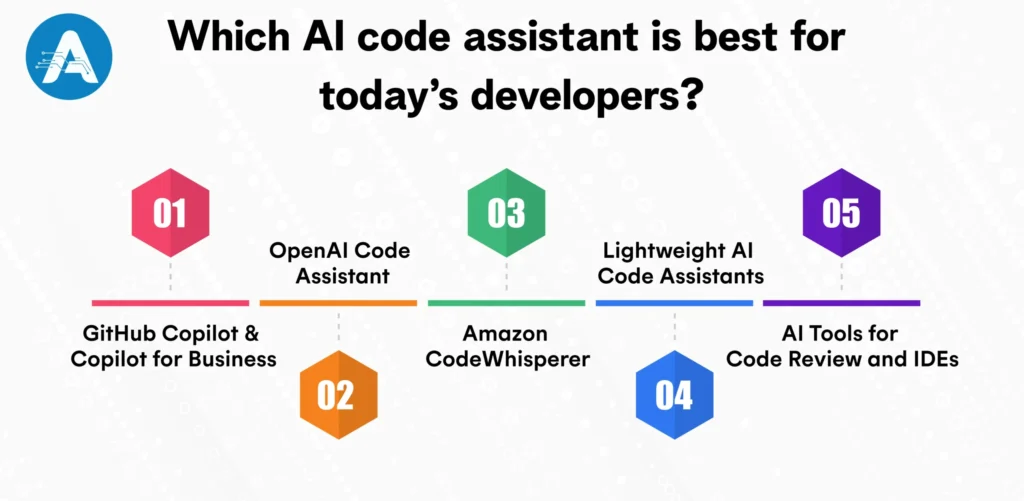
1. GitHub Copilot and Copilot for Business
GitHub Copilot is an AI code assistant that works directly inside your code editor. As you write programming code, it suggests the next line, completes full functions, and can even help generate unit tests. You don’t need to switch tabs or search documentation; it supports you right where you code.
Why developers prefer it
- Works smoothly inside the editor, making it one of the best AI for writing code in daily development
- Integrates easily with Visual Studio Code and GitHub, so there’s no need to change existing workflows
- Helps write repetitive and boilerplate logic much faster
- Acts as a smart AI code assistant, suggesting complete lines and functions as you type
- Saves time by reducing constant switching between documentation and code
- From personal experience, it feels like a junior teammate who already understands your project structure and coding style
For example, imagine you’re building a REST API. Instead of writing the same controllers, validations, and test cases every time, Copilot automatically suggests most of the code. You simply review it, make small changes if needed, and move ahead, saving time while still staying in full control of your work.
Ideal For- If you are looking for a reliable AI code assistant that accelerates work without changing your existing workflow, then GitHub Copilot is the apt choice. It is suitable for developers and teams who already use GitHub and VS Code daily.
2. OpenAI Code Assistant
OpenAI tools like ChatGPT work as an AI code assistant that helps you write, understand, and improve code programming. You can ask questions in normal language, and it responds with code, explanations, or fixes. Many coding tools and editors also use OpenAI models in the background.
Why developers choose it:
- Explains programming code clearly, making complex logic easier to understand
- Works like the best AI chatbot, guiding you step by step when something breaks
- Helps debug errors by explaining why an issue happens, not just how to fix it
- Makes learning new concepts easier, especially for beginners
- Useful for planning features before writing actual code
- From personal experience, it feels like talking to a patient senior developer who never gets tired
For example, if you’re not sure how to structure a feature, you can describe what you want to build, and OpenAI suggests logic, sample code, and even test ideas. You review the answer, adjust it, and move forward with confidence.
Ideal For: Are you looking for a conversational AI code assistant that helps with explanations, debugging, documentation, and planning complex features? OpenAI is an excellent choice. It is especially suitable for developers who prefer discussing problems in natural language and want guidance while working on larger AI coding tasks.
3. Amazon CodeWhisperer
Amazon CodeWhisperer is an AI code assistant designed for developers working on AWS. It helps write AI programming that follows common cloud patterns and automatically suggests AWS SDK usage while you code.
Why developers favor it:
- Understands AWS services deeply and suggests cloud-ready AI programming code
- Helps follow AWS best practices automatically while coding
- Provides security-focused suggestions to reduce common cloud mistakes
- Saves time when working with AWS SDKs and service integrations
- Works well for setting up services like S3, Lambda, and DynamoDB
- From experience, it feels especially useful when building or scaling AWS-based applications
For instance, if you’re building a cloud application on AWS, CodeWhisperer can suggest ready-to-use code for accessing databases, managing storage, or handling permissions that reduce manual effort and common mistakes.
Best for: If your team builds most of its applications on AWS (Amazon Web Services) and needs cloud-aware guidance, Amazon CodeWhisperer is a strong best AI for writing code choice that fits naturally into AWS-based workflows.
4. Lightweight AI Code Assistants
These are lightweight AI code assistants that focus on fast code suggestions. Many of them offer local or remote completions and are designed to work with minimal delay, making them comfortable for everyday AI programming tasks.
Why developers go for it:
- Fast code suggestions with very low delay
- Strong focus on privacy, with offline or on-premise options
- Useful when working with sensitive or confidential AI programming code
- More affordable compared to larger enterprise AI tools
- Easy to use for small projects or solo developers
- From my experience, they feel lightweight and efficient without adding complexity
For example, while working on a small or private project, these tools quickly suggest the next lines of code as you type. You pick what you need, make small changes, and continue by saving time without sharing sensitive code or spending extra money.
Apt for: If your team values privacy or works with sensitive code, these AI tools are a good fit. They are especially suitable for startups, small teams, or individual developers who want a cost-effective AI for writing code solutions without the complexity of large enterprise platforms.
5. AI Tools for Code Review and IDEs
Many modern IDEs and code review tools now include built-in AI features. These tools help generate tests, detect bugs, and find security issues by reviewing AI programming code automatically.
Why developers pick it:
- Acts as a safety net by reviewing code automatically
- Catches bugs, performance issues, and security risks early
- Works alongside an AI code assistant to improve code quality
- Reduces the chances of errors reaching production
- Builds confidence before deployment, especially in team projects
For example, after writing code with the best AI for writing code, a review tool analyzes it during CI checks and flags potential issues. You fix them early, reducing bugs and improving overall code quality.
Ideal For: If your team wants cleaner and safer code, these AI tools are a strong choice. They are especially useful for teams that already use CI/CD pipelines and want automated checks to review, test, and validate code changes before deployment.
Now that you’re familiar with the best AI code tools, let’s move on to the key factors you should consider when choosing the right AI code assistant for your work.
How to choose the best AI for writing code?
Choosing the best AI for writing code becomes easier when you focus on tools that match your skill level and daily workflow. Reliable AI application development services help ensure the AI code assistant you choose is secure, easy to use, and truly helpful for learning and building better code.
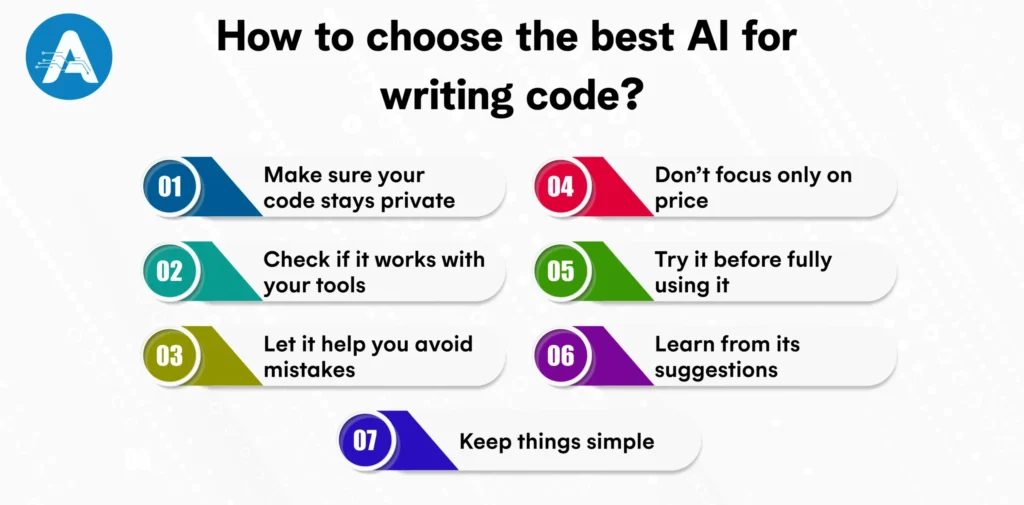
- Make sure your code stays private: If you’re working on private projects, choose an AI code assistant that keeps your programming code safe and doesn’t share it without permission.
- Check if it works with your tools: Pick the best AI for writing code tool that supports the language and editor you already use. This makes learning and coding much easier.
- Let it help you avoid mistakes: The best AI for writing code should point out common errors and unsafe code so you can fix them early.
- Don’t focus only on price: Free or affordable tools are great, but also think about how much time the AI code assistant saves you when writing or understanding code.
- Try it before fully using it: Start small. Use the tool for simple tasks and see if it actually helps you learn and work faster.
- Learn from its suggestions: A good AI tool explains what it writes. This helps beginners understand programming code instead of just copying it.
- Keep things simple: Choose AI code tools that are easy to use and don’t feel confusing. Simple tools help beginners grow with confidence.
Top benefits of using AI for writing code
Using the best AI for writing code makes coding faster, easier, and less stressful. A good AI development company provides tools that fit your workflow, helping you and your team get more done with less effort.
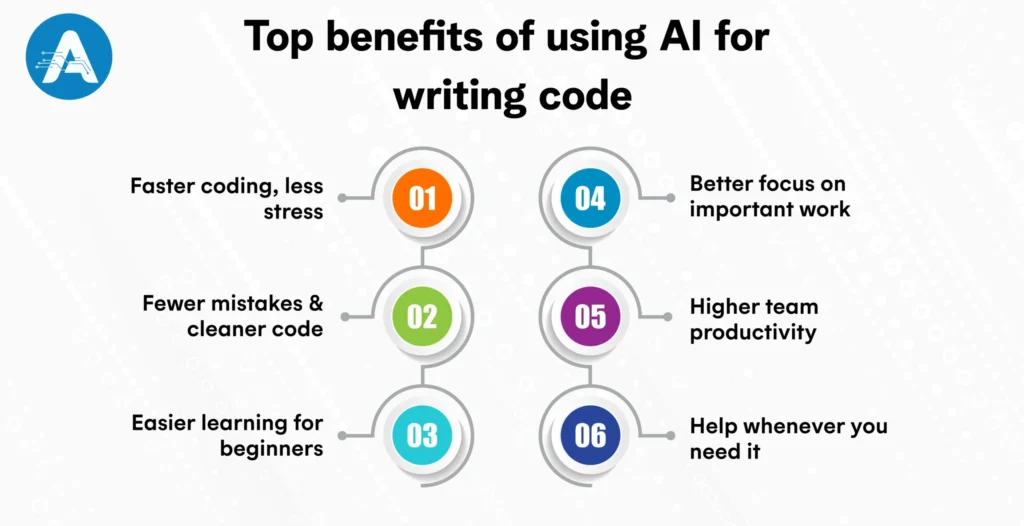
- Faster coding, less stress: The best AI for writing code takes care of repetitive tasks, so you spend less time typing the same things and more time solving real problems.
- Fewer mistakes and cleaner code: An AI code assistant helps spot common errors early and suggests better ways to write your programming code, making it safer and easier to maintain.
- Easier learning for beginners: AI explains code in plain language. This makes learning new concepts less confusing and helps beginners gain confidence faster.
- Better focus on important work: Instead of getting stuck on setup or boilerplate logic, the best AI for writing code lets you focus on the main features and ideas behind your project.
- Higher team productivity: Teams using AI code tools often finish tasks faster, review code more smoothly, and collaborate better with less back-and-forth.
- Help whenever you need it: An AI code assistant is always available, whether you’re coding late at night, learning something new, or racing against a deadline.
You may also want to know Hiring AI Developers
Safe Practices for AI Code Assistants
Using an AI code assistant can make coding much faster and easier, but it’s important to stay careful. AI might sometimes suggest code that has mistakes, security issues, or license concerns, so it’s always a good idea to review its output before using it in your project. Running tests and scans on the generated programming code helps catch problems early.
If your project involves sensitive data, make sure the AI tool uses secure endpoints or on-premise models to protect your information. Human oversight is key as AI should assist, not replace your judgment.
For teams and beginners, guidance from an experienced AI application developer can help ensure safety, proper integration, and best practices. Keeping your code modular and avoiding deep dependence on vendor-specific tools also prevents lock-in, giving you flexibility in the future. By following these practices, you can gain the benefits of AI safely and reliably.
Conclusive Statement
The world of best AI for writing code is evolving quickly, and the best tools for your team are those that fit your security policies, integrate smoothly into your workflow, and include a human-first review process. Start small: run pilot projects, track developer experience and defect rates, and choose AI code assistants that support your programming languages and deployment setup. By taking a careful, measured approach, you can make AI a reliable partner that boosts productivity, improves code quality, and keeps your projects safe.
Are you curious about how people like you and me can create an artificial intelligence startup that actually works in real life? Trust me, you don’t need to be a tech expert or come from a big company to get started. AI today is easier to use, more practical, and more business-friendly than ever before, giving every entrepreneur a chance to turn simple ideas into powerful real-world solutions.
This blog will help you gain clearer insights into what artificial intelligence is, how to select the right types of AI, how artificial intelligence coding functions, and how to build a strong, scalable business model.
Understanding Artificial Intelligence for today’s businesses
Before learning how to create artificial intelligence, it’s essential to understand what artificial intelligence truly means for modern businesses. Today, AI is not just a technology-based concept; rather, it is a practical tool that helps companies make faster decisions, enhance efficiency, and unlock new revenue opportunities.
Artificial intelligence refers to computer systems that can analyze data, learn from patterns, make decisions, and take intelligent actions. These systems use algorithms and software that allow machines to recognize trends, predict outcomes, and automate tasks that previously needed human involvement. In simple words, when you ask what is artificial intelligence or what is an AI is, you’re asking how machines can think, learn, and act with intelligence.
Furthermore, AI is also one of the fastest-growing markets in the world. In 2025, the global artificial intelligence market is estimated to be between $638 billion and $750 billion, showing massive demand across industries. Some reports expect AI to grow to $2.4 trillion to $3.5 trillion by the early 2030s as more businesses depend on machine learning, automation, and natural language processing.
Nowadays, AI is no longer optional. It has become essential for businesses that want to stay competitive. For entrepreneurs, AI technology offers a perfect opportunity to innovate and build meaningful AI products that solve real problems.
We can observe that businesses are not just talking about AI anymore; they’re actively integrating it into their daily operations, using it for everything from customer support and workflow automation to smarter data-driven decision-making.
Moreover, AI appears in many forms that businesses rely on today, including:
- Rule-based automation that follows predefined logic.
- Machine learning models that continuously learn and improve from data.
- Generative AI systems that create text, images, ideas, and designs.
- Computer vision and robotics that interpret and interact with the physical environment.
Understanding which type of AI fits your business goals is essential because it shapes your artificial intelligence strategy, product development, and technical foundation.
You may also want to know the AI Voice Generator Platform Development
A Simple Step-by-Step Way to Create an Artificial Intelligence Startup
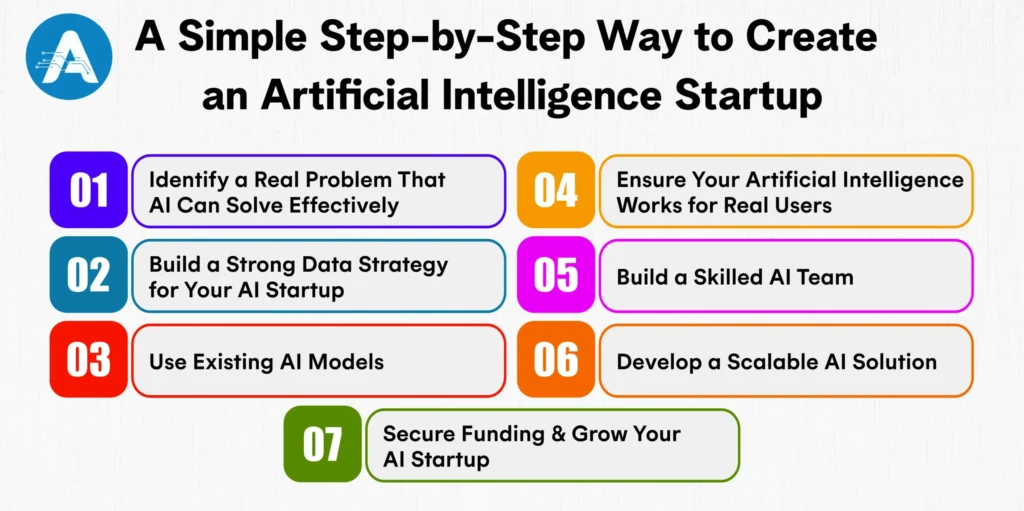
1) Identify a Real Problem That AI Can Solve Effectively
Before you create an artificial intelligence solution, it’s important to check whether the problem trulyrequires AI. Many people rush toward AI because it feels exciting, but real success comes from choosing a genuine problem that customers already find difficult or time-consuming.
To keep your idea practical, ask yourself:
- Will artificial intelligence make this task quicker, simpler, or more accurate?
- Can a machine learn from the data available and perform better than a human?
- Are people or businesses already paying for manual, inefficient, or outdated methods?
If the answer is “yes”, then you are on the right track.
For example, if your enterprise lacks the tools or processing capacity required to run advanced AI systems, then Neysa solves this gap by offering ready-to-use AI infrastructure that your organisation can adopt immediately.
2) Build a Strong Data Strategy for Your AI Startup
Data is the fuel that powers every artificial intelligence system.
Before you start building anything with artificial intelligence code, you must be clear about how your data will be collected, structured, and used.
Start by asking yourself:
- What type of data does my AI model need to learn and deliver accurate results?
- Do I already have this data, or do I need to collect, purchase, or request it from partners?
- Is the data clean, labelled, and organized so that machine learning with AI can understand it easily?
- Am I using this data in an ethical and legally compliant way?
Even the most advanced AI machine learning model will fail if the data is messy or incomplete. High-quality data leads to high-quality predictions; poor data leads to unreliable outcomes.
No need to worry; if you don’t have a lot of data at the beginning, most AI startups start this way. By employing the following sources, you can still build a good data foundation:
- Data partnerships with companies that already gather the information you need
- Public or open-source datasets that can be used for training your initial models
- Synthetic data, which is becoming a powerful option when real data is limited, sensitive, or expensive to access
For instance, suppose you want to build an AI HR screening tool
To train it, you need résumés, job descriptions, and past hiring results.
However, as a new startup, you may not yet have a large dataset. Here’s how you can still get the data you need:
- Work with small recruitment agencies to access anonymized resumes
- Use open-source datasets that include sample résumés
- Create synthetic résumés to help your model learn basic patterns
- Collect data from your early clients and improve your model over time
Many successful AI HR tools started with small amounts of data and achieved steady improvement over time.
3) Use Existing AI Models
Most AI startups today don’t create AI models from scratch, as developing your own large model takes a lot of money, time, and computing power, and sometimes doesn’t give you any real business advantage.
Instead of building everything from scratch, most successful AI startups choose smarter and faster options that include:
- Employ ready-made AI models from OpenAI, Anthropic, Google, or Meta through simple API calls
- Customize these models with your own domain data so they become more accurate for your business needs
- Mix both methods, where you use open-source models and add your own features to create something unique
This is also the stage where you begin working with artificial intelligence codes.
You’ll write simple scripts to connect your product with APIs, fine-tune the models, or integrate AI directly into your app or platform.
For instance, if your startup requires a fully custom model like computer vision, recommendation engines, or speech recognition, then you’ll likely use frameworks such as:
- PyTorch
- TensorFlow
- Other AI/ML libraries designed for model training and deployment
These tools help you build smaller, specialized models without the extreme cost of building a full, large-scale system from scratch.
4) Ensure Your Artificial Intelligence Works for Real Users
At this stage, many AI startups face challenges. Artificial Intelligence is not only a smart technology, but it also makes work easier for users.
Before investing a significant amount of time or money, ensure that you test your AI solution with real users by starting small.
- A clear problem that your artificial intelligence solution is addressing
- A working prototype or MVP that users can test and interact with
- Early feedback from real users to find out what works and what needs improvement
Your AI doesn’t need to be perfect at this stage. The key is to see how users engage with it and use their feedback to improve your AI model, features, and overall product experience.
For instance, suppose you are developing an AI-powered customer support chatbot. Instead of spending months building the perfect system, you launch a basic version for a small group of users or businesses.
Early feedback might show you:
- The chatbot handles simple questions effectively
- It struggles with more complex queries
- Its responses could be faster or sound more natural
This input allows you to improve your AI machine learning model gradually, making it more accurate and useful before rolling it out to a larger audience.
5) Build a Skilled AI Team
You require a team of skilled individuals to create a successful AI startup :
- AI researchers or machine learning engineers to design and improve models
- Product managers who understand business challenges and user needs
- AI app developers to integrate models into real products and make them user-friendly
Finding skilled AI talent can be challenging. Many startups get started by working with contractors, hiring remote AI developers, or partnering with research groups until they can grow a full in-house team.
For instance, Artisan AI is a startup that builds digital AI colleagues to automate business workflows.
In the beginning, the founders worked with remote AI developers and contractors to create their initial prototypes. This allowed them to test ideas quickly without hiring a full in-house team.
6) Develop a Scalable AI Solution:
Running an AI startup requires strong infrastructure because AI systems are resource-intensive. You’ll need to plan for:
- GPUs or cloud computing power to train and run AI models efficiently
- Data storage and processing for handling large datasets safely and quickly
- Model deployment and monitoring to make sure your AI works reliably in real-world conditions
- Secure APIs and services to connect your AI models with your product and users
It’s important to have a clear strategy for your infrastructure. Many startups use cloud providers like AWS, Azure, or Google Cloud. Others use edge computing for faster processing or a hybrid approach that combines both cloud and on-site resources.
For example, when OpenAI launched ChatGPT, they relied heavily on cloud computing and GPU clusters to train and deploy their models. This scalable setup allowed them to handle millions of users simultaneously while maintaining high performance.
Smaller AI startups can follow a similar approach on a smaller scale. Planning scalable infrastructure from the start allows your AI startup to grow smoothly, support more users, and expand AI capabilities without major technical roadblocks.
7) Secure Funding and Grow Your AI Startup
AI startups are one of the fastest-growing categories in tech today, attracting attention from investors, enterprises, and the media.
To gain traction, focus on proving your product works and showing real user adoption. This helps you attract funding and grow faster.
For example, Anthropic, an AI research startup, raised hundreds of millions within months of launching.
- OpenAI partnered with Microsoft to scale enterprise adoption of its AI models.
- Early traction in the form of users, partnerships, or pilot deployments helps investors trust your vision and supports long-term growth.
Which Skills and Tools Are Essential for an AI Startup?
If you’re creating an artificial intelligence startup, you’ll regularly work with a mix of technical skills and practical tools, including:
- Python and artificial intelligence libraries such as TensorFlow and PyTorch for building and training AI models
- Cloud platforms like AWS, Azure, or Google Cloud to run and scale AI systems
- APIs for generative AI to add features like text, image, or content generation
- Front-end or mobile development skills are especially important if you’re an AI app developer building user-facing products
- Data engineering and pipeline management to collect, clean, and prepare data for machine learning with AI
Beyond tools, businesses must understand the artificial intelligence characteristics that allow AI to learn, adapt, and deliver real value, which are as follows:
- Adaptability: Artificial intelligence systems get better over time by learning from new data and real-world use.
- Learning from data: AI uses past information to make quicker, smarter, and more accurate decisions.
- Pattern recognition: AI can spot trends and behaviors in large amounts of data that people often miss.
- Decision automation: Artificial intelligence helps businesses move faster by automatically handling routine and data-based decisions with better accuracy.
You may also want to know the best AI for Writing Code
How to Monetize an Artificial Intelligence Startup
Once you create an artificial intelligence solution, the next big question is how your startup will make money. Most successful artificial intelligence businesses follow proven monetization models that align with how AI is used in real life.
Here are some common and effective ways AI startups generate revenue:
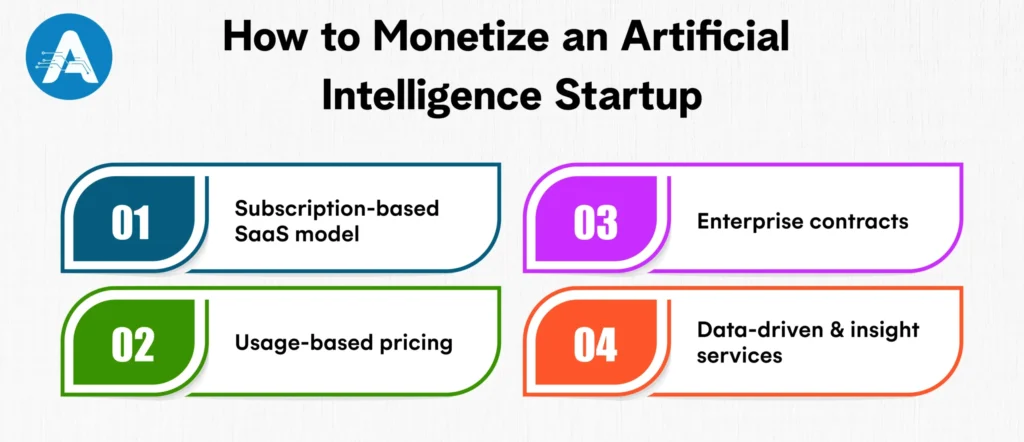
Subscription-based SaaS model
Many AI startups charge a monthly or yearly subscription for access to their artificial intelligence platform. This works well for AI tools used regularly, such as automation software, analytics dashboards, or AI-powered business applications built by an AI app developer.
Usage-based pricing
In this model, customers pay based on how much they use the AI system. This could include charges per API call, AI model usage, or computing time. It’s a popular choice for companies offering AI services through artificial intelligence codes and APIs, especially when customers have varying usage needs.
Enterprise contracts
Larger organizations often require customized AI solutions. An AI development company can generate revenue through long-term enterprise contracts by delivering tailored artificial intelligence systems, seamless integrations, and ongoing support to meet specific business needs.
Data-driven and insight services
Some AI startups monetize by offering advanced insights, predictions, and analytics powered by AI machine learning and machine learning with AI. Businesses pay a premium for smarter decision-making based on AI-generated intelligence.
Choosing the right monetization strategy depends on what AI is in your product, how it works, the types of AI you use, and the value it delivers to customers. For an AI application developer, having a clear and well-defined revenue model helps the startup grow sustainably while attracting long-term clients and investor confidence.
Moving Forward with Your Artificial Intelligence Vision
If you’ve reached this point, you’re already thinking seriously about how to create an artificial intelligence solution and turn it into a real business opportunity.
Artificial intelligence is no longer just a technology trend; it’s a powerful business enabler. You don’t need to build the next global AI platform to succeed. What matters is identifying the right problem, understanding what is in real business terms, and using AI artificial intelligence to deliver practical value.
Whether you’re exploringAI machine learning, choosing the right types of AI, or working with an AI development company that offers AI application development services, success depends on smart planning and clear execution.
Imagine building an AI-powered product that helps businesses save time, reduce costs, or make better decisions. That’s the real potential of AI startups today, creating meaningful impact through well-designed artificial intelligence solutions.
Your journey starts now, with the right idea, the right strategy, and the right use of AI technology.