AI Platform •
14 min read •December 31, 2025•86 views
Understanding Data Annotation: Everything Businesses Need to Know
Table of Contents
AI is no longer working behind the scenes. It is shaping the decisions we make every day in business. It influences which products your customers notice, helps us spot risks before they grow, and reveals opportunities hidden deep within your data. From personalized recommendations to smart automation, AI has become part of how we help your business move faster and make smarter decisions.
What truly makes AI systems work for you is not just advanced algorithms, but the quality of data guiding them. This is where data annotation becomes essential for all of us. By transforming your raw and unstructured data into clear, actionable signals, data annotation enables your AI models to understand context and take informed, meaningful action. When we label data accurately, your AI systems become more precise, more reliable, and easier to scale as your business grows.
If you are investing in AI, data annotation should not feel like a background task or a technical formality. It is a strategic foundation that directly affects accuracy, speed to market, and your long-term return on investment. With the right data annotation approach, we can mitigate risk, enhance outcomes, and develop AI solutions that perform reliably in real-world business scenarios.
In this guide, we will walk you through everything you need to know about data annotation. You will learn how it works, where it delivers the most value, and how the right tools and platforms can support your AI initiatives as they scale.
What Is Data Annotation?
Data annotation is the process of labeling raw data so your AI systems can understand it, learn from it, and make accurate decisions. These labels act as clear instructions that teach AI models how to recognize patterns, predict outcomes, and perform tasks reliably.
In simple terms, Data annotation means teaching machines using real examples.
What Is Data Annotation in AI?
In AI data annotation, an AI development company uses human experts and intelligent automation to tag data such as images, text, audio, and video with meaningful labels. These labeled datasets help your machine learning models understand the relationship between inputs and outputs.
For example, data annotation helps you:
Label images of cars, bikes, and pedestrians for self-driving and computer vision systems
Tag customer emails as complaints, feedback, or support requests for AI-powered customer service
Transcribe and label speech data for voice assistants and speech recognition models
Without proper annotation, your AI sees only numbers, pixels, or text strings, not context or meaning. Data annotation turns raw data into actionable intelligence.
Why Data Annotation Is Critical for Artificial Intelligence
Artificial intelligence data annotation is the foundation of supervised machine learning, which powers most real-world AI solutions used by businesses today.
When we annotate data accurately, you get AI models that perform better, scale faster, and deliver measurable business value.
The Importance of Data Annotation
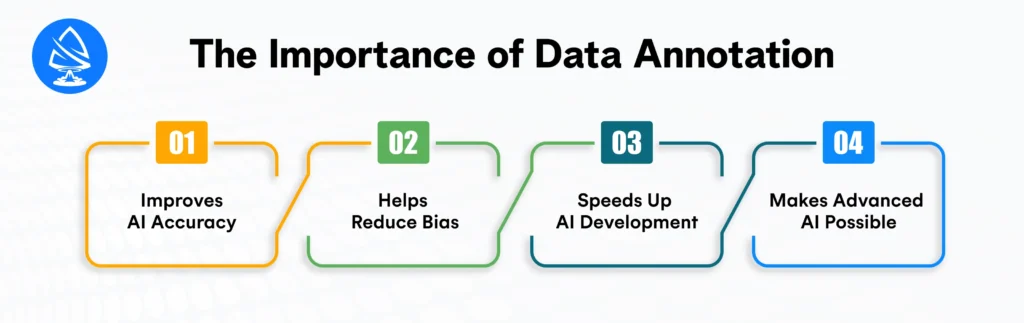
Data annotation is essential for helping AI systems understand data accurately. By labeling data correctly, AI models can learn patterns, reduce errors, and deliver reliable results across real-world applications.
Improves AI Accuracy
High-quality data annotation allows AI models to learn from clear and correct examples. Accurate labels help reduce errors and improve prediction quality, leading to more dependable AI outcomes in real-world use cases.
Helps Reduce Bias
Well-annotated and diverse datasets support the development of balanced AI models. Consistent labeling across different data types helps minimize bias and promotes fair, trustworthy AI decisions.
Speeds Up AI Development
Clear and structured annotations simplify the training process for machine learning models. Faster learning cycles reduce rework and help AI solutions move from development to deployment more efficiently.
Makes Advanced AI Possible
Complex applications such as facial recognition, sentiment analysis, medical imaging, and autonomous systems depend on precise data annotation. Detailed labeling enables AI models to understand patterns that simple data alone cannot provide.
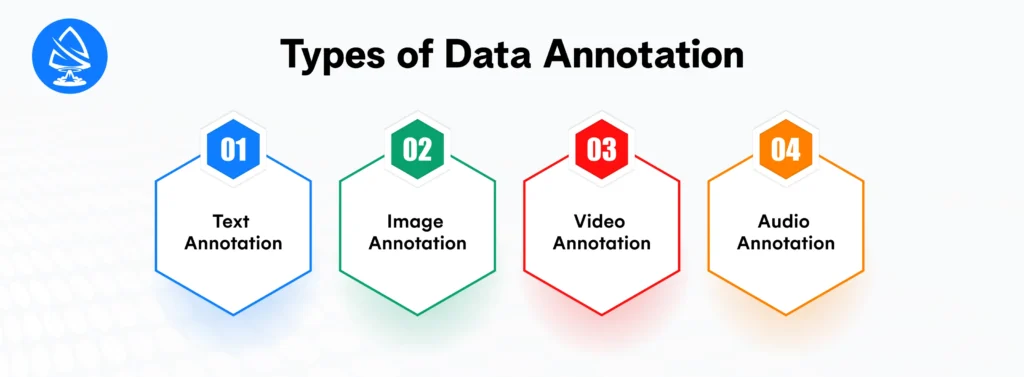
Different AI use cases require different types of data annotation. Each annotation method helps AI models learn specific patterns, behaviors, and contexts. Below are the most common types used in real-world AI applications.
1. Text Annotation
Text annotation involves tagging words, sentences, or entire documents with meaningful labels such as intent, sentiment, or named entities. This type of annotation supports many natural language processing (NLP) applications.
Common Applications
Chatbots and virtual assistants
Spam detection and email filtering
Sentiment analysis
Document classification
For example, Amazon uses text annotation to analyze customer reviews and identify sentiment patterns, helping improve product recommendations and customer experience.
2. Image Annotation
Image annotation focuses on labeling visual elements within images so AI systems can detect objects, shapes, and patterns accurately. This type of annotation is widely used in computer vision projects.
Common Applications
Bounding boxes
Polygon annotation
Semantic segmentation
Keypoint annotation
For example, Self-driving cars use image annotation to identify pedestrians, traffic signs, road lanes, and vehicles. Labeled images help these systems learn how to drive safely in real traffic conditions.
3. Video Annotation
Video annotation involves labeling objects, actions, and movements across video frames. This method helps AI track behavior and understand motion over time.
Common Applications
Surveillance and security systems
Sports analytics
Autonomous driving
For example, Retail businesses use video annotation to analyze customer movement inside stores. These insights help optimize store layouts, improve product placement, and enhance the overall shopping experience.
4. Audio Annotation
Audio annotation focuses on labeling speech, sounds, and voice data so AI systems can understand spoken language and audio cues.
Common Applications
Speech transcription
Speaker identification
Emotion detection
For example, Voice assistants like Alexa and Siri use audio annotation to understand spoken commands, accents, and tone. Call center AI also uses it to detect customer emotions for better support.
What Is Online Annotation?
Online annotation uses cloud-based data annotation systems that allow teams to label data collaboratively from anywhere in the world. These platforms make it easier for us to manage large annotation projects while keeping workflows simple and efficient.
With online data annotation, you benefit from:
Easy scaling with a remote annotation workforce
Faster project turnaround and delivery
Centralized quality control and review processes
Most modern data annotation platforms are cloud-based, making them ideal for businesses and global enterprises that need speed, flexibility, and consistency.
Data Annotation Tools and Platforms
Choosing the right data annotation tool or dataset annotation tool plays a critical role in the success of your AI and machine learning projects.
What Are Data Annotation Tools?
Data annotation tools are software solutions that help us label, organize, and manage training data efficiently. For businesses offering AI application development services, these tools streamline the annotation process while ensuring high accuracy and quality.
They support:
Multiple data types, including images, text, audio, and video
Automation combined with human-in-the-loop annotation
Built-in quality checks and validation workflows
Seamless integration with machine learning pipelines
Using the right data annotation tools ensures your AI models are trained effectively, enabling faster development and more reliable performance for your AI applications.
Must-Have Features in a Data Annotation Platform
A reliable data annotation platform should support both current needs and future growth. When selecting a platform, look for features that help us scale and maintain quality.
Key features include:
Scalability to handle large and complex datasets
Support forAI data annotation workflows
Flexible and custom labeling options
Strong data security, privacy, and compliance standards
Analytics and performance tracking for continuous improvement
For businesses working with visual data, advanced image annotation tools with accuracy controls and quality assurance features should be a top priority.
Is Data Annotation Technology Legit?
A common question many people ask is whether data annotation technology is legitimate. The short answer is yes, when data annotation is carried out through trusted platforms and professional organizations.
Data annotation is a critical part of building accurate and reliable AI and machine learning models, which is why many global companies depend on it.
Why Data Annotation Is Sometimes Misunderstood?
The growth of remote data annotation workhas also created some uncertainty in the market. This confusion often comes from:
Low-quality or unverified annotation platforms
Unrealistic income promises
Limited transparency around processes and payments
These issues can make data annotation appear questionable, even though the underlying technology is widely used by leading enterprises.
Established organizations across industries rely on professional data annotation services to train and improve AI systems.
Real World Uses of Data Annotation
Medical image annotation for early cancer detection
Financial document annotation for fraud detection and analysis
Image and video annotation for autonomous vehicle training
Text and conversational data annotation for AI chatbots
Major enterprises invest millions of dollars every year in data annotation because the performance, accuracy, and reliability of their AI solutions depend directly on high-quality labeled data.
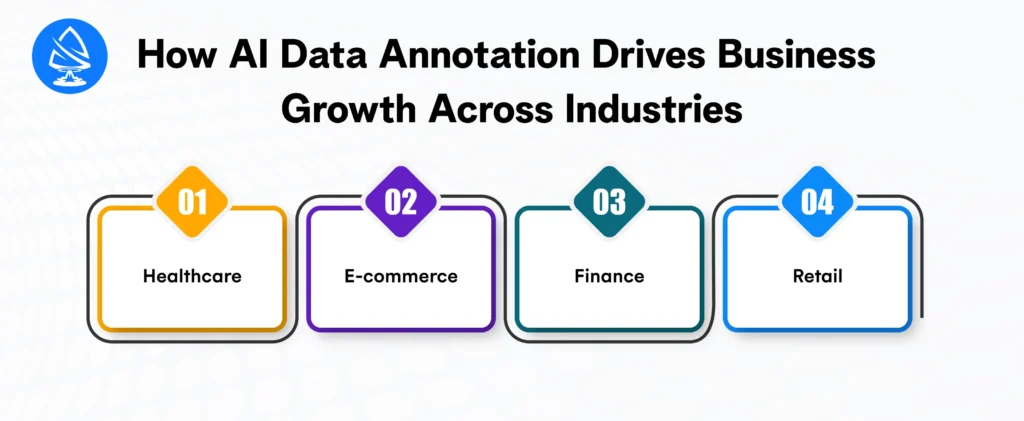
How AI Data Annotation Drives Business Growth Across Industries
AI systems can only learn effectively when the underlying data is clearly labeled. This is where data annotation becomes crucial. Across industries, businesses rely on annotated data to build smarter, faster, and more reliable AI solutions. An experienced AI application developer uses this labeled data to create models that deliver real-world results.
Healthcare
In healthcare, annotated medical images such as X-rays, MRIs, and CT scans help AI systems identify tumors, fractures, and abnormalities at an early stage. This supports doctors in making faster and more accurate diagnoses, improving patient outcomes, and reducing human error.
E-commerce
For e-commerce businesses, data annotation improves how AI understands product images, descriptions, and customer behavior. Labeled product data helps enhance search accuracy, power personalized recommendations, and deliver a better shopping experience for customers.
Finance
In the finance sector, annotated transaction data enables AI models to spot unusual patterns and detect fraudulent activity in real time. It also supports better risk assessment, compliance monitoring, and secure financial operations.
Retail
Retailers use image and video annotation to track inventory, analyze foot traffic, and understand customer behavior inside stores. These insights help businesses optimize stock levels, improve store layouts, and enhance overall customer engagement.
Industry reports suggest that AI adoption can increase productivity by nearly 40%, and accurate data annotation is one of the key factors behind this improvement.
Manual vs Automated Data Annotation
Businesses generally choose between manual, automated, or hybrid data annotation methods. Each approach offers different advantages depending on accuracy needs, speed, and project scale.
Manual Data Annotation
Manual annotation is performed by trained human experts. It delivers high accuracy and is best suited for complex or sensitive data such as medical records or legal documents. However, it requires more time and resources.
Automated Data Annotation
Automated annotation uses AI tools to label large volumes of data quickly. It is faster and more cost-effective, but the results often need human review to ensure accuracy and reliability.
The Hybrid Approach
Most organizations adopt a human-in-the-loop model, combining automation with human oversight. This approach balances speed, cost, and quality, making it ideal for large-scale AI projects.
Common Data Annotation Challenges and Their Solutions
As more businesses rely on AI, data annotation has become a critical step, but it comes with its own set of challenges. Some of the most common issues include:
Rising costs: Manual annotation, especially for large datasets, can become expensive.
Inconsistent labeling: Different annotators may interpret guidelines differently, leading to uneven or incorrect labels.
Bias in datasets: If the data is not diverse or representative, AI models can inherit biases.
Scaling difficulties: Handling massive volumes of data efficiently is often a major hurdle.
Using reliable annotation tools: High-quality platforms improve efficiency and maintain accuracy.
Implementing quality assurance workflows: Regular checks and validations prevent mistakes and maintain data integrity.
Leveraging online annotation platforms: Outsourcing or using cloud-based solutions helps scale operations without compromising quality.
Focusing on dataset diversity: Ensuring data represents different scenarios, demographics, and conditions reduces bias in AI models.
By combining these strategies, businesses can overcome annotation challenges, save time and costs, and generate high-quality data that powers better AI results.
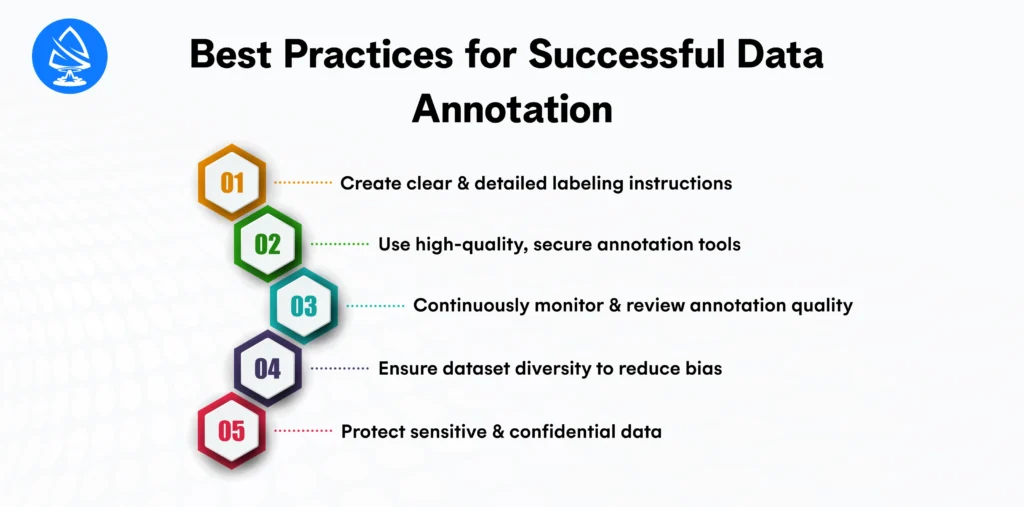
Best Practices for Successful Data Annotation
To get the most out of data annotation and ensure your AI models perform accurately, businesses should follow these proven best practices:
Create clear and detailed labeling instructions
Provide annotators with step-by-step guidelines and examples. Clear instructions reduce errors and ensure consistency across large datasets.
Use high-quality, secure annotation tools
Invest in reliable annotation platforms that offer advanced features, easy collaboration, and strong data security to protect sensitive information.
Continuously monitor and review annotation quality
Regularly check the work for accuracy and consistency. Implement feedback loops so errors can be corrected promptly and standards maintained.
Ensure dataset diversity to reduce bias
Include data from different scenarios, demographics, and conditions. Diverse datasets help AI models make fair, accurate, and unbiased decisions.
Protect sensitive and confidential data
Follow strict data privacy practices and compliance standards to safeguard personal or proprietary information while annotating.
The Future of Data Annotation
Data annotation is evolving quickly as AI technology advances. Businesses can expect new trends to shape the field, including AI-assisted labeling, synthetic data generation, and industry-specific annotation platforms designed to meet unique business needs. At the same time, there is a growing focus on ethical AI and responsible handling of data.
As AI systems become more sophisticated, the demand for accurate, scalable, and high-quality annotated data will only increase. Investing in robust data annotation practices is no longer just a task; it’s a long-term strategic move that can give businesses a competitive edge in building smarter, more reliable AI solutions.
Final Thoughts
Data annotation is more than just a technical step; it is a strategic investment for your business. Understanding what data annotation and prioritizing high-quality labeling help you deploy AI faster, improve model accuracy, and achieve a stronger return on investment.
Whether you are building computer vision models, chatbots, or predictive analytics, selecting the right data annotation platform and using reliable data annotation tools, image annotation tools, or a dataset annotation tool can make all the difference in your AI success.
In today’s world, powered by intelligent systems, artificial intelligence data annotation and AI data annotation solutions act as the silent force driving innovation. By investing in proper online annotation processes and the right data annotation tech, you ensure your AI projects deliver measurable results for your business.
Planning for AI Project
Get clarity on use cases, architecture, costs, and timelines with insights from 50+ real-world AI implementations.
Data annotation is the process of labeling raw data, such as images, text, audio, or video, to make it understandable for AI models. It provides context so machines can learn patterns, recognize objects, or understand language.
2. What are the types of data annotation?
Common types include image annotation, text annotation, audio annotation, and video annotation. Each type is used for specific AI applications, such as self-driving cars, chatbots, speech recognition, or video analytics.
3. What are data annotation tools?
Data annotation tools are software solutions that help label and organize datasets efficiently. They can be used for images, text, audio, or video, and often include quality checks and collaboration features.
4. What is online annotation?
Online annotation is cloud-based data labeling. It allows remote teams to work collaboratively, ensures version control, and enables faster project delivery.
5. Which industries use data annotation?
Almost every AI-driven industry uses it: healthcare, automotive, finance, retail, and technology.
6. Can AI automate data annotation?
Yes. Automated tools can pre-label data to save time, but human verification is often required to maintain high accuracy, especially for complex or nuanced tasks.
7. How do I choose the right data annotation platform?
Look for features such as multi-data type support, collaboration, quality checks, scalability, integration with AI pipelines, and robust data security. Popular data annotation platforms offer flexibility and reliability.
Design workflows are evolving at breakneck speed. AI Image Generators have officially transitioned from experimental “toys” to essential everyday assets for modern creatives. The…