AI Platform •
15 min read •January 3, 2026•131 views
How to Build an Artificial Intelligence Governance Framework
Table of Contents
Artificial Intelligence (AI) is not just something for the future; it is already shaping how we live and work. From apps that suggest your next favorite show to tools that help doctors predict illnesses, AI is everywhere. However, the reality is that AI can accomplish amazing things, yet it can also create serious problems if not managed carefully. Many organizations have successfully built AI models that transformed their business, while others have struggled because governance was not part of the plan. This leads to an important question every organization must ask: how do you build an artificial intelligence governance framework that keeps AI smart, safe, and trustworthy?
This article provides step-by-step guidance, supported by real-world situations and practical insights, to enhance your understanding.
What AI Governance Is and Why It Matters
AI governance is the set of rules, processes, and guidelines that help organizations use artificial intelligence in a responsible and controlled way. For an AI application developer, AI governance provides a clear framework to ensure systems are fair, reliable, secure, and aligned with business goals. It clearly defines how AI should be built, used, monitored, and improved over time.
It ensures that AI systems are fair, reliable, secure, and aligned with business goals. Simply put, AI governance defines how AI should be built, used, monitored, and improved over time.
Governance may sound like a complex corporate term, but at its core, it is about making sure AI behaves the way it is intended to. AI systems often make decisions that directly affect people, money, and reputations. Without proper governance, AI can produce biased outcomes, misuse data, or make decisions that are difficult to explain. These issues can lead to legal risks, loss of customer trust, and long-term damage to a company’s reputation.
This is why AI governance matters. Studies by McKinsey and MIT estimate that 70–85% of AI initiatives fail, mainly because of poor data quality, unclear objectives, and limited executive support.
Strong AI governance helps organizations avoid these risks while building trust and confidence in their AI systems. It ensures AI is transparent, ethical, and dependable. It also clarifies who is responsible for AI decisions, how risks are managed, and how performance is regularly reviewed.
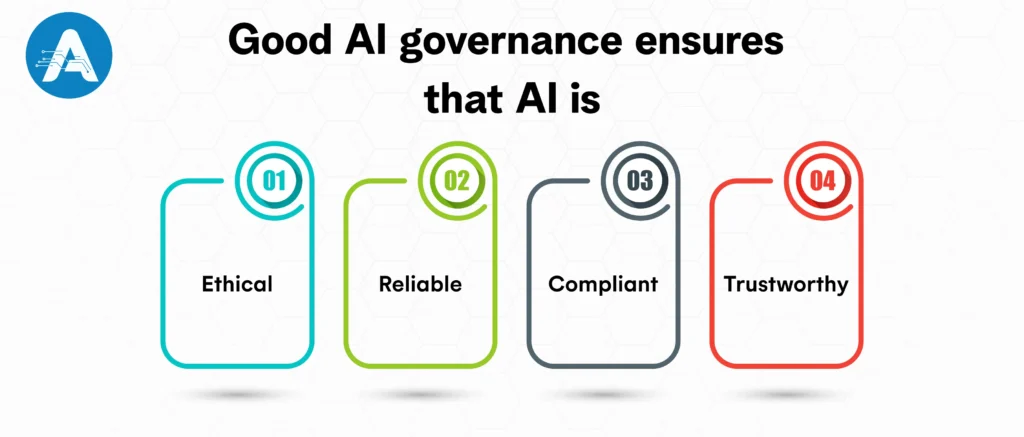
Good AI governance ensures that AI is:
Ethical – treats everyone fairly and reduces bias
Reliable – delivers accurate and consistent results
Compliant – follows laws and regulations
Trustworthy – builds confidence among teams, customers, and stakeholders
For example, while working with a fintech startup on an AI-based loan approval system, early testing showed the model was rejecting qualified applicants due to hidden data bias. By introducing AI governance early, false rejections were reduced by 30%, and trust was built with both customers and regulators.
In short, with the right governance in place, businesses can innovate with confidence knowing their AI systems are responsible, transparent, and built for long-term success.
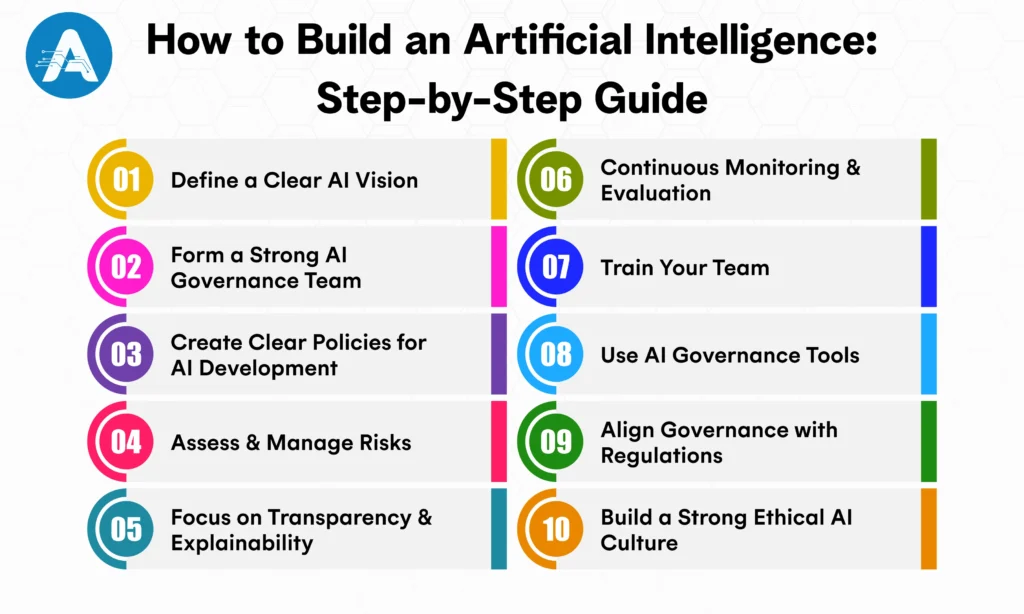
How to Build an Artificial Intelligence: Step-by-Step Guide
This step-by-step guide explains how to build an artificial intelligence system, from planning and data preparation to model development and deployment. It helps businesses and beginners understand the AI building process clearly and practically.
Step 1: Define a Clear AI Vision
Before you build an artificial intelligence, you need a clear purpose. Ask yourself:
What problem do you want your AI to solve?
What ethical values will guide your AI decisions?
How will you measure AI success?
For example, a healthcare company wanted to build an AI system for patient diagnosis. Their vision was clear and practical: AI should support doctors, not replace them, while ensuring safety, transparency, and fairness.
Tips to define your AI vision:
Make sure your AI supports your business goals
Involve people from different teams early
Keep ethics at the center while building AI
Step 2: Form a Strong AI Governance Team
To successfully build an AI model, you need the right people guiding it. Your AI governance team should include:
Ethics officers to ensure fairness and responsible AI building
Data scientists to develop and monitor AI models
Legal experts to manage compliance and regulations
Business leaders to align AI building with strategy
Example: A fintech company built an AI model for loan approvals. By involving legal, ethics, and business teams, they reduced bias and built customer trust.
Step 3: Create Clear Policies for AI Development
Policies are the foundation of build an artificial intelligence. They define how your AI is built, deployed, and managed. Focus on:
Data policies: Ensure data quality, privacy, and governance
Model policies: Set standards for accuracy, fairness, and explainability
Deployment policies: Plan monitoring, updates, and rollback strategies
Risk policies: Identify and manage AI risks and failures
For example, when a retail company decided to build an AI app for personalized marketing, clear policies helped prevent bias and protect customer trust. This approach made their AI building process ethical, transparent, and effective.
Step 4: Assess and Manage Risks
AI systems are not perfect, and failures can happen. Risk management helps protect the business from unexpected issues.
Identify risks such as bias, inaccurate results, and security gaps
Assess impact on finances, reputation, and daily operations
Reduce risks through human review, regular audits, and backup processes
For example, Uber’s AI-based pricing system once caused unfair surge pricing. Strong governance and risk controls could have reduced customer backlash and reputational damage.
Step 5: Focus on Transparency and Explainability
AI should not work like a black box. When AI decisions are clear and understandable, trust naturally increases.
Use models that are easier to interpret whenever possible
Keep records of AI decisions and actions
Use dashboards to track performance and fairness
For example, in healthcare, explainable AI helps doctors understand why a patient is marked as high risk, making AI decisions more reliable and accepted.
Step 6: Continuous Monitoring and Evaluation
AI systems change over time, so governance must be ongoing.
Monitor accuracy, bias, and performance changes
Update AI models with fresh and relevant data
Regularly review ethical impact and business outcomes
For example, Companies like Netflix continuously monitor recommendation systems to ensure content remains relevant and fair, showing how AI can be managed responsibly.
Step 7: Train Your Team
AI governance works best when employees understand how AI systems function and make decisions.
Training should focus on:
Ethical use of AI
Understanding AI outputs
Reporting errors, bias, or unexpected behavior
For example, Organizations that invest in AI training often see better adoption and fewer mistakes because employees become active contributors to responsible AI use.
Step 8: Use AI Governance Tools
Technology plays an important role in managing AI governance.
Track AI model versions and data sources
Check systems for bias and fairness
Monitor performance and compliance
For example, AI governance tools from leading technology providers help make build an artificial intelligence safer, clearer, and more controlled.
Step 9: Align Governance with Regulations
AI regulations are evolving quickly, and businesses must stay prepared.
Follow major AI laws and guidelines, such as the EU AI Act, which focuses on risk assessment for high-risk AI systems
Pay attention to regulations like the US Algorithmic Accountability Act that promote fairness and transparency
Build compliance into AI governance from the start instead of handling it at the last moment
For example, when governance and compliance work together, organizations can avoid legal risks and move forward with confidence.
Step 10: Build a Strong Ethical AI Culture
AI governance goes beyond policies and processes. It is also about building the right mindset across the organization.
Encourage teams to think critically and ask simple but important questions:
Is this AI decision fair and unbiased?
Could it negatively affect users or customers?
Who is responsible for the outcome of this AI decision?
For example, A strong ethical culture supports technical governance and helps build long-term trust in AI systems.
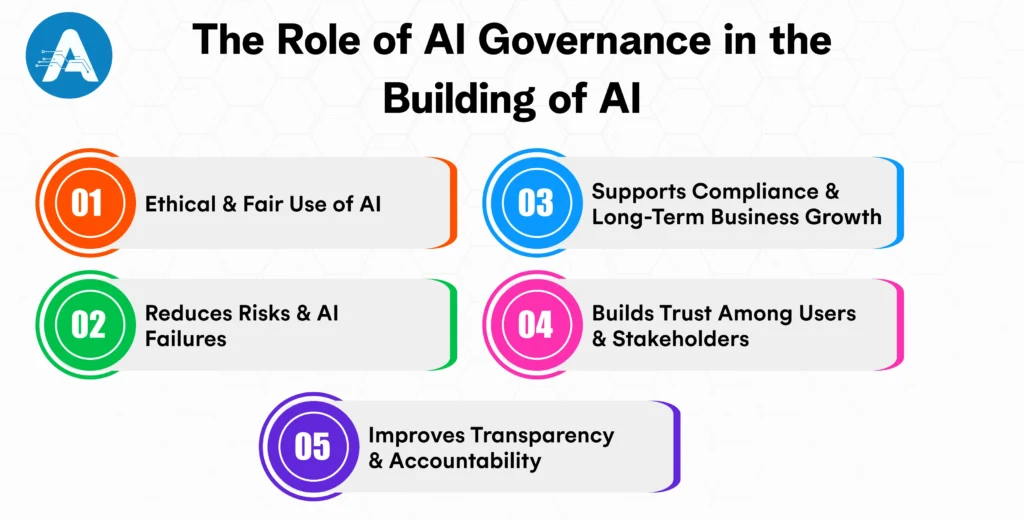
The Role of AI Governance in the Building of AI
For an AI development company, AI governance guides the building of AI by setting clear rules for responsible and ethical development. It helps reduce risks, improve transparency, and ensure AI systems are trustworthy.
Ethical and Fair Use of AI
An AI governance framework helps ensure that AI systems treat everyone fairly. It reduces the risk of bias, discrimination, and unfair outcomes by establishing clear rules for data use, model design, and decision-making. This is especially important in areas like hiring, lending, healthcare, and customer service, where AI decisions can directly affect people’s lives.
Reduces Risks and AI Failures
AI governance helps identify and manage risks such as incorrect predictions, system failures, data misuse, or security issues. By implementing controls, reviews, and monitoring, organisations can identify problems early and prevent costly mistakes that could impact operations or brand image.
Supports Compliance and Long-Term Business Growth
AI regulations are increasing worldwide. An AI governance framework helps organizations stay compliant with current and future laws while aligning AI initiatives with business goals and values. This allows companies to innovate safely, scale AI faster, and gain a long-term competitive advantage.
Builds Trust Among Users and Stakeholders
Trust is critical for AI adoption. When AI systems are governed properly, customers, employees, and partners feel more confident using them. Governance ensures transparency, clear ownership, and responsible use of AI, which strengthens trust and protects the organization’s reputation.
Improves Transparency and Accountability
With a governance framework, AI decisions are easier to understand and explain. It clearly defines who is responsible for AI outcomes and how decisions are made. This transparency makes it easier to review AI behavior, handle complaints, and ensure accountability across teams.
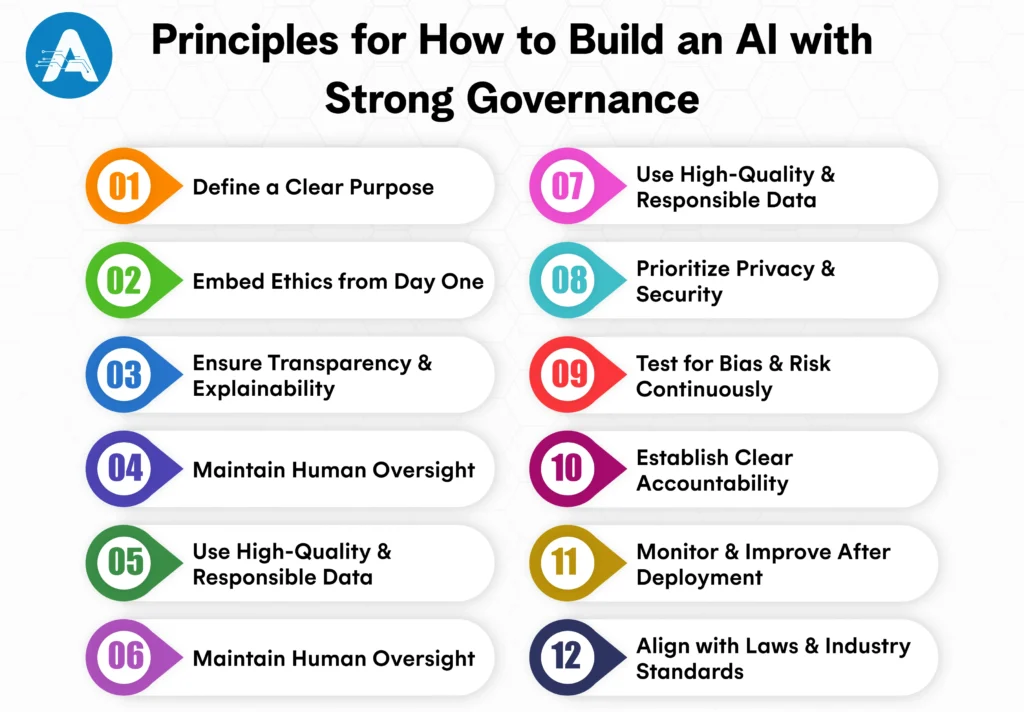
Principles for How to Build an AI with Strong Governance
AI application development services should focus on building solutions that are ethical, transparent, and aligned with business goals. Strong governance ensures data privacy, fairness, and human oversight throughout the AI development lifecycle. This approach builds trust, reduces risk, and enables responsible, scalable AI adoption.
Define a Clear Purpose
When building an AI system, it is important to start with a clearly defined purpose. The AI should address a specific business or user problem and support meaningful outcomes. Its goals must align with organizational values and ethical standards. A well-defined purpose helps guide development decisions and prevents misuse or unnecessary complexity.
Embed Ethics from Day One
Ethics should be integrated into AI development from the very beginning, not added later. Fairness, inclusivity, and responsible decision-making must guide data selection and model design. Addressing ethical risks early helps reduce bias and builds trust. This approach ensures the AI system behaves responsibly throughout its lifecycle.
Ensure Transparency and Explainability
AI systems should be designed so their decisions can be understood by users and stakeholders. Transparency helps explain how outcomes are generated and why certain decisions are made. This is especially important in high-impact areas such as healthcare or finance. Explainable AI builds confidence and strengthens governance.
Maintain Human Oversight
AI should assist human decision-making rather than replace accountability. Clear processes must be in place for human review and intervention when needed. Critical decisions should always involve human judgment. This ensures ethical control and prevents over-reliance on automated systems.
Use High-Quality and Responsible Data
The effectiveness of AI depends heavily on the quality of data used. Data should be accurate, unbiased, and collected through legal and ethical means. Poor-quality or biased data can lead to unreliable and unfair outcomes. Responsible data practices are essential for strong AI governance.
Prioritize Privacy and Security
Protecting user data must be a top priority when building AI systems. Privacy-by-design principles should be embedded throughout the development process. Strong security measures help prevent data breaches and misuse. Compliance with data protection regulations further strengthens trust and governance.
Test for Bias and Risk Continuously
AI governance does not end after deployment. Regular testing is required to identify bias, performance issues, and emerging risks. As data and usage patterns change, models must be reassessed and improved. Continuous evaluation ensures the AI remains fair, reliable, and safe.
Establish Clear Accountability
Clear ownership of AI systems is essential for effective governance. Organizations must define who is responsible for AI decisions, performance, and failures. Accountability ensures quicker issue resolution and better risk management. It also reinforces trust among users and stakeholders.
Monitor and Improve After Deployment
Once deployed, AI systems must be continuously monitored to ensure consistent performance. Changes in data or environment can impact accuracy and fairness. Regular updates and improvements help maintain alignment with governance standards. Ongoing monitoring supports long-term success.
Align with Laws and Industry Standards
AI systems must comply with applicable laws, regulations, and industry guidelines. Legal alignment reduces operational and reputational risks. Industry standards also promote ethical and responsible AI use. Compliance helps organizations build trust and scale AI solutions confidently.
The Future of AI Governance in Build an Artificial Intelligence
The future of AI governance will focus on balancing innovation with responsibility as AI becomes central to business and society. Governments and organizations will introduce clearer regulations, global standards, and ethical frameworks to support safe and responsible AI development without limiting growth.
AI governance will increasingly prioritize transparency, explainability, and accountability, especially when building high-risk AI systems. Organizations will be expected to clearly document how AI models are built, trained, and deployed. Regular audits and impact assessments will become a standard part of AI application development services.
Another major shift will be toward continuous and automated AI governance. Instead of one-time compliance checks, businesses will use monitoring tools to track bias, security, and performance in real time. This ensures AI systems remain compliant, fair, and reliable as they evolve.
Overall, the future of AI governance will be more human-centric and collaborative. Strong human oversight, cross-functional teams, and cooperation between regulators, developers, and businesses will be essential. This approach will build trust, enable responsible AI adoption, and support long-term, sustainable AI growth.
Reasons to Choose Artoon Solutions for Your AI Governance Needs
Partnering with Artoon ensures a structured and reliable approach when you build an artificial intelligenceor work on AI projects. Artoon combines deep expertise in AI development with strong governance frameworks, helping organizations reduce risks, ensure ethical practices, and maintain transparency throughout the AI lifecycle.
Moreover, with Artoon, businesses can confidently build an AI, knowing that every model, app, or system follows best practices for compliance, accountability, and performance. From designing AI solutions to monitoring and improving them, Artoon provides the guidance and tools needed for safe, trustworthy, and scalable AI.
Furthermore, choosing Artoon for AI governance ensures your AI initiatives are not only innovative but also aligned with business goals, ethical standards, and regulatory requirements, turning AI projects into long-term value for your organization.
Wrapping Up
AI governance is no longer optional; it is a critical part of building responsible and successful AI systems. A strong governance framework helps reduce risks, improve transparency, and ensure AI solutions remain ethical, reliable, and aligned with business goals. It also builds trust among users, customers, and stakeholders while supporting long-term growth.
By embedding governance into every stage of AI development, organizations can innovate with confidence. The right approach to AI governance ensures that artificial intelligence is not only powerful but also safe, compliant, and built for long-term success.
Planning for AI Project
Get clarity on use cases, architecture, costs, and timelines with insights from 50+ real-world AI implementations.
1. How to build an artificial intelligence system responsibly?
To build an artificial intelligence system responsibly, organizations must combine strong technical development with AI governance. This includes using quality data, reducing bias, ensuring transparency, and continuously monitoring AI performance to align with ethical and business goals.
2. How does AI governance support the building of AI models?
AI governance supports building AI models by setting standards for fairness, accuracy, and explainability. It also ensures models are regularly reviewed and updated to maintain performance and trust.
3. Why is AI governance important when you build an AI?
AI governance is important when you build an AI because it helps control risks such as biased decisions, data misuse, and system failures. It ensures AI systems are reliable, compliant, and trusted by users and stakeholders.
4. How to build an AI app with governance in place?
When learning how to build an AI app, governance should be integrated from the start. This includes setting clear objectives, protecting user data, testing for bias, and monitoring app performance after deployment.
5. Is AI governance necessary for businesses planning to build an AI?
Yes, AI governance is essential for businesses involved in AI building. It ensures AI initiatives align with business goals, meet regulations, and deliver consistent value without unnecessary risk.
6. Why is monitoring important in AI building?
Monitoring is critical in AI building because models can degrade over time due to new data or changing conditions. Governance frameworks provide processes to track accuracy, fairness, and reliability continuously.
7. Can governance make AI building faster and safer?
Yes, governance makes AI building faster and safer by providing structured processes, early risk detection, and guidelines for responsible development. This allows teams to innovate confidently while avoiding costly mistakes.
8. How to Build an AI Model with Governance?
Knowing how to build an AI model responsibly requires integrating governance at every stage. Governance ensures that data, algorithms, and outputs meet ethical, legal, and operational standards. It reduces bias, improves explainability, and maintains consistent performance, allowing AI models to deliver reliable and trustworthy results.
Design workflows are evolving at breakneck speed. AI Image Generators have officially transitioned from experimental “toys” to essential everyday assets for modern creatives. The…