AI Platform •
14 min read •January 2, 2026•119 views
Leveraging ERP AI Chatbots for Smarter Business Operations
Table of Contents
As businesses grow, managing day-to-day operations becomes increasingly complex. Finance, HR, inventory, sales, and customer data are often scattered across multiple systems, making it difficult to access the right information at the right time. To overcome this challenge, many organizations rely on enterprise resource planning (ERP) systems to bring all critical business functions onto a single platform.
However, even the most advanced ERP platforms often feel powerful yet complicated. Users struggle with complex dashboards, slow data retrieval, and inefficient workflows, which can limit adoption and productivity. At the same time, today’s fast-moving digital world demands instant responses, real-time insights, and seamless access to information for customers, employees, and leadership teams alike.
This is where an ERP AI Chatbot becomes a true game-changer. By combining artificial intelligence with ERP systems, these chatbots simplify how users interact with enterprise data. Instead of navigating multiple screens and reports, users can simply ask questions and receive accurate, real-time answers, making ERP systems more intuitive, responsive, and business-friendly.
According to 2025 industry research, over 70% of ERP vendors have integrated AI-enabled capabilities, highlighting the rapid adoption of intelligent technologies in ERP platforms. Businesses that utilize AI-powered ERP Chatbot tools can make decisions more quickly and work more efficiently, as they receive information faster. Many organizations are also utilizing chatbots for everyday internal tasks, making ERP systems easier and more natural to use.
In this blog, we will explore how ERP chatbot works, why they matter for modern enterprises, and how they are reshaping the way businesses interact with enterprise resource planning systems to operate smarter and faster.
Understanding ERP in the Modern Business Environment
Before understanding how chatbots transform ERP systems, it is important to first understand what an ERP system is and why it matters in today’s business environment.
An enterprise resource planning (ERP) system is the backbone of an organization. It integrates core business processes such as finance, human resources, supply chain, inventory, procurement, sales, and customer management into one centralized platform. The primary goal of ERP software is to eliminate data silos, reduce manual work, and enable smoother, more efficient operations across departments.
Whether a business uses ERP software to manage payroll, track inventory, process invoices, or forecast demand, the objective remains the same: centralized data, better visibility, and streamlined decision-making. With the rise of online ERP software and cloud-based ERP systems, organizations can now access critical business information anytime and from anywhere.
User Experience Challenges in Traditional ERP Platforms
Despite their power, many ERP platforms are often perceived as complex and difficult to navigate. Employees may need extensive training just to perform simple tasks like checking reports or retrieving basic data. Even experienced users can find daily ERP interactions time-consuming.
Some common challenges include:
Interfaces that are difficult to understand and navigate
Too many screens are required to find a single piece of information
Reliance on IT teams for simple reports and routine queries
Delays in accessing real-time, actionable insights
As businesses grow and operations become more dynamic, these limitations can slow productivity and reduce overall ERP adoption. This is why ERP systems must evolve to become more user-friendly and responsive.
The Rise of ERP AI Chatbots
An ERP AI Chatbot is an intelligent virtual assistant developed using advanced AI application development services that connects directly with an enterprise resource planning system. Instead of navigating multiple dashboards and modules, users can interact with the ERP platform through simple, conversational language, making everyday tasks faster and easier.
Just like messaging apps or voice assistants used in daily life, ERP AI chatbots bring the same level of simplicity to ERP online systems. With the support of AI application development services, users can ask routine questions about sales performance, overdue invoices, inventory availability in a specific warehouse, or payroll status and receive instant, accurate answers. The chatbot understands each request, retrieves real-time data from the ERP system, and delivers responses seamlessly without the need to switch between different ERP modules.
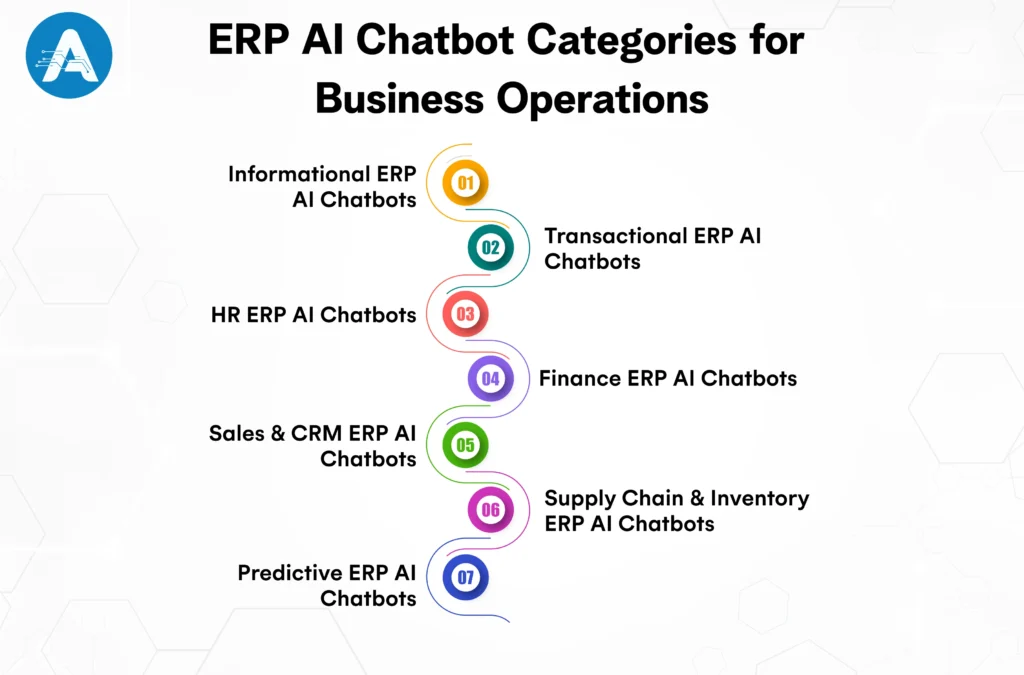
ERP AI Chatbot Categories for Business Operations
ERP AI chatbots can be grouped into several types based on how businesses use them within enterprise resource planning systems.
Informational ERP AI Chatbots
These chatbots answer common ERP questions by providing real-time data from finance, HR, sales, inventory, and procurement modules.
Transactional ERP AI Chatbots
These chatbots allow users to complete ERP tasks through chat, such as creating purchase orders, approving requests, or updating records.
HR ERP AI Chatbots
These chatbots support HR activities like payroll inquiries, leave balance checks, attendance tracking, and employee onboarding.
Finance ERP AI Chatbots
Designed for accounting teams, these chatbots help track invoices, payments, budgets, and financial reports directly from the ERP system.
Sales and CRM ERP AI Chatbots
These chatbots provide instant access to customer details, order status, pricing, and sales performance data.
Supply Chain and Inventory ERP AI Chatbots
Used in operations and logistics, these chatbots show stock levels, warehouse availability, order tracking, and supplier information.
Predictive ERP AI Chatbots
Advanced ERP AI chatbots use historical ERP data to deliver forecasts, trends, and insights for smarter planning and decision-making.
Essential Features of ERP AI Chatbots for Businesses
An Artificial Intelligence app development company plays a crucial role in building ERP AI chatbots that align with business goals and integrate seamlessly with enterprise systems. These chatbots combine intelligent automation, real-time ERP data access, and secure workflows to help organizations improve efficiency, decision-making, and overall system usability.
Natural language understanding: Allows interaction with ERP systems using simple, conversational language instead of technical commands or complex queries.
Real-time ERP data access: Retrieves live information from finance, HR, sales, inventory, and other ERP modules without delays.
Multi-module integration: Connects seamlessly with multiple ERP modules to deliver a unified and consistent view of business data.
Task and transaction execution: Enables actions like approvals, record updates, request creation, and submissions directly through chat.
Role-based access control: Ensures secure ERP usage by allowing access only to data and actions permitted by assigned roles.
AI-driven insights and recommendations: Analyze ERP data to identify trends, exceptions, and insights that support better business decisions.
24/7 availability provides: Uninterrupted access to ERP information and support, regardless of time or location.
Omnichannel support: Works across web platforms, mobile devices, and collaboration tools for flexible ERP access.
Scalability and customization: Adapt easily to business growth and can be tailored to specific ERP workflows and requirements.
Secure and compliant framework: Maintains data security, audit logs, and compliance with enterprise standards and regulations.
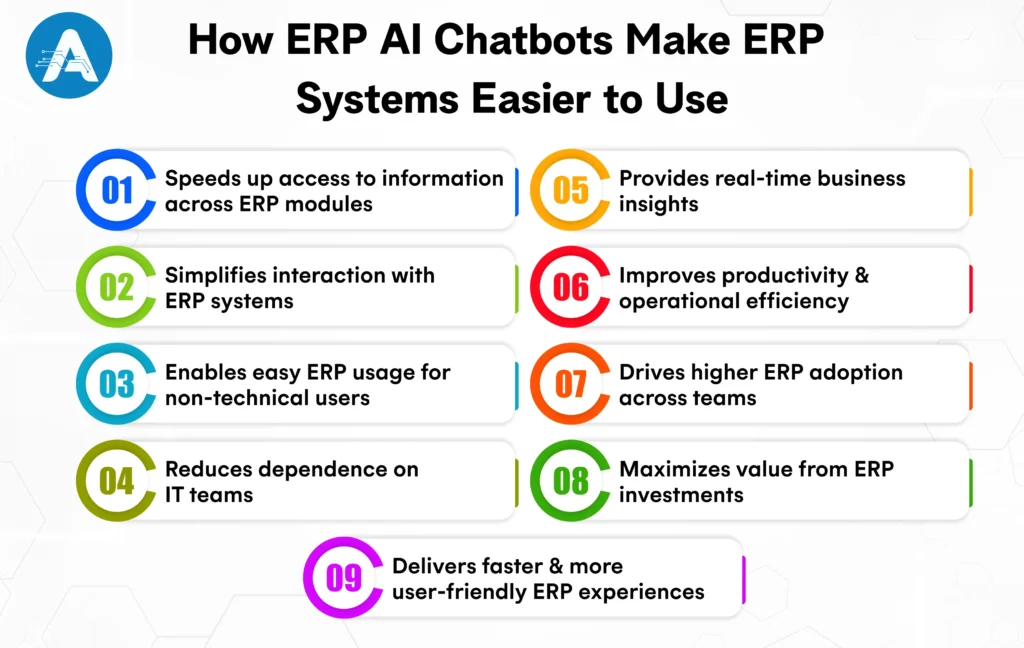
How ERP AI Chatbots Make ERP Systems Easier to Use
ERP AI chatbots act as a bridge between users and complex ERP platforms. They do not replace ERP systems but enhance them by making interactions simpler and more intuitive. By enabling conversational access to ERP data, these chatbots reduce the effort required to navigate dashboards and reports, allowing faster access to critical business information.
This approach offers key advantages that benefit businesses in the following ways:
Speeds up access to information across ERP modules: Users can quickly retrieve data from finance, HR, sales, and inventory without navigating multiple screens or reports.
Simplifies interaction with ERP systems: Conversational access reduces interface complexity and makes daily ERP tasks easier to perform.
Enables easy ERP usage for non-technical users: ERP functions can be accessed without extensive training or deep technical knowledge.
Reduces dependence on IT teams: Routine data queries and report generation can be handled directly without IT involvement.
Provides real-time business insights: Instant access to live data supports quicker and more informed business decisions.
Improves productivity and operational efficiency: Less time spent on system navigation allows teams to focus on higher-value work.
Drives higher ERP adoption across teams: Simpler access encourages regular usage across departments and roles.
Maximizes value from ERP investments: Better usability ensures organizations fully leverage their enterprise resource planning systems
Delivers faster and more user-friendly ERP experiences: This is especially valuable for businesses using cloud-based ERP systems where speed and accessibility matter most.
For example, imagine a retail company that relies on an ERP online system to track inventory and sales performance.
Without an ERP AI chatbot, managers spend valuable time navigating multiple screens and exporting reports just to get basic insights. This slows down decision-making and increases day-to-day operational effort.
With an ERP AI chatbot, the same information is available through simple, conversational queries. Teams can access real-time data faster, reduce manual work, and focus more on important business priorities.
As a result, everyday operations become smoother and more efficient.
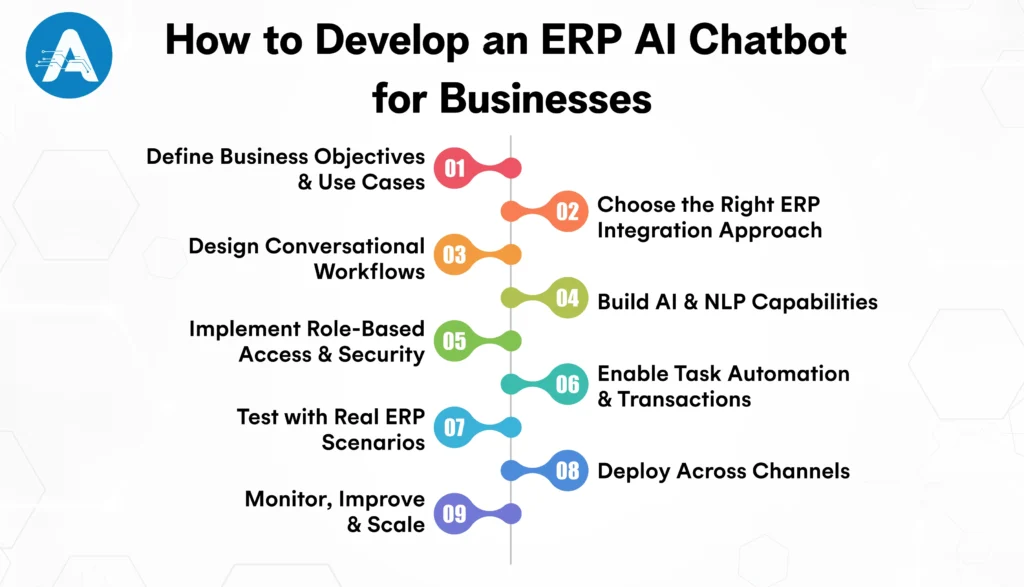
How to Develop an ERP AI Chatbot for Businesses
Developing an ERP AI chatbot involves integrating artificial intelligence with enterprise resource planning systems to create a seamless, efficient, and user-friendly conversational interface. An experienced AI application developer can help design, build, and integrate the chatbot seamlessly with your ERP platform. Below are the key steps involved in the development process.
1. Define Business Objectives and Use Cases
Start by identifying what the ERP AI chatbot should achieve. Common use cases include answering ERP queries, generating reports, automating approvals, or handling HR and finance requests. Clear objectives ensure the chatbot aligns with business needs.
2. Choose the Right ERP Integration Approach
The chatbot must connect securely with the ERP system using APIs or middleware. A skilledAI application developer ensures real-time access to ERP modules such as finance, HR, inventory, sales, and procurement without disrupting existing workflows.
3. Design Conversational Workflows
Create simple, intuitive conversation flows that mirror actual business questions. The chatbot should understand natural language queries and guide users smoothly through ERP-related tasks.
4. Build AI and NLP Capabilities
Implement natural language processing (NLP) and machine learning to help the chatbot accurately understand user intent, context, and variations in questions. This ensures precise data retrieval and meaningful interactions.
5. Implement Role-Based Access and Security
Ensure the ERP AI chatbot respects ERP user roles and permissions. This step protects sensitive business data and maintains compliance across departments.
6. Enable Task Automation and Transactions
Configure the chatbot to perform actions such as approvals, record updates, request creation, and status checks, in addition to providing instant answers to queries.
7. Test with Real ERP Scenarios
Conduct thorough testing using real-world ERP queries and workflows. This step validates accuracy, performance, and security before deployment.
8. Deploy Across Channels
Make the ERP AI chatbot accessible on web portals, mobile apps, and collaboration platforms to provide easy access for all teams.
9. Monitor, Improve, and Scale
Continuously monitor the chatbot’s performance, refine responses based on user feedback, and expand features as business needs evolve to ensure the ERP AI chatbot remains effective and up to date.
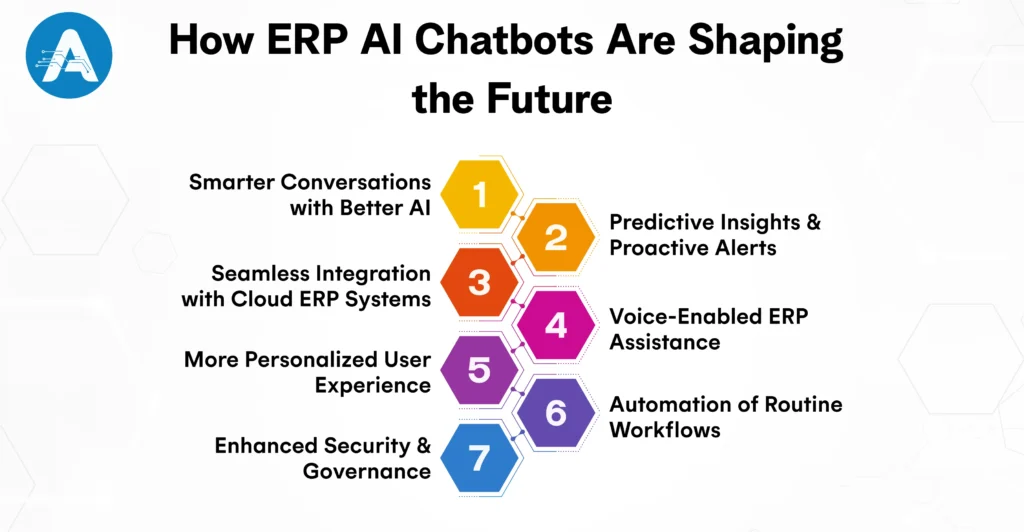
How ERP AI Chatbots Are Shaping the Future
The future of ERP AI chatbots is looking very promising as AI technology keeps improving and business needs keep changing. These chatbots will become smarter, more proactive, and easier to use, helping teams get insights faster. They will also automate routine tasks, personalize responses for different users, and work seamlessly with cloud ERP systems.
Smarter Conversations with Better AI
ERP chatbots will become even more intelligent, understanding complex questions and context more accurately. Instead of simple replies, they will offer deeper insights, predictions, and suggestions.
Predictive Insights and Proactive Alerts
Rather than waiting for you to ask, future chatbots will proactively surface important insights, such as warnings about low inventory, cash flow issues, or upcoming deadlines, before you even notice them.
Seamless Integration with Cloud ERP Systems
As more businesses move to cloud-based ERP systems, chatbots will work more smoothly with mobile and remote workflows. You’ll be able to get updates and take action from anywhere, anytime.
Voice-Enabled ERP Assistance
Voice control is becoming more common in everyday tools. Soon, you may be able to talk to your ERP AI chatbot just like you talk to a voice assistant, making data access even faster and hands-free.
More Personalized User Experience
Chatbots will learn individual user habits and preferences, tailoring responses based on roles, past behavior, and work patterns. For example, a finance manager and supply chain lead will get different insights based on what they need most.
Automation of Routine Workflows
Beyond answering questions, future ERP AI chatbots will automate simple workflows, like approving purchase requests, creating invoices, or scheduling tasks, saving even more time.
Enhanced Security and Governance
As chatbots become more capable, they will also come with stronger security features, ensuring sensitive ERP data remains protected while enabling flexible access.
What makes Artoon the best choice for your ERP AI chatbot?
When it comes to choosing a partner for your best ERP AI chatbot, you want more than just technical expertise. You need a team that understands your business, your processes, and your goals. Artoon combines deep knowledge of enterprise resource planning systemswith advanced AI and natural language capabilities, ensuring your ERP AI chatbot works seamlessly with your workflows and delivers accurate, actionable insights.
Our AI experts create custom solutions that fit your industry, your data, and your needs, whether you are using cloud-based ERPsystemsor anonline ERP software platform. Our focus is on making your life easier by designing chatbots that are intuitive and simple to use, helping your team get answers quickly, reduce repetitive work, and increase adoption.
Moreover, you will see measurable results such as faster access to insights, reduced manual effort, and improved operational efficiency. Security and reliability are a priority, protecting your sensitive ERP data with enterprise-grade safeguards while providing ongoing support to help your chatbot evolve as your business grows. This ensures that your ERP AI chatbot becomes a strategic tool for smarter business operations and a true partner in your success.
If you are looking for the right partner to implement your ERP AI chatbot, contact the services of Artoon and take the first step toward smarter business operations.
Planning for AI Project
Get clarity on use cases, architecture, costs, and timelines with insights from 50+ real-world AI implementations.
An ERP AI chatbot is a smart assistant for your enterprise resource planning system. It helps you access data, generate reports, and perform tasks quickly. You can use simple conversations instead of navigating complex ERP dashboards.
2. How can an ERP AI chatbot help my business?
Your ERP AI chatbot improves efficiency and reduces manual work. By giving real-time insights from your ERP software solutions, you help your team make faster decisions and focus on more important tasks.
3. Can it integrate with existing ERP software?
Absolutely. ERP AI chatbots integrate with your enterprise resource planning ERP systems, ensuring smooth workflows and faster access to information without disrupting current processes.
4. How secure is an ERP AI chatbot?
Security is a priority. ERP AI chatbots work with your enterprise resource planning system using encryption, role-based access, and enterprise-grade safeguards to protect your sensitive business data.
5. Will it reduce the dependency on IT teams?
Yes, it will. Your ERP AI chatbot can handle routine queries and simple tasks. This frees your IT team to focus on strategic projects. Your employees can get answers directly without waiting for support.
6. Can it automate tasks in ERP systems?
Yes, ERP AI chatbots can automate repetitive workflows like report generation or order tracking. This reduces manual work and saves valuable time for your team. It helps your business operate more efficiently and accurately.
7. Is it suitable for small and medium businesses?
Absolutely. Even SMEs using online ERP software can benefit from an ERP AI chatbot. It helps reduce errors, saves time, and improves productivity. Your team can get insights and updates quickly without complex processes.
Design workflows are evolving at breakneck speed. AI Image Generators have officially transitioned from experimental “toys” to essential everyday assets for modern creatives. The…