AI Platform •
9 min read •February 11, 2026•13 views
How Predictive Analytics for Supply Chain Optimizes Operations
Table of Contents
Supply chains are always operating in a state of uncertainty, whether it is a change in demand, a supplier glitch, or rising logistics costs. It is difficult to react quickly when relying on old reports or manual planning. This is where Predictive Analytics for Supply Chain comes into play.
By leveraging both past and current information, predictive analytics seeks to predict what is to come and inform better decisions. Instead of reacting to problems when they occur, companies can forecast demand, optimize inventory, and maximize efficiency before the fact.
Moving from traditional, reactive analytics to predictive, data-driven models helps organizations improve accuracy, reduce costs, and sustain service levels even in turbulent environments.
This shift from traditional supply chain analytics to predictive, data-driven models enables organizations to improve accuracy, reduce costs, and maintain service levels even in volatile conditions.
As digital transformation accelerates, predictive analytics in supply chain has become essential for building resilient and agile operations. AI development companies that adopt predictive approaches gain better visibility, faster response times, and a measurable competitive advantage across their supply chain.
What Is Predictive Analytics in the Supply Chain
Predictive analytics in supply chain involves the use of data, statistics, and machine learning algorithms to predict what will happen next in the supply chain. It is not only focused on what happened but on what is likely to happen next.
How Predictive Analytics Differs from Traditional Analytics
Traditional analytics in supply chain is all about analyzing history. It seeks answers to questions like:
What happened?
Why did it happen?
On the other hand, Supply chain predictive analytics is all about looking ahead. It combines historical patterns with real-time data to predict what will happen next.
What Predictive Analytics Enables
Using predictive analytics, businesses can:
Make more accurate predictions about demand
Predict inventory shortages or overages
Predict logistics-related delays and transportation-related risks
Identify potential issues with suppliers’ performance early on
This advanced analysis of supply chain data allows teams to respond before problems impact operations.
Why It Matters
The ability to use data to make predictions and look ahead makes Predictive Analytics for Supply Chain a powerful tool that goes beyond simple reporting. It helps to eliminate uncertainty, improve efficiency, and make better decisions about planning and procurement.
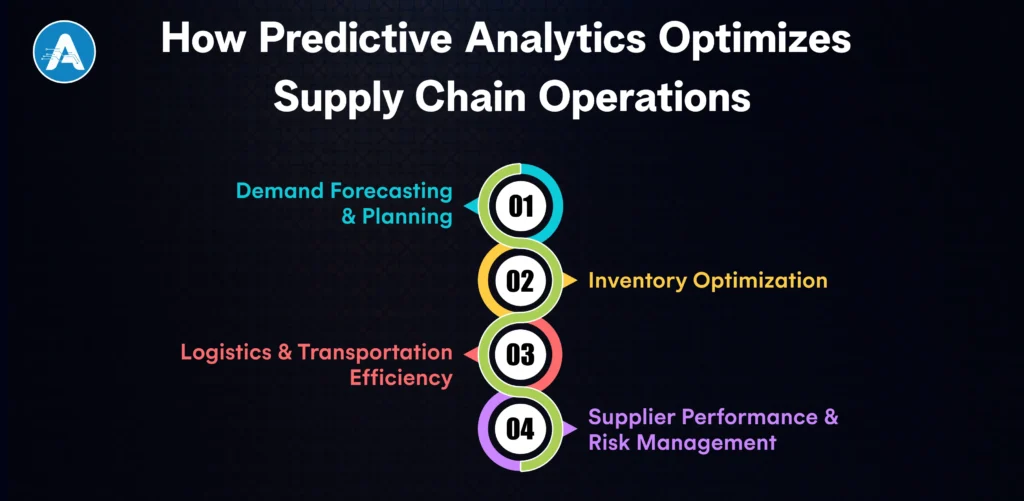
How Predictive Analytics Optimizes Supply Chain Operations
Predictive Analytics for Supply Chain enables organizations to move from reactive problem-solving to proactive optimization. By forecasting future scenarios, businesses can plan more accurately, reduce costs, and improve overall efficiency across supply chain functions.
1. Demand Forecasting and Planning
Predictive models analyze historical sales data, market trends, seasonality, and real-time demand signals to forecast future demand more accurately. This helps organizations align production and procurement with actual market needs.
Example: A manufacturer can predict demand surges during peak seasons and adjust production schedules in advance, avoiding last-minute capacity constraints or missed sales opportunities.
2. Inventory Optimization
Using predictive supply chain analytics, businesses can determine optimal inventory levels across multiple locations. Predictive insights help balance service levels with carrying costs by identifying when and where stock will be needed.
Example: Retailers can automatically adjust reorder points based on predicted demand fluctuations, reducing overstock while preventing stockouts.
3. Logistics and Transportation Efficiency
Predictive analytics improves logistics planning by forecasting delivery times, transportation risks, and route performance. This enables smarter analytics supply chain decisions and proactive delay management.
Example: Logistics teams can anticipate potential shipment delays caused by traffic patterns or weather conditions and reroute deliveries before service levels are impacted.
4. Supplier Performance and Risk Management
Predictive analytics helps assess supplier reliability by analyzing historical performance, lead times, and external risk factors. This supports more accurate supply chain analysis processes and early risk detection.
Example: Procurement teams can receive alerts about suppliers likely to miss delivery commitments, allowing them to secure alternative sourcing in advance.
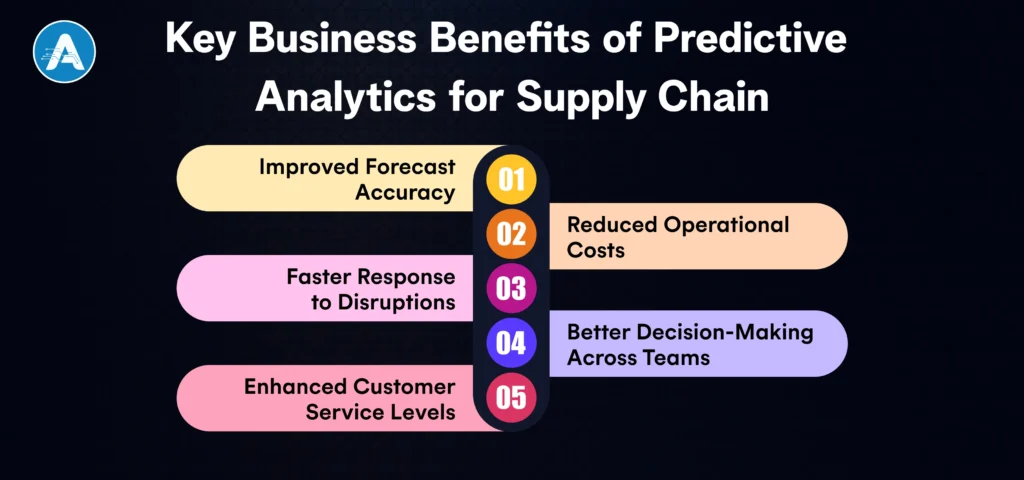
Key Business Benefits of Predictive Analytics for Supply Chain
Implementing Predictive Analytics for Supply Chain delivers measurable improvements across cost, efficiency, and decision-making. Instead of relying on assumptions or static plans, organizations gain forward-looking insights that support smarter and faster actions.
1. Improved Forecast Accuracy
Predictive models reduce guesswork by analyzing patterns in demand, seasonality, and external factors. This leads to more reliable forecasts and better alignment between supply and demand.
2. Reduced Operational Costs
By optimizing inventory levels, transportation routes, and production planning, businesses can significantly lower holding costs, expedited shipping expenses, and resource waste.
3. Faster Response to Disruptions
With predictive insights, teams can identify potential risks, such as supplier delays or logistics bottlenecks, before they escalate. This allows proactive mitigation rather than reactive firefighting.
4. Better Decision-Making Across Teams
Shared insights from analytics in supply chain improve coordination across procurement, operations, and logistics.
5. Enhanced Customer Service Levels
Accurate demand planning and reliable delivery forecasts help ensure products are available when and where customers need them, improving satisfaction and trust.
Technologies Powering Predictive Analytics in Supply Chain
The success of Predictive Analytics for Supply Chain depends on the right combination of technologies that enable accurate forecasting and real-time decision-making.
Key Technologies Used here:
Artificial Intelligence & Machine Learning
Identify complex patterns in large supply chain datasets
Continuously improve predictions as new data is introduced
Enable advanced demand forecasting, risk detection, and optimization
Process large volumes of structured and unstructured data
Support scalable and cost-effective analytics
Enable faster deployment of predictive models across operations
Real-Time Data Integration
Combines data from ERP, WMS, TMS, IoT devices, and external sources
Improves accuracy by updating predictions as conditions change
Supports proactive adjustments to inventory and logistics plans
Advanced Analytics Tools & Dashboards
Translate predictive insights into actionable visual reports
Help stakeholders quickly understand risks and opportunities
Improve cross-team visibility and collaboration
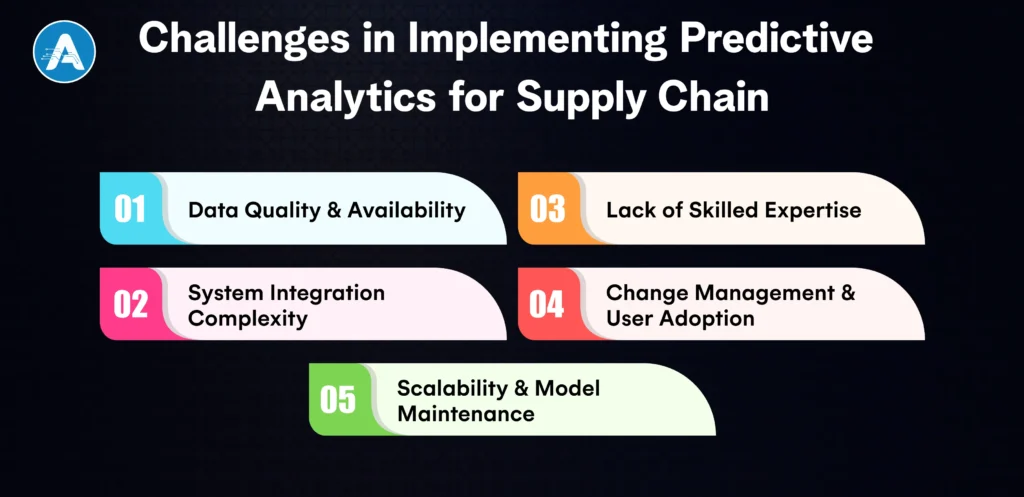
Challenges in Implementing Predictive Analytics for Supply Chain
Although Predictive Analytics for Supply Chain presents considerable operational benefits, there are various challenges associated with its successful implementation. These issues should be addressed at an early stage in order to make perfect predictions and value in the long run.
Data Quality and Availability
Data quality is one of the largest issues with Predictive Analytics for Supply Chain. Supply chain data tends to be decentralized in several systems, including ERP, WMS, and TMS, and creates discrepancies and gaps.
Incomplete or inaccurate data reduces prediction reliability
Siloed systems limit end-to-end visibility
Historical data may not reflect current market dynamics
System Integration Complexity
Application of Predictive Analytics for supply chain necessitates smooth collaboration with the current supply chain systems. Predictive insights cannot be put to real-time use without appropriate integration.
Difficulty connecting analytics platforms with legacy systems
Delayed data flow is impacting prediction accuracy
Minor automation in supply chain procedures
Lack of Skilled Expertise
Another major challenge in Predictive Analytics for Supply Chain is the shortage of skilled professionals who understand both analytics and supply chain operations.
Need for data science and machine learning expertise
Dependence on experienced AI and analytics teams
Limited in-house capability to build and maintain models
Change Management and User Adoption
Even with accurate insights, Predictive Analytics for Supply Chain may fail if teams do not trust or adopt predictive recommendations.
Resistance to moving away from manual planning methods
Lack of training and user confidence
Difficulty aligning predictive outputs with existing workflows
Scalability and Model Maintenance
As supply chains evolve, Predictive Analytics for Supply Chain models must adapt to new data, suppliers, and market conditions.
Models require continuous monitoring and retraining
Scalability challenges as data volume increases
Risk of declining accuracy over time without optimization
By addressing these challenges with the right data strategy, technology foundation, and skilled resources, organizations can unlock the full potential of Predictive Analytics for Supply Chain and drive sustained operational excellence.
Conclusion
Predictive Analytics for Supply Chain is now an important organizational requirement that operates in a relatively dynamic and uncertain environment. With reactive changing to proactive analysis, companies can be able to predict demand precisely, manage inventory better, and be aware of the disruption well in advance of it impacting businesses.
Due to the fact that predictive models make use of real-time and past data, supply chain teams are more visible and in control of procurement, logistics, and distribution. This will result in reduced operation costs, enhanced service delivery, and speed. By working with the right AI application developers and adopting scalable AI application development services, businesses can overcome implementation challenges and maximize the long-term value of predictive analytics.
Planning for AI Project
Get clarity on use cases, architecture, costs, and timelines with insights from 50+ real-world AI implementations.
Predictive Analytics to Supply Chain applies historical and real-time data, statistical and machine learning models in the prediction of future supply chain outcomes. It assists businesses to predict demand, manage inventory, minimize risk, and conduct proactive business decisions rather than responding to procurement errors through post-facto decision-making.
2. What is the difference between predictive and traditional supply chain analytics?
Conventional supply chain analytics is the one that looks at the previous performance and gives an explanation as to what has occurred. Conversely, predictive analytics in supply chain is prospective and involves looking into the future by forecasting what is expected to occur next using data patterns to plan and make decisions, and its implementation is faster.
3. What are the issues that predictive analytics will address within the supply chain operations?
The supply chain predictive analytics assists in solving some of the most widespread issues, such as poor demand forecasting, oversupply or undersupply of inventory, delays in logistics, or disruptive suppliers. Through a better analysis of supply chain data, the businesses will be able to cut the expenses and achieve a higher level of service.
4. What are the technologies needed in predictive analytics in the supply chain?
The use of Predictive Analytics of Supply Chain demands artificial intelligence and machine learning models, big data and cloud analytics systems, and real-time data integration, as well as an advanced analytics dashboard. These predictive systems require the contribution of talented individuals, including an Artificial Intelligence Developer, to create and support them.
5. Will predictive analytics fit the small and mid-sized supply chains?
Yes. Whereas predictive analytics was previously only used in large businesses, nowadays cloud-based analytics supply chain solutions open up the technology to small and mid-sized businesses. Companies may begin with a few use cases, like demand forecasting or inventory optimization, and increase predictive capability as time goes on.
Design workflows are evolving at breakneck speed. AI Image Generators have officially transitioned from experimental “toys” to essential everyday assets for modern creatives. The…