AI Platform •
13 min read •January 5, 2026•100 views
SLM vs LLM: How to Choose the Best AI Model for Your Business Success
Table of Contents
SLM vs LLM Imagine you are running a growing online business. Orders are coming in, customers are engaging, and everything is moving fast. But behind the scenes, your team is spending hours answering the same questions every single day. Where is my order? How do I get a refund? Can you share product details again?
At some point, you pause and think, there has to be a smarter way to handle this. That is when AI language models come into play.
You start exploring options, and suddenly you are faced with a confusing choice. SLM vs LLM.
Should you use a small language model that is fast, affordable, and designed for specific tasks? Or should you invest in a large language model that promises advanced intelligence but comes with higher costs and greater infrastructure requirements?
This is where many businesses get stuck.
Not every task needs a massive language model AI with deep reasoning capabilities. In many real-world cases, small language models can solve business problems more efficiently than large AI systems. But in other situations, LLMs are exactly what you need.
The real challenge is knowing which AI model actually fits your business goals and which one will quietly drain your budget without delivering results.
That is why understanding SLM vs LLM is so important for your business growth.
In this guide, you will learn how small language models and large language models work, where each one performs best, and how an AI application developer can help you choose the right model to improve efficiency, reduce costs, and scale your business with confidence.
What Is a Small Language Model (SLM)?
A small language model is a focused type of AI language model built to perform specific tasks efficiently. SLM models are designed to deliver accurate results while using fewer resources, making them practical for everyday business use.
These small language models are trained with fewer parameters, which means they require less computing power and lower infrastructure costs. A small model is easier to deploy, faster to run, and simpler to maintain, especially for businesses working with limited budgets or technical teams.
In real business environments, small language models are commonly used for repetitive and well-defined tasks such as customer support automation, document classification, internal search systems, invoice processing, and workflow automation. A small LLM works effectively when it is trained on business-specific data and clear rules.
This is why many organizations choose small LLM models when speed, cost efficiency, and reliability are top priorities.
What Is a Large Language Model (LLM)?
Large language models are designed to handle complex and varied language tasks. They can understand broader context, connect ideas across topics, and respond more flexibly and conversationally. This makes them useful when tasks are not fixed or when requirements change frequently.
An LLM AI model is trained on massive datasets that include books, websites, articles, and code. This allows the language model AI to understand context deeply and generate human-like responses across many different use cases.
Large language models are widely used for long-form content creation, advanced analysis, multilingual translation, coding assistance, and strategic support across teams. Their flexibility makes them valuable for businesses that need AI to work across multiple functions.
However, this capability requires more computing power and higher operational investment.
SLM vs LLM: A Comparative Overview
Choosing between small language models vs large language models depends on your resources, speed needs, and business use case. A large language model (LLM AI model) provides higher accuracy and versatility for complex tasks, while small language models (SLMs) focus on faster performance, lower costs, and efficient task automation.
Many businesses consult AI application development services to implement the right model for their goals and ensure seamless integration into workflows. The table below highlights the key differences between SLM vs LLM, helping you select the best AI language model for your business needs.
Key Consideration
Small Language Models (SLMs)
Large Language Models (LLMs)
Model Size
Compact models with millions of parameters, optimized to perform specific language tasks efficiently
Very large models with billions of parameters, designed to handle broad and complex language understanding across many domains
Cost Efficiency
Highly cost-efficient for daily operational tasks and high-volume usage
High and requires powerful GPUs, large memory, and scalable cloud infrastructure
Latency
Low latency with fast response times, ideal for real-time applications
Higher latency due to heavier processing per request
Deployment
Can run on edge devices, mobile apps, local servers, or private clouds
Primarily cloud-based due to heavy infrastructure needs
Training Data
Requires less task-focused training data
Trained on massive and diverse datasets for general-purpose intelligence
Accuracy
Moderate to high accuracy for well-defined and repetitive tasks
Very high accuracy for complex reasoning and long-context understanding
Scalability
Scales efficiently with low resource consumption
Highly scalable but resource-intensive as usage grows
Data Privacy
Better control since models can run on-premise or locally
Cloud processing raises privacy and compliance concerns
Advanced chatbots, content creation, research, analytics, and multi-domain reasoning
Ideal For
Startups, SMBs, and enterprises focused on efficiency and cost control
Enterprises with complex requirements and larger AI budgets
Key Differences between SLMvs LLM
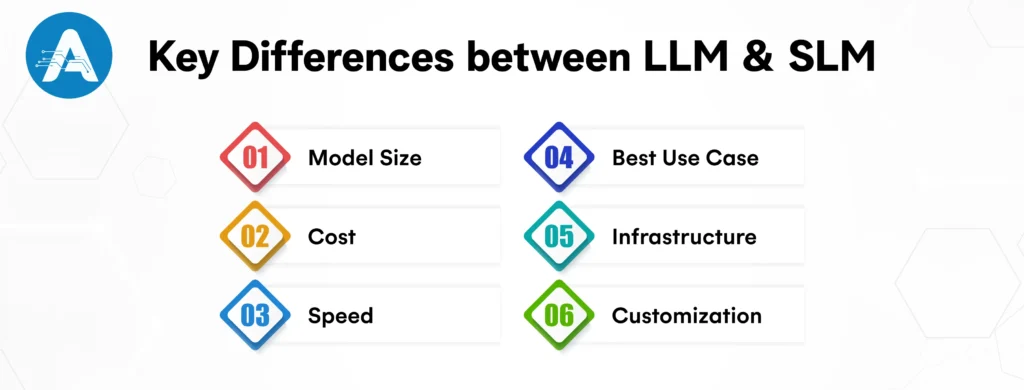
Both SLM vs LLM are powerful AI language models, but they serve very different business needs. The real difference lies insize, cost, speed, and use case, all of which directly impactyour results and Return on Investment (ROI). This is why choosing the right approach with the support of an experienced AI development company can make a significant difference.
Model Size
A small language model is compact, with millions of parameters, making it lightweight and efficient for focused tasks.
A large language model (LLM AI model) has billions of parameters, allowing it to handle complex language, deep context, and broad knowledge.
If your task is specific, a small model works perfectly. Use an LLM only when deep reasoning is required.
Cost
SLM models are budget-friendly, using less computing power and simpler infrastructure.
LLMs are expensive due to high GPU, memory, and cloud requirements.
For businesses seeking faster ROI and predictable costs, small language models are the smarter choice.
Speed
Because they are lightweight, small LLM models deliver faster responses.
LLMs are slower due to heavier processing.
When quick response time impacts user experience, small language models deliver better performance than LLMs.
Best Use Case
SLMs are ideal for automation, sentiment analysis, recommendations, FAQs, and virtual assistants.
LLMs are best for content creation, research, analysis, and complex conversations.
Choose a small language model over a large language model when efficiency and cost matter.
Infrastructure
Small language models can run on edge devices, mobile apps, or local servers.
Large language models usually need cloud-based, high-end infrastructure.
If easy deployment is important, small language models are easier to manage.
Customization
SLM models are easy to fine-tune and maintain.
LLMs require more data, time, and expertise to customize.
For businesses that require frequent updates and adjustments, small language models provide better flexibility.
SLM vs LLM Key Takeaways
Small language models (SLMs) are fast, cost-efficient, and built for specific tasks
Large language models (LLMs) are powerful, flexible, and designed for complex, wide-ranging tasks
The real question in SLM vs LLM is not which one is better, but which AI language model aligns with your business goals, budget, and use case.
SLM vs LLM Use Cases for Business Growth
The easiest way to understand SLM vs LLM is to look at how businesses actually use these models in daily work. Both are powerful AI language models, but they are built for different types of tasks.
Where Small Language Models Work Best
Small language models are ideal when the work is clear, repetitive, and predictable. If a task follows rules and does not change often, an SLM usually does the job efficiently.
Businesses commonly use SLM models for customer support chatbots that handle routine questions like order tracking, delivery timelines, and return policies. They are also widely used for document sorting, invoice processing, form checking, internal knowledge search, and automating simple workflows.
Because small language models need less computing power, they can run on local systems or private setups. This helps businesses save costs, respond faster, and keep better control over their data. That is why many companies choose small LLM models when they want reliable results without high running expenses.
Where Large Language Models Are More Useful
Large language models are better suited for tasks that are less fixed and more flexible. When work involves creativity, deeper understanding, or changing requirements, an LLM AI model performs better.
Businesses often use large language models for writing blogs and marketing content, translating multiple languages, analyzing customer feedback, generating code, summarizing large documents, and supporting research or planning activities. These models can understand broader context and adjust their responses based on different situations.
Because a language model AI of this size can handle many tasks at once, it is usually integrated into enterprise platforms and customer-facing applications where versatility is important.
SLM vs LLM: How to Pick the Right Model
The choice between SLM vs LLM becomes easier when you focus on what you want AI to do for your business.
If your goal is to automate routine work that follows clear rules, small language models are usually the better fit. They handle day-to-day tasks quickly, reliably, and at a lower cost.
If your work involves changing requirements, creative thinking, or a deeper understanding of language, large language models are more suitable. They adapt better to complex tasks and support broader business needs.
By matching the model to the task, you can choose the right AI language model that supports your business growth without unnecessary complexity or expense.
SLM vs LLM in a Simple Example
Imagine you run an online store where customers ask the same questions every day, like “Where is my order?” “When will it be delivered?”, or “How can I return a product?” To save time, you decide to use AI. If you choose a small language model, you can train it just on your products, orders, and return policies. The model then gives quick and accurate answers, works fast, costs less, and does exactly what you need. This is exactly where small language modelsor small LLM modelsare most effective.
Now imagine a different scenario. You want AI to write marketing content, analyze customer reviews, create email campaigns, and provide new ideas for your business. These tasks are varied and often change, requiring a deeper understanding of context. In this situation, a large language modelor LLM AI model is a better choice because it can handle multiple types of tasks at once and generate responses that are more flexible and insightful.
This example shows that for tasks that are simple, repetitive, and clearly defined, small language models are usually enough to get the job done efficiently. On the other hand, when tasks are complex, flexible, or require deeper understanding and creativity, large language models become more useful. Understanding this difference makes it easier to see the practical meaning of SLM vs LLM and decide which model fits your business needs.
Emerging Trends and the Future of SLM vs LLM
AI language models are evolving fast, and both small language models and large language models are becoming increasingly important for businesses. SLM models are getting smarter while staying lightweight, making them ideal for automating tasks like customer support, internal search, and workflow management, often on local systems or edge devices for lower cost and better privacy.
At the same time, LLM AI models are advancing rapidly, capable of generating content, translating languages, analyzing large datasets, and assisting with creative or technical tasks. Many businesses now work with an AI application developer to implement hybrid systems, where SLM models handle routine tasks, and LLMs manage complex or evolving workflows, balancing speed, cost, and capability.
Looking ahead, SLMs will become even faster, cheaper, and more specialized, while LLMs will grow smarter, more adaptable, and better at understanding nuanced language. The future lies in using both SLM vs LLM strategically to drive efficiency, innovation, and business growth.
Conclusive Statement- Which AI Model Is Right for You?
There is no one-size-fits-all answer when it comes to the difference between LLM and SLM. The right choice depends on your business goals, budget, and the specific tasks you want AI to handle. If your priority is efficiency, cost control, fast responses, predictable tasks, and data privacy, a small language model (SLM) or a small LLM modelis often the smarter choice. These models are lightweight, easy to deploy, and ideal for automating routine workflows such as virtual assistants, recommendation systems, or sentiment analysis.
On the other hand, if your business requires intelligence at scale, deep reasoning, or complex content creation, a large language model (LLM AI model) is better suited to meet your needs. LLMs excel at handling multi-domain tasks, generating creative content, and understanding nuanced language, making them ideal for research, content creation, and sophisticated analytics, provided your budget allows for the higher infrastructure and operational costs.
Before investing in any AI language model, take a moment to define your business goal, your budget, and your use case. When you choose a model that aligns with your actual needs, AI stops being an expense and starts becoming a growth engine for your business.
Planning for AI Project
Get clarity on use cases, architecture, costs, and timelines with insights from 50+ real-world AI implementations.
SLM vs LLM mainly differ in size, cost, speed, and use case. Small language models (SLMs) are lightweight, efficient, and cost-effective for specific tasks. Large language models (LLM AI models) are massive, handle complex tasks, and are ideal for multi-domain intelligence or creative applications.
2. How do I choose between SLM and LLM for my business?
Start by defining your business goals, use case, budget, and infrastructure. If you need efficiency, cost savings, and fast deployment, go with small language models. If you require intelligence, creativity, and multi-domain capabilities, choose an LLM AI model.
3. What is a small language model?
Start by defining your business goals, use case, budget, and infrastructure. If you need efficiency, cost savings, and fast deployment, go with small language models. If you require intelligence, creativity, and multi-domain capabilities, choose an LLM AI model.
4. What is a small language model?
Small LLM models are compact versions of large language models. They combine the efficiency of SLMs with some capabilities of LLMs, making them suitable for businesses that need advanced AI but want lower costs and faster deployment.
5. What is an LLM AI model?
An LLM AI model is a large language model trained on massive datasets. It excels at understanding complex language, generating content, performing multi-domain tasks, and handling nuanced queries, making it perfect for research, content creation, and analytics.
6. When should I use a small language model instead of an LLM?
Use a small language model when your tasks are repetitive, well-defined, or need fast responses, such as customer support, sentiment analysis, or FAQ automation. It saves cost and resources compared to deploying a large LLM AI model.
7. When is a large language model better than a small model?
A large language model is better when you need deep reasoning, creative content generation, multi-domain knowledge, or tasks requiring complex language understanding. LLMs are ideal for content creation, research, and advanced analytics.
Design workflows are evolving at breakneck speed. AI Image Generators have officially transitioned from experimental “toys” to essential everyday assets for modern creatives. The…