AI Platform •
14 min read •December 29, 2025•116 views
How to Choose the Best AI Programming Language?
Table of Contents
When one of my friends started building an AI (artificial intelligence) chatbot for his startup, he chose the wrong programming language. Six months later, the project failed not because the idea was bad, but because the technology choice was wrong. Selecting the best AI programming language can give an organisation a long-term competitive advantage.
Modern businesses must take a thoughtful approach when choosing the best AI programming language, as artificial intelligence now plays a central role in gaining and maintaining a competitive advantage rather than being just an experimental technology. Selecting the right AI programming language directly impacts how quickly solutions are built, how smoothly systems scale, how easily skilled talent can be hired, access to the best AI tools, and the long-term success of artificial intelligence solutions across the organization.
Why Choosing the Best AI Programming Language Matters for Business Growth?
Artificial intelligence is not only about building smart algorithms. It is also about choosing the right foundation to support them. The right AI programming language helps teams build solutions faster, scale systems smoothly as demand grows, and reduce long-term development costs. It facilitates collaboration, enhances code quality, and streamlines maintenance over time.
A well-chosen AI programming language also gives businesses better access to skilled talent, strong community support, and the best AI tools available in the market. It enables faster experimentation, easier integration with existing systems, and more reliable performance in real-world environments. Most importantly, it allows organizations to move from ideas to production-ready AI solutions with confidence and clarity.
Choosing the wrong AI programming language can slow down AI projects and create avoidable business challenges. It often increases development and maintenance costs, delays product launches, and makes it harder to find skilled AI developers. Poor compatibility with existing systems can also lead to integration issues, while limited support for modern AI tools may restrict innovation and reduce the overall impact of AI solutions.
The best AI programming language depends on your specific goals, the skills of your team, and how quickly you need to bring AI solutions to market.
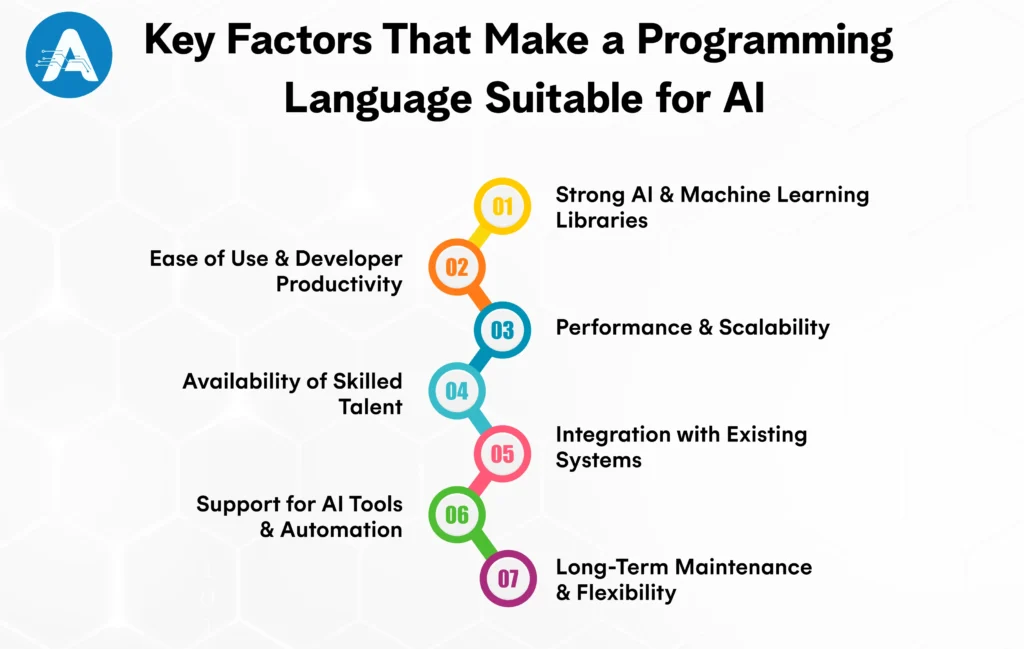
Key Factors That Make a Programming Language Suitable for AI
Understanding what makes a programming language suitable for AI is essential before evaluating different options. The right language helps teams build AI solutions more efficiently, enhance performance, simplify complexity, and ensure the long-term scalability and maintenance of AI projects.
Strong AI and Machine Learning Libraries
The best AI programming language should provide ready-to-use libraries and frameworks for machine learning, deep learning, and data processing. These libraries make AI coding faster, reduce development effort, and improve accuracy. With strong ecosystems, teams can build reliable artificial intelligence code without starting from scratch, saving time and cost for both startups and large AI development companies.
Ease of Use and Developer Productivity
A language with simple syntax and a clear structure helps developers write, test, and update AI solutions more efficiently. Easy-to-learn languages improve productivity, making AI for coding more accessible and allowing teams to experiment, iterate, and innovate faster. This is especially important when using an AI code assistant to support rapid development.
Performance and Scalability
AI systems often handle massive datasets and, in many cases, require real-time responses. The best programming language for AI should deliver strong performance while scaling smoothly as workloads increase. High efficiency ensures that AI language choices support long-term growth without slowing down systems or increasing infrastructure costs.
Availability of Skilled Talent
Choosing a widely adopted AI programming language makes it easier to hire skilled developers and scale teams quickly. Languages with strong global communities offer better documentation, troubleshooting support, and proven practices. This talent availability is a major advantage for any AI development company working on complex or long-term AI projects.
Integration with Existing Systems
Modern AI solutions rarely work in isolation. They must connect seamlessly with existing software, databases, cloud platforms, APIs, and enterprise systems. A suitable AI programming language simplifies integration, enabling businesses to deploy the best AI software without disrupting current operations.
Support for AI Tools and Automation
Languages that are well-supported by AI code assistants, AI code generators, and advanced code generation tools help teams automate repetitive tasks and improve code quality. Strong compatibility with the best AI for coding tools allows developers to focus more on logic and innovation rather than manual coding.
Long-Term Maintenance and Flexibility
AI models and systems evolve as data, technologies, and business needs change. The best AI programming language should support easy updates, testing, and long-term maintenance. Flexible languages reduce technical debt and allow AI solutions to adapt without costly rewrites, ensuring sustainable success for businesses and AI development companies alike.
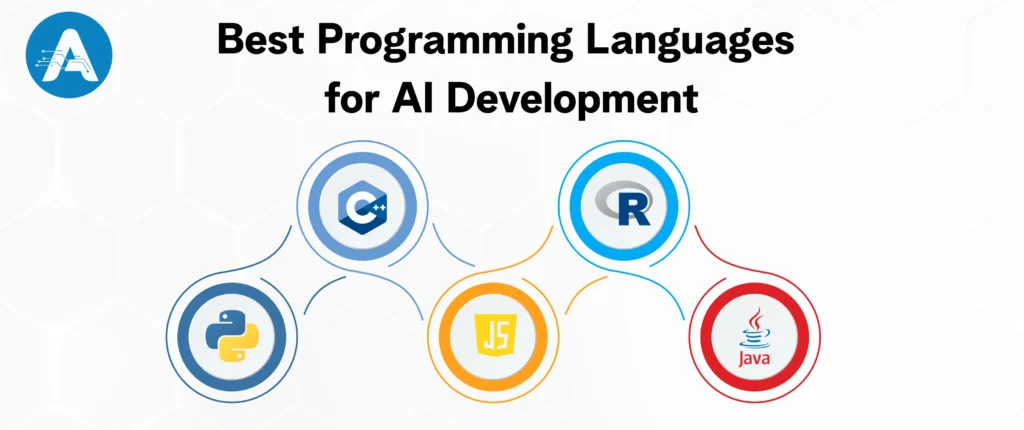
Different programming languages support AI development in different ways, offering unique strengths in performance, scalability, and ease of use. Understanding these options helps businesses select the right foundation for building effective and scalable AI solutions.
1. Python: The Most Popular AI Programming Language
When businesses and developers talk about the best AI programming language, Python is often the first choice. Its simplicity, flexibility, and powerful AI ecosystem make it widely preferred for AI development across industries.
Why Businesses Prefer Python for AI Development
Python was not originally designed for artificial intelligence, yet it has become the backbone of many modern AI solutions. Its simple and easy-to-read syntax allows developers to focus on solving business problems instead of dealing with complex code structures, which speeds up development and reduces errors.
Businesses prefer Python for AI development for several key reasons.
Easy-to-read syntax that helps teams build AI solutions faster
A rich ecosystem of AI and machine learning libraries that reduces development effort
Strong compatibility with AI code assistants and AI code generator tools for faster coding
Seamless integration with cloud platforms and existing enterprise systems
Some of the most widely used Python libraries for AI and machine learning include TensorFlow, PyTorch, Scikit-learn, Keras, and Hugging Face Transformers. These libraries provide ready-to-use tools that help businesses develop reliable and scalable AI applications without starting from scratch.
If you need rapid prototyping, deep learning models, and easy access to the best AI tools, and want to use AI for coding and automation, then Python is the ideal choice for your business operations.
For example
Netflix uses Python to recommend shows and movies to its users. By analyzing what people watch, Python-based AI helps Netflix suggest content that matches individual preferences, keeping users engaged and coming back to the platform.
Python also has a few limitations alongside its many advantages. While it is highly flexible and easy to use, Python runs slower than compiled languages such as C++. For AI applications that need real-time processing or very low response times, Python may require performance optimization or support from faster languages to achieve the desired results.
2. C++: High-Performance AI Programming Language
When performance and speed are critical, C++ is often considered one of the strongest options for AI development. Its ability to deliver fast execution and fine-grained control over system resources makes it suitable for performance-intensive AI applications.
Why Businesses Use C++ for AI Development
C++ is widely used in AI projects where real-time processing and low latency are essential. Unlike interpreted languages, C++ is a compiled language, which allows AI systems to run faster and more efficiently.
Businesses rely on C++ for AI development for several key reasons.
• High-speed execution for performance-critical AI systems • Direct control over memory and hardware resources • Strong suitability for real-time and embedded AI applications • Reliable performance for large-scale and complex AI models
C++ is commonly used in areas such as computer vision, robotics, autonomous vehicles, and game AI, where response time and accuracy are crucial.
If your AI application requires real-time decision-making, low latency, or hardware-level optimization, C++ can be a strong choice for your business.
For example
Autonomous vehicle companies use C++ for real-time decision-making, allowing self-driving cars to quickly process sensor data and respond to road conditions within milliseconds.
However, C++ can be more complex to learn and maintain compared to higher-level languages. Development time may be longer, and it requires experienced developers to manage memory and system-level details effectively.
3. JavaScript: AI for Web and Frontend Applications
JavaScript has expanded beyond web development and is now widely used for AI-powered web applications. Its ability to run in both browsers and servers makes it unique among AI programming languages.
Why Businesses Use JavaScript for AI Development
JavaScript allows businesses to bring AI directly into web applications, improving user experience and interactivity without complex backend systems.
Businesses prefer JavaScript for AI development because it offers
Easy deployment of AI models in web environments
Real-time interaction with users through browsers
Smooth integration with frontend and backend systems
Support for AI libraries like TensorFlow.js
JavaScript is commonly used for chatbots, recommendation features, and AI-driven user interfaces on websites and web platforms.
If your AI solution is focused on web-based experiences or customer-facing applications, JavaScript can be an effective choice.
For example
Web-based chatbots use JavaScript to analyze user messages in real time and respond instantly within the browser, improving customer support experiences.
But JavaScript is not ideal for heavy AI computation and often relies on backend systems for complex model training.
4. R: A Data-Focused AI Programming Language
R is widely used for AI projects that focus on data analysis, statistics, and research-driven insights. It is especially popular among data scientists and analysts working with structured data.
Why Businesses Use R for AI Development
R is designed for statistical computing and data visualization, making it ideal for AI projects that rely heavily on data exploration and predictive modeling.
Businesses choose R for AI development because it offers
Strong statistical and analytical capabilities
Powerful data visualization tools
Excellent support for data modeling and forecasting
Easy experimentation with AI and machine learning algorithms
R is commonly used in healthcare, finance, academia, and research organizations for predictive analytics and decision-making models.
If your AI projects are data-heavy and focused on insights rather than real-time deployment, R can be a valuable tool.
For example
R is used in healthcare analytics to predict patient outcomes by analyzing medical data and identifying risk patterns to support better treatment decisions.
On the other hand, R is less suited for production-scale AI systems and large applications, especially when compared to Python or Java.
5. Java: Enterprise-Friendly Programming Language for AI
Java is a popular choice for AI development in enterprise environments. Its stability, scalability, and strong security features make it suitable for building large, long-term AI systems.
Why Businesses Prefer Java for AI Development
Java is known for its platform independence, allowing AI applications to run consistently across different systems. This makes it especially valuable for enterprises with complex infrastructure.
Businesses choose Java for AI development for several reasons.
Strong scalability for large AI applications
High reliability and security for enterprise use
Easy integration with existing enterprise systems
Extensive support for distributed and cloud-based AI solutions
Java is often used in AI-driven recommendation engines, fraud detection systems, and customer analytics platforms in industries like banking, telecom, and e-commerce.
If your business needs AI solutions that integrate deeply with enterprise systems and scale across large user bases, Java can be a practical and reliable option.
For example
Banks use Java to build AI-powered fraud detection systems. Java-based AI analyzes transaction patterns in real time to identify suspicious activity and help prevent financial fraud at scale.
On the downside, Java can be more verbose than other languages and may feel slower during early prototyping compared to Python.
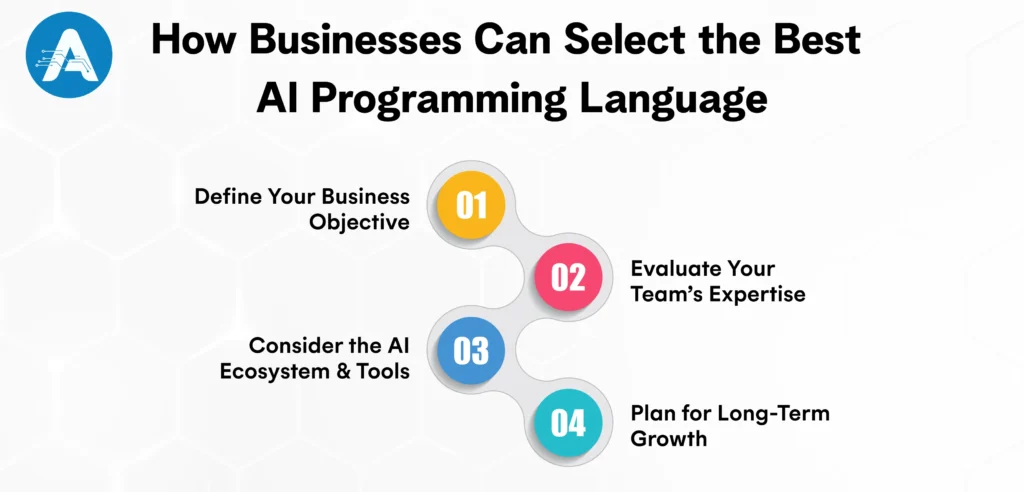
How Businesses Can Select the Best AI Programming Language
The success of any AI initiative largely depends on choosing the best AI programming language. Picking a language that aligns with your business goals, team expertise, and long-term growth can save time, reduce costs, and improve efficiency for AI solutions.
Define Your Business Objective
The first step in any AI project is to define your business goal. Each objective requires different technical strengths, so select a programming language that fits your needs. Python or R is ideal for predictive analytics and AI coding, Java works well for enterprise automation, C++ handles real-time AI efficiently, and JavaScript powers web-based AI applications. Selecting the right language early accelerates development, reduces risks, and maximizes ROI.
Evaluate Your Team’s Expertise
A programming language is only effective if your team can use it efficiently. If your developers already know Python, switching to another language can increase training costs, extend timelines, and add project risks. Leveraging existing expertise helps your business move faster, reduce expenses, and maintain smoother execution, especially when working with artificial intelligence codes and AI for coding projects.
Consider the AI Ecosystem and Tools
The libraries, frameworks, and tools available for a language play a key role in AI development. Python, for example, has one of the most advanced AI ecosystems, supporting AI code generation, AI code generators, AI code assistant, and other best AI tools. A robust ecosystem speeds up development, simplifies troubleshooting, and ensures smooth deployment of AI solutions for any AI application developer.
Plan for Long-Term Growth
AI projects often start small but can evolve into core business systems. Choosing a language that scales with growing data, integrates seamlessly with existing platforms, and supports future advancements ensures sustainability. Investing in thebest AI software and the right AI language keeps your business adaptable and ready for new challenges. Partnering with experienced AI application development services ensures your AI initiatives remain efficient and future-proof.
Common Mistakes Companies Make in AI Development
Many businesses make costly errors when choosing an AI programming language. Common mistakes include following trends blindly, ignoring talent availability, and underestimating integration needs.
Following Trends Without Strategy: Choosing a language just because it’s popular doesn’t ensure it meets your AI goals and can lead to wasted time and higher costs.
Ignoring Talent Availability: Selecting a language few developers know can make hiring harder, increase costs, and delay projects.
Underestimating Integration Needs: AI rarely works alone. Neglecting integration with existing systems can create bottlenecks and operational challenges.
Wrapping Up
There is no single programming language that works for every AI project. However, for most businesses today, Python stands out as the best AI programming language due to its simplicity, strong ecosystem, and compatibility with the best AI software and tools. Other languages shine in specific scenarios: Java is ideal for enterprise-level applications, C++ is suited for performance-critical AI solutions, JavaScript powers AI-driven web experiences, and R excels in data-heavy research and analytics. The most successful companies don’t pick a language at random; they assess their goals, team skills, and future growth to choose the language that best fits each specific AI challenge.
Planning for AI Project
Get clarity on use cases, architecture, costs, and timelines with insights from 50+ real-world AI implementations.
1. What is the best AI programming language for businesses?
For most businesses, Python is the best AI programming language due to its simplicity, strong ecosystem, and compatibility with the best AI software and tools.
2. How do I choose the right AI language for my team?
Consider your team’s existing expertise, project goals, and the ecosystem of available AI tools to select a language that reduces learning curves and accelerates delivery.
3. How do AI code assistants improve productivity?
AI code assistants suggest code snippets, debug issues, and help generate artificial intelligence code, streamlining development workflows.
4. What is the difference between AI for coding and AI coding tools?
AI for coding refers to using AI to write or suggest code, while AI coding tools provide frameworks, libraries, and platforms to implement AI functionality.
5. What long-term factors should businesses consider in AI projects?
Consider scalability, future integrations, evolving data needs, and compatibility with the best AI tools to ensure your AI solutions remain sustainable.
6. Why is Python preferred for AI development?
Python offers extensive libraries for AI coding, machine learning, deep learning, and AI-driven analytics, making development faster and more efficient.
7. Can Java be used for AI applications?
Yes, Java is ideal for enterprise AI applications due to its scalability, robustness, and strong support for integration with large systems.
Design workflows are evolving at breakneck speed. AI Image Generators have officially transitioned from experimental “toys” to essential everyday assets for modern creatives. The…