AI Platform •
11 min read •December 29, 2025•142 views
Haystack vs LangChain: Choosing the Right Tool for Your AI Project
Table of Contents
One of my friends worked on a business AI project where he had to choose between Haystack vs LangChain. He started with LangChain because it was quick to set up and easy to turn into a chatbot, and it worked well in the early stages. But once real documents and larger datasets were added, the answers became inconsistent. After incorporating Haystack into the search setup, the responses felt more reliable and easier to trust. That’s when it became clear the decision was not about choosing one tool over the other, but about using each where it worked best.
Today, companies are building AI chatbots, document search engines, internal knowledge assistants, and customer-facing AI tools. In nearly every discussion about these projects, the same two names consistently appear: LangChain and Haystack. Understanding how each tool fits different needs is the key to making the right choice for your AI project.
Why Haystack vs LangChain Matters?
Choosing between Haystack vs LangChain matters because both tools solve different problems in AI projects. LangChain is great when you want to build quickly, experiment, or create conversational features like chatbots. Haystack, on the other hand, is designed for accurate search and works better when your AI needs to pull reliable answers from documents. Understanding this difference early helps you avoid wrong answers, reduce rework, and build an AI system that actually performs well in real business situations.
What Is A Haystack?
In AI, Haystack is an open-source framework focused on search, question answering, and document-based AI. It is built to handle large amounts of data and is often used in systems where accuracy and reliability are critical.
Haystack works well for:
Searching across millions of documents
Building structured AI search pipelines
Retrieving accurate, source-based answers
Enterprise-level AI applications
Haystack focuses less on conversation and more on finding the right information first, then generating answers based on trusted data.
What Is LangChain?
LangChainis an open-source framework that helps you build AI applications using large language models. Instead of working with a single prompt, LangChain allows you to connect prompts, tools, memory, and external data into structured workflows called LangChain chains.
This makes it easier to create AI systems that can think through tasks, remember context, and interact with other tools or data sources.
Developers choose between LangChain and Haystack based on what their AI project needs most. While both tools are powerful, they serve different purposes, which is why the decision often comes down to speed versus accuracy.
Many developers prefer LangChain when they want to build quickly and experiment with AI features. It is especially popular for chatbots and conversational AI because LangChain chains make it easy to connect prompts, tools, and memory into flexible workflows. With a large community on GitHub LangChain, developers can move fast, test ideas easily, and build AI agents without much setup.
On the other hand, developers turn to Haystack when accuracy and reliable search are more important than rapid experimentation. Haystack is designed for document-heavy AI systems and works well as a Haystack search engine that pulls answers directly from real data. Its structured pipelines help reduce hallucinations, making it ideal for enterprise projects, internal knowledge bases, and compliance-focused applications.
Just as Haystack Rock in Oregon stands firm and precise in the ocean, Haystack provides a solid foundation for AI systems that need dependable, document-backed answers.
In simple terms, developers rely on LangChain for flexibility and fast development, and on Haystack when their AI system requires accuracy and trustworthiness.
Haystack vs LangChain: Understanding Their Core Philosophy
The key difference between Haystack vs LangChain is not superiority, but their approach to problem-solving.
Haystack: Search-First Approach
Haystack focuses on finding the right information before generating an answer.
It searches through large document collections, ranks the most relevant results, and then passes only trusted data to the language model. This helps reduce errors and keeps responses grounded in real content.
That’s why Haystack works best for search engines, document-based Q&A systems, and enterprise AI applications where accuracy, reliability, and transparency really matter.
LangChain: LLM-First Approach
LangChain puts the language model at the centre of the application.
The LLM decides what action to take, when to use tools, and how to respond to users. It connects prompts, tools, memory, APIs, and external services into one smooth workflow.
Because of this flexibility, LangChain is ideal for chatbots, AI assistants, workflowautomation, and interactive applications where conversations and dynamic decision-making are important.
Haystack vs LangChain: Key Features Compared
Core Aspect
Haystack
LangChain
Main Purpose
Finds the right information and answers questions accurately
Builds AI apps by connecting LLMs, tools, and logic
Smaller but consistent community (Haystack GitHub)
Huge community and very active (GitHub LangChain)
Haystack vs LangChain: How They Are Used in Real Life
Both tools are powerful, but they are used in different real-world situations. The right choice depends on what you are building and how accurate or flexible your system needs to be.
Consider Haystack, if:
You are building a search system based on large documents (PDFs, manuals, knowledge bases)
Accuracy and reliability are more important than creative responses
You are deploying AI in an enterprise or regulated environment
You need clear, explainable answers backed by real data sources
In real life, Haystack is commonly used by enterprises and research teams that need reliable, trustworthy information.
Consider LangChain, if:
You are building a chatbot or AI assistant that talks naturally with users
You want to build and test ideas quickly without a heavy setup
You need the AI to use tools, call APIs, or take actions automatically
You are experimenting with workflows, agents, or multi-step reasoning
In practice, LangChain is popular with startups and developers creating AI chatbots and smart interactive tools.
LangChain vs Llama Index: Key Differences and Use Cases
Another comparison that often comes up for teams at an AI development company is LangChain versus LlamaIndex. Both frameworks are powerful but serve slightly different purposes, and understanding their strengths can help teams choose or even combine them effectively.
LlamaIndex Strengths
LlamaIndex is primarily focused on data ingestion and indexing. Its main goal is to help organize and structure documents so that an AI system can access and query them efficiently.
Key Advantages:
Structured document querying: If your project involves PDFs, spreadsheets, or large knowledge bases, LlamaIndex makes it easy for the AI to locate exactly what it needs.
Optimized for retrieval-heavy tasks: LlamaIndex is designed to handle large volumes of data and return relevant information quickly, making it ideal for search and knowledge-based applications.
LangChain Benefits
LangChain is designed for flexible orchestration and advanced AI workflows. It focuses on connecting language models with tools, APIs, and logic to help developers create more dynamic applications.
Key Advantages:
Flexible AI workflows: LangChain can manage multi-step tasks, handle dynamic decision-making, and integrate multiple tools or agents seamlessly.
Ideal for building AI applications: From chatbots to automated systems, LangChain gives you the structure to control how the AI interacts with data and other components.
Adaptable and scalable: Whether you are experimenting with small prototypes or deploying full-scale AI solutions, LangChain can scale to fit your needs.
Using LlamaIndex and LangChain in AI Applications
Many teams building advanced AI systems find that combining LlamaIndex and LangChain delivers the best results. LlamaIndex excels at organizing and retrieving large volumes of data, while LangChain provides the flexibility to process that data, generate intelligent responses, and orchestrate complex AI workflows.
Build highly accurate AI applications: LlamaIndex ensures the AI has access to the most relevant documents and data.
Create flexible, dynamic workflows: LangChain handles multi-step reasoning, agent-based decisions, and integration with external tools or APIs.
Develop scalable solutions: From chatbots to enterprise automation systems, this combination supports both small prototypes and full-scale AI deployments.
By integrating these frameworks, teams can deliver powerful, reliable, and adaptable AI applications, maximizing both accuracy and flexibility.
The popularity of AI frameworks is clear from platforms like GitHub LangChain and Haystack GitHub, where developers actively contribute and share projects. Tools such as Haystack Search Engine demonstrate how widely these frameworks are being adopted in real-world AI applications.
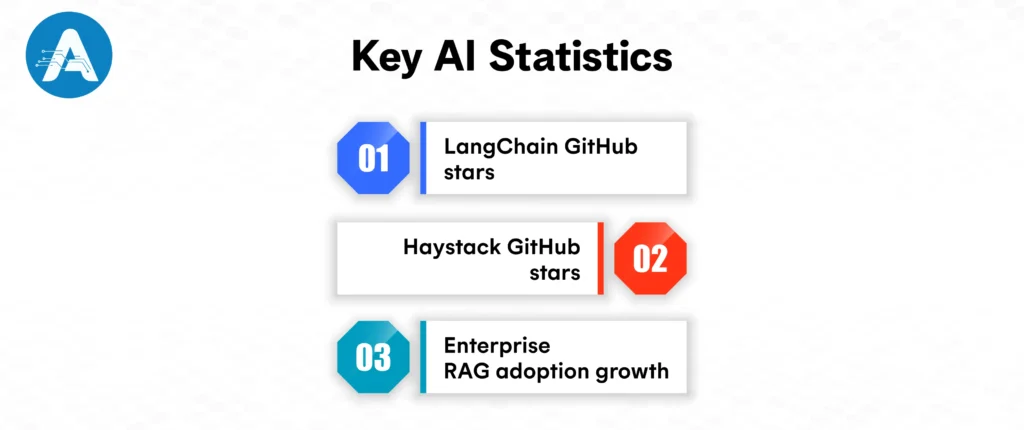
LangChain GitHub stars: 123,000 approximately
Haystack GitHub stars: Over 20,000
Enterprise RAG adoption growth: CAGR of 38.4% or as high as 49.1% between 2025 and 2030.
LangChainhas gained immense popularity among developers, supported by a large and active community on GitHub. In contrast, Haystackis widely trusted by enterprises for building reliable, document-focused AI systems.
For an AI application developer, this highlights an important insight: choosing the right framework depends on whether you prioritize community support and flexibility (LangChain) or enterprise-grade reliability (Haystack).
In short, LangChain dominates developer mindshare, while Haystack dominates enterprise trust and real-world applications.
Best Practices from Real AI Projects
The most effective AI solutions often come from a practical, hybrid approach rather than relying on a single framework. Successful projects combine the strengths of different tools to achieve both accuracy and flexibility.
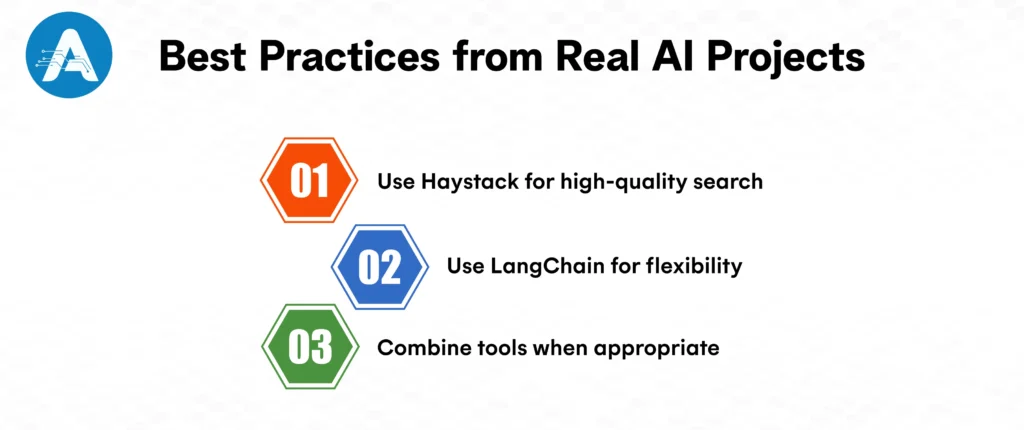
Use Haystack for high-quality search: When precise, document-focused results are essential, Haystack Search Engine delivers reliable performance, which is why enterprises trust it for real-world applications.
Use LangChain for flexibility: For projects requiring dynamic workflows, multi-step reasoning, or enhanced user interactions, LangChain provides the adaptability and community support needed to innovate.
Combine tools when appropriate: Many AI applications integrate both frameworks using Haystack for accurate data retrieval and LangChain to orchestrate responses and manage interactions.
The key takeaway is that AI isn’t about choosing sides; it’s about choosing what works bestfor each project. The principle remains the same: combine accuracy with flexibility for optimal results.
Final Thoughts on Haystack vs LangChain
There is no one-size-fits-all winner when comparing Haystack and LangChain, as each framework excels in different areas. LangChain is known for its innovation, speed, and ability to support experimentation, making it ideal for projects that require flexibility and rapid prototyping. In contrast, Haystackstands out for its precision, scalability, and enterprise readiness, making it the preferred choice for large-scale, reliable search and document-focused applications.
Furthermore, choosing the right framework depends on several factors, including project size, data complexity, team expertise, and long-term maintenance goals. Smaller prototypes or experimental projects may benefit from LangChain, which is easier to get started with and allows for flexibility and rapid development.
On the other hand, larger, document-focused systems that require accuracy, scalability, and enterprise-level reliability are better suited for Haystack. Ultimately, the decision should align with the specific needs of your project, balancing flexibility, precision, and the resources available for development and maintenance.
Planning for AI Project
Get clarity on use cases, architecture, costs, and timelines with insights from 50+ real-world AI implementations.
LangChain is an open-source framework that helps developers build applications using large language models (LLMs). It focuses on chaining prompts, tools, memory, and external data to create flexible AI workflows, such as chatbots, agents, and multi-step reasoning systems.
2. What is Haystack?
Haystack is an open-source framework designed for building document-based AI search systems. It excels at information retrieval, question answering, and retrieval-augmented generation (RAG), making it highly reliable for enterprise-grade applications.
3. How do LangChain and Haystack differ?
LangChain focuses on flexible AI workflows, experimentation, and integration with tools, while Haystack is optimized for accurate document retrieval, enterprise reliability, and scalable search systems.
4. Can LangChain and Haystack be used together?
Yes. Many AI teams combine Haystack for precise data retrieval and LangChain for orchestrating responses. This hybrid approach leverages the strengths of both frameworks for building powerful, accurate, and flexible AI systems.
5. Which is better for startups or small projects?
LangChain is often preferred for startups or smaller projects because it is easier to get started with, supports rapid prototyping, and offers flexibility for experimentation.
6. Which is better for enterprise applications?
Haystack is the safer choice for enterprises, especially for large-scale, document-focused AI systems, due to its precision, scalability, and trustworthiness in critical business environments.
Design workflows are evolving at breakneck speed. AI Image Generators have officially transitioned from experimental “toys” to essential everyday assets for modern creatives. The…