AI Platform •
10 min read •February 12, 2026•152 views
Stable Diffusion vs Midjourney: Which AI Art Tool To Choose?
Table of Contents
Suppose you are starting up a new fitness application. Your marketing team needs eye-catching hero banners, your product team wants futuristic UI illustrations, and your investors expect polished pitch visuals, all within a week.
Recruiting a complete design team would consume time and money. Rather, you open an AI art generator, enter a prompt, and a few seconds later, you have beautiful AI-generated images that are ready to be used.
Now comes the real decision: Stable Diffusion vs Midjourney, which one should you rely on?
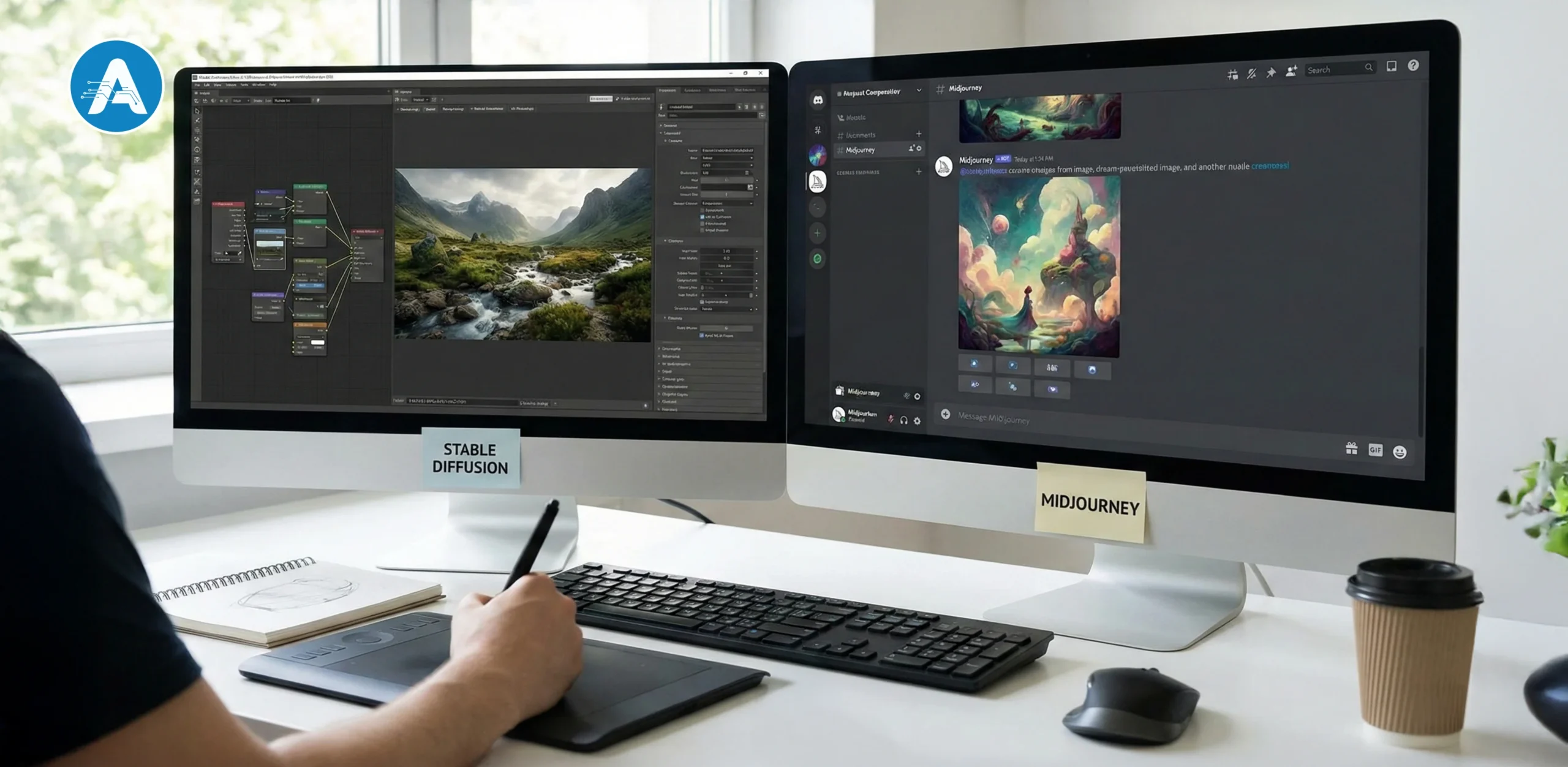
As Midjourney AI is associated with the creation of very artistic and ready-to-distribute images with the minimum of effort, Stable Diffusion AI provides more detailed adjustment and control, particularly when teams consider the Stable Diffusion model as part of their application. One is more interested in simplicity and beauty. The other focuses on the flexibility and ownership.
Choosing between Midjourney vs Stable Diffusion is not just about image quality; it’s about workflow, scalability, technical control, and long-term strategy. In this guide, we will also divide the two tools into details so that you can determine which AI art generator best suits your creative or business interests.
What is Midjourney?
Midjourney is a cloud-based AI tool that is famous for creating highly stylized and visually appealing AI-generated images. Midjourney is mainly hosted on Discord, where users enter their commands, and the image output is generated in seconds. There is no need for installation, GPU setup, or model selection. It is simply a matter of entering the command and generating the image.
The most notable aspect of Midjourney AI is its artistic nature. Midjourney AI is best at creating cinematic lighting effects, fantasy artwork, concept art, and social media visuals. Midjourney AI is preferred by designers and marketers because the generated images are highly polished, even when created from simple commands.
How It Works
Users join the Midjourney Discord server, enter a prompt using structured commands, and the AI processes it in the cloud. Images can be upscaled, varied, or re-rendered using built-in controls. Everything runs on Midjourney’s infrastructure, meaning you don’t manage models, servers, or updates.
Key Strengths
Extremely easy to use
High-quality artistic outputs
Fast generation speed
No hardware requirements
Active creative community
Limitations
Limited deep customization compared to a stable diffusion model
No full local control or ownership of the model
Subscription-based pricing
Less flexibility for developers who want API-level integration
In the Stable Diffusion vs Midjourney debate, Midjourney is often the go-to choice for creators who prioritize aesthetics and simplicity over technical control.
What is Stable Diffusion?
Stable Diffusion is an open-source AI art generator built on a latent diffusion architecture. Unlike Midjourney, it isn’t limited to a single hosted platform. You can run Stable Diffusion AI locally on your machine, deploy it on cloud infrastructure, or integrate it directly into your own application.
At its core, the stable diffusion model works by starting with random noise and gradually refining it into an image based on a text description. What makes it powerful is the level of control it offers. Developers can fine-tune models, use custom checkpoints, apply LoRA files, control negative prompts, and adjust sampling methods for precision output.
How It Works
You install Stable Diffusion locally or access it via APIs from providers. Once running, you enter a stable diffusion prompt, define parameters such as steps, CFG scale, seed value, resolution, and generate the image. Advanced users can even train their own datasets to create a custom style or brand-specific visual identity.
Key Strengths
Open-source and highly customizable
Full control over prompts and parameters
Ability to fine-tune and train custom models
No recurring subscription if self-hosted
Ideal for production-level AI integration
Limitations
Requires technical setup
Hardware-dependent (GPU recommended)
Quality depends heavily on the chosen model and prompt
In the midjourney vs stable diffusion comparison, Stable Diffusion appeals strongly to developers and businesses that want ownership, flexibility, and deeper integration rather than just ready-made artistic outputs.
Stable Diffusion vs Midjourney
Both tools are powerful AI art generators, but they are built with different priorities in mind. Before choosing between Stable Diffusion vs Midjourney, it’s important to compare them across usability, control, scalability, and long-term business value.
Factor
Midjourney
Stable Diffusion
Platform Type
Cloud-based AI art generator (Discord-based access)
Open-source AI model that can be self-hosted or cloud-deployed
Ease of Use
Very beginner-friendly
Moderate to advanced
Image Quality Style
Highly artistic, cinematic, stylized outputs
Flexible – realism, artistic, or custom-trained styles
Customization Level
Limited parameter control
Full control over model, checkpoints, LoRA, seeds, and CFG scale
Prompt Flexibility
Simple structured prompts
Advanced stable diffusion prompt control with negative prompts
Model Training
No access to the underlying model
Can fine-tune or train your own stable diffusion model
Cost Structure
Monthly Subscription
Free open-source
Best For
Designers, marketers, content creators
AI developer, startups, product teams
API Integration
Limited direct integration
Developer-friendly and production-ready
Ownership & Control
Platform-controlled
Full ownership if self-hosted
Stable Diffusion vs Midjourney: Which One Actually Makes Better Images?
When people compare Stable Diffusion vs Midjourney, what they’re really asking is “Which one will give me the kind of images I need faster, easier, and better?” The answer depends on what you’re trying to create.
Midjourney: When You Want Stunning Art Fast
Midjourney is for you if you want beautiful, eye-catching images without much tweaking. You type a simple prompt, and it often gives you something that looks:
Cinematic
Dramatically lit
Rich in texture
Almost like a digital painting
It’s especially great for:
Fantasy artwork
Concept art
Social media visuals
Marketing creatives
Benefit: It’s fast and consistently impressive.
Challenge: It has a strong artistic “style,” so it may not always be perfectly neutral or product-accurate. If your goal is “Make this look amazing”, Midjourney usually wins.
Stable Diffusion: When You Want Control and Precision
Stable Diffusion is for you if you care about control. You can choose models, adjust settings, refine prompts, and even train it on your own style. That makes it powerful for:
Hyper-realistic portraits
E-commerce product mockups
Game assets
On-brand marketing visuals
The catch? It requires more effort. The quality depends on:
The model you choose
How well you write your prompt
Your configuration
If your goal is “Make this look exactly how I need it to look”, Stable Diffusion gives you that flexibility.
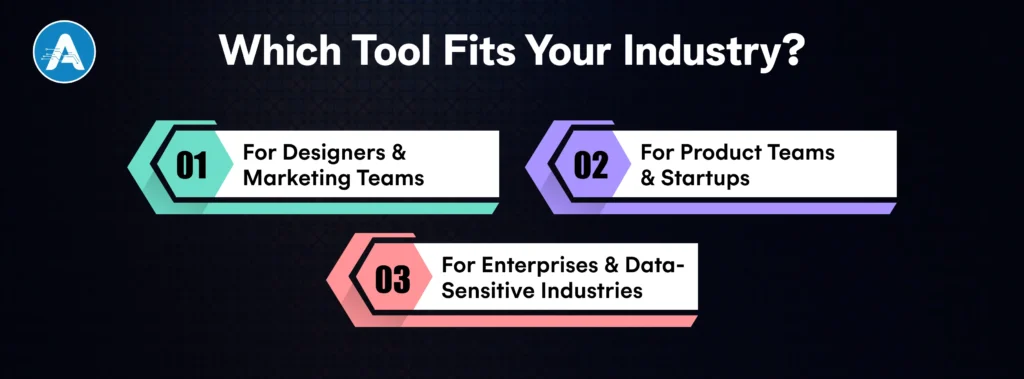
Which Tool Fits Your Industry?
Choosing between Stable Diffusion vs Midjourney becomes easier when you evaluate real-world use cases. The right AI art generator depends on whether you need quick creative assets or production-level AI integration.
1. For Designers & Marketing Teams
If your goal is to create social media creatives, ad visuals, blog banners, or concept artwork quickly, Midjourney AI is often the preferred choice. It produces highly polished AI-generated images with minimal prompt effort. Marketing teams can iterate fast without worrying about technical configuration.
Best suited for:
Branding campaigns
Social media content
Storyboarding
Creative experimentation
2. For Product Teams & Startups
If you are building an AI-powered feature inside your SaaS platform, mobile app, or e-commerce tool, Stable Diffusion AI becomes more practical. The stable diffusion model can be deployed via API, self-hosted for privacy, or fine-tuned for brand-specific outputs.
Best suited for:
AI-powered design tools
Custom image generation inside apps
White-label AI solutions
Automated product mockups
An experienced AI application developer can integrate Stable Diffusion into backend systems to create scalable AI workflows. Businesses working with an AI development company or offering AI application development services often prefer this level of control for enterprise deployments.
3. For Enterprises & Data-Sensitive Industries
If privacy, model control, and customization matter, Stable Diffusion provides a stronger long-term advantage because it can be hosted on private infrastructure. Midjourney, being fully cloud-based, does not offer the same deployment flexibility.
Which One Should You Choose?
After comparing features, prompts, cost, and scalability, the final decision in Stable Diffusion vs Midjourney depends entirely on your goal.
Choose Midjourney If:
You want high-quality AI-generated images instantly
You don’t want to manage infrastructure
Your focus is marketing, branding, or concept art
Ease of use matters more than deep customization
Midjourney AI is ideal for designers, content creators, and teams that need visually impressive results without technical overhead.
Choose Stable Diffusion If:
You want full control over the stable diffusion model
You need advanced prompt engineering and negative prompts
You plan to fine-tune or train custom models
You want to integrate image generation inside your app or SaaS
Data privacy and infrastructure ownership matter
For startups and enterprises working with an AI development company or an AI application developer, Stable Diffusion AI often becomes the better long-term investment because it can scale and integrate directly into AI application development services.
Final Thought
The issue of control versus convenience is what ultimately establishes the comparison between Stable Diffusion vs Midjourney. They are both powerful AI art generator sites that can create high-quality AI-generated images, yet are used by different users.
Midjourney AI is the best at providing high-quality, visually appealing results with little work, which is why it is a good solution for creatives who seek to obtain high-quality output as quickly and efficiently as possible.
Conversely, the Stable Diffusion AI, which runs on the versatile Stable Diffusion model, has profound customization, stable diffusion prompt control, and fine workflow adjustment through a stable diffusion prompts generator strategy.
The decision is more strategic to businesses and product teams. When you are playing around with images, Midjourney is a good one. Stable Diffusion offers flexibility and ownership in the long term in the case you are developing scalable AI features, integrating image generation into your platform, or collaborating with an AI developer.
Within the context of the midjourney vs stable diffusion debate, the correct choice is based on the necessity to possess an artistic instrument – or a programmable AI machine aimed at development.
Planning for AI Project
Get clarity on use cases, architecture, costs, and timelines with insights from 50+ real-world AI implementations.
It depends on your goal. In the Stable Diffusion vs Midjourney comparison, Midjourney is better for fast, artistic AI-generated images with minimal setup. Stable Diffusion AI is better for customization, model control, and integration into applications.
2. Which AI art generator is free?
Stable Diffusion AI is open-source, meaning you can run the Stable Diffusion model locally without licensing fees. Midjourney operates on a paid subscription model.
3. Which tool gives more control over prompts?
Stable Diffusion offers deeper control through advanced stable diffusion prompt parameters, negative prompts, sampling methods, and seed values. Midjourney AI provides simplified prompt controls but limits deeper technical adjustments.
4. Is Midjourney better for beginners?
Yes. Midjourney is easier for beginners because it runs through Discord and requires no installation or hardware setup. It’s ideal for creators who want quick, polished visuals without technical configuration.
5. Can Stable Diffusion be integrated into applications?
Yes. Stable Diffusion AI can be deployed via API or self-hosted infrastructure, making it suitable for SaaS platforms and AI-powered products. An AI developer or AI application developer can integrate it as part of AI application development services.
6. How does DALL·E compare in the midjourney vs stable diffusion debate?
The DALL·E image generator offers a managed API environment with structured commercial usage. It sits between Midjourney’s artistic simplicity and Stable Diffusion’s deep customization, depending on integration needs.
At 2:00 AM, an autonomous system detects a supply chain disruption, reroutes inventory, updates customers, and logs financial impact, all without human intervention. Companies…
As businesses grow, operations become more complex, and customer expectations rise. A custom AI solution helps automate processes, improve decision-making, and deliver personalized experiences…